 dogracingtips
Updated October 2026
Licensed
 Available in US
Fast payouts
18+ Only
What Separates Dog Racing From Every Other Betting Market
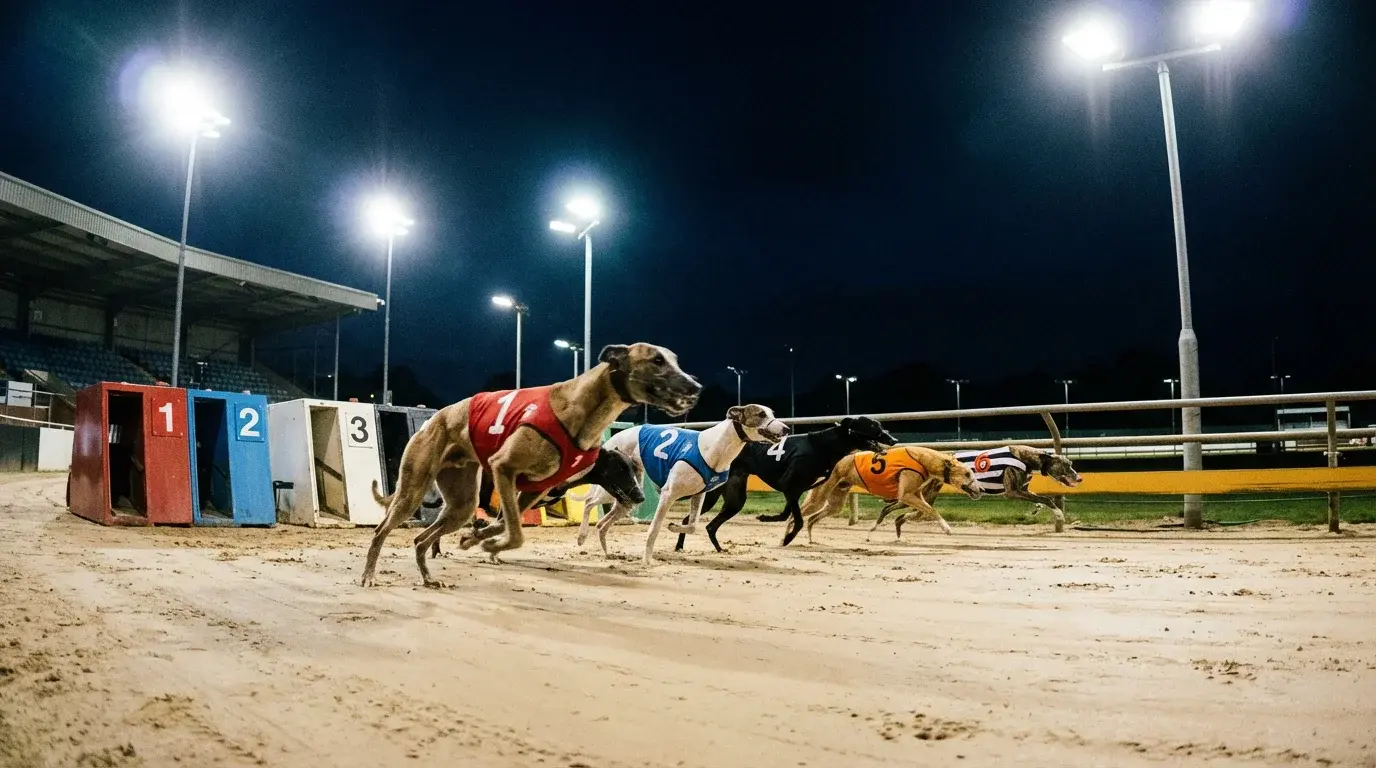
Six dogs, one bend, half a minute — and every variable is visible before the traps open. That is the fundamental proposition of greyhound racing as a betting sport. No jockeys. No mid-race tactics. No team selection headaches or last-minute formation shifts. Six runners leave the boxes simultaneously, follow a mechanical lure around a fixed oval, and finish before most football matches complete their opening phase of play. The entire contest is over in roughly thirty seconds.
This compressed, transparent format is what makes UK greyhound racing one of the purest data-driven betting environments in the world. Every relevant variable — trap draw, running style, form figures, sectional times, weight, age, trainer record — is published on the racecard before the first race. Nothing is hidden. Nothing requires insider contacts, paddock observation, or reading between the lines of a press conference. The bookmakers know this. They also know that most punters glance at the form figures, pick a name, and move on. That gap between available information and information actually used is where profitable greyhound betting begins.
Compare this to horse racing. A twelve-runner handicap at Cheltenham involves ground preference, jockey intent, equipment changes, trainer instructions, pace scenarios, and a race lasting two minutes or more — long enough for a dozen things to go wrong that no racecard could predict. In a six-runner greyhound sprint, the variables are fewer, more measurable, and more consistently predictive. The dog that leads at the first bend wins more often than not. The dog drawn against its running style almost never overcomes the disadvantage. These are not hunches. They are statistical patterns backed by decades of data.
UK greyhound graded racing is the standard competitive format across all tracks licensed by the Greyhound Board of Great Britain. Each race features six runners on a sand track, chasing a mechanical lure over distances typically ranging from 225 to over 940 metres. Dogs are graded by ability from A1 (fastest) down to A11, with separate prefixes for sprint (D), stayer (S), and other distance categories. Meetings run every day of the year except Christmas Day, with evening cards typically broadcast via RPGTV and SIS to licensed betting shops and online platforms.
This guide does not offer today's selections. It offers something more durable: the analytical framework that produces them. From reading the racecard column by column, to understanding how trap draw and running style shape race outcomes, to building a repeatable selection process you can apply tonight and every night after — this is the system. The dogs are fast. The information is faster, if you learn to use it.
The racecard is where it all starts.
How to Read a Greyhound Racecard
The racecard tells you everything — if you know where to look. Every GBGB-licensed meeting publishes a full racecard before racing starts, available free through the Racing Post, Timeform, RPGTV, and individual track websites. The card is dense, compact, and loaded with data that most bettors never read past the first two columns. Learning to read it properly is the single most valuable skill in greyhound betting, because every analytical tool discussed in this guide depends on information the racecard already provides.
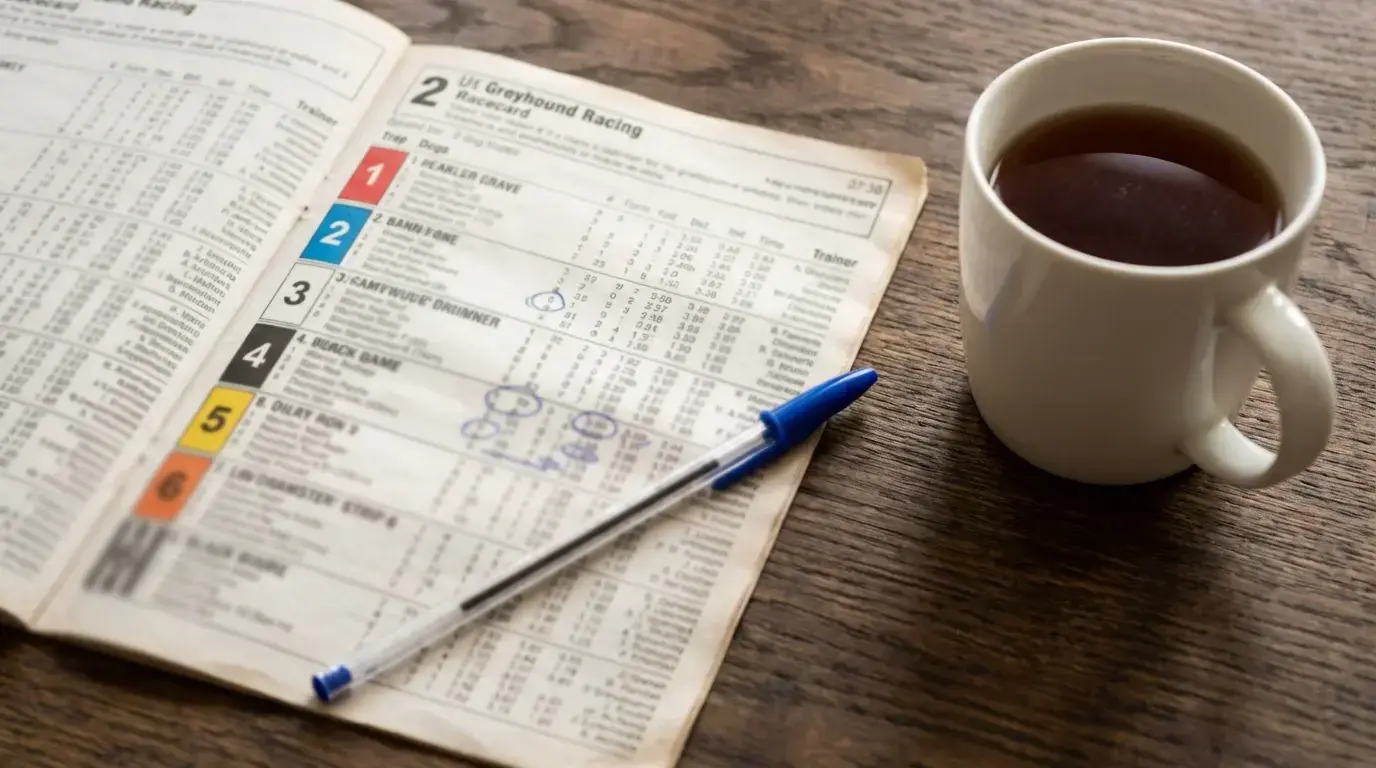
A standard UK racecard line for each runner contains the following: trap number (1 to 6, colour-coded), dog name, trainer, form figures from the last six races, best recent time over course and distance, sectional time to the first bend, current racing weight in kilograms, age, days since last race, and a seeding indicator — r for railer, m for middle runner, w for wide runner. Some providers add calculated speed ratings, Timeform performance figures, or brief comments from the previous outing. Between them, these columns give you a compressed profile of every runner in the field.
Sample Racecard Row
Trap 1 (Red) — Ballymac Nova | Trainer: P. Janssens | Form: 2-1-1-3-1-1 | Best: 29.42 | Sect: 5.16 | Wt: 32.4 kg | Age: 2y | Last: 7d | Seed: r
Reading: A two-year-old railer drawn in the ideal inside box. The form string shows four wins from six, with the most recent run a victory (rightmost figure). Sectional time of 5.16 suggests strong early speed — this dog reaches the first bend quickly. Seven-day turnaround indicates the trainer is confident. Weight is consistent with recent runs. Profile: in-form front-runner with the right draw. The market will respect this dog. The question is whether the price still holds value.
The critical mistake is reading columns in isolation. Form figures tell you one thing; the trap draw tells you another; the sectional time tells you a third. None of them is definitive alone. A dog showing excellent recent form but drawn against its natural running style is a fundamentally different proposition from the same dog drawn correctly. The racecard rewards readers who synthesise every column into a single assessment, not those who fixate on one number.
Decoding Form Figures
A sequence of 1-1-2 is obvious. But 3-6-2 tells a sharper story — and this is where most casual bettors lose interest too early. The form string lists finishing positions from the dog's most recent six races, with the latest result on the right. Numbers 1 through 6 represent finishing position in a six-runner field. Letter codes indicate specific events: F for a fall, T for being trapped for room at the first bend, R for refusing to chase, and a hyphen for a break from racing.
Context is everything. A third-place finish at Nottingham in A1 company represents a higher standard of performance than a win at a smaller track in A5. The track abbreviation and grade printed alongside each form figure are not decorative — they are essential for calibrating what the number actually means. Two dogs might both show 3-4-2 in their last three runs, but if one ran over 480 metres against open-class opposition and the other over 265 metres in D3 company, they are not comparable animals.
Patterns matter more than individual figures. A form line running 1-1-2-4-5-6 is a dog losing its edge through fatigue, class exposure, or physical decline. A string of 6-4-3-1 could signal genuine improvement — but only if the grade remained constant or increased. If the dog simply dropped from A3 to A6, the improving figures reflect easier opposition, not better performance. Always read form alongside grade before drawing conclusions.
Weight, Age, and Condition Signals
A kilo either way is nothing to a human. To a greyhound over 480 metres, it is the difference between leading at the bend and chasing shadows home. Weight fluctuations of even half a kilogram between runs can signal shifts in fitness, preparation, or health. A dog steadily gaining weight over three or four outings may be losing its racing condition. A sudden weight drop can indicate stress or illness. Stable weight across a run sequence is a quiet positive — it tells you the trainer has the dog exactly where it needs to be.
Age follows a clear curve. Dogs under two are still maturing and often improve dramatically over short periods as muscle develops and racing experience builds. A juvenile with moderate early form can look like a different animal within a month. Dogs over four tend to slow, though well-managed veterans trained by shrewd kennels can hold their level surprisingly long — and these dogs often go underpriced because the market applies a blanket discount to age without checking whether the specific dog has actually declined.
The Trap Draw — Where Races Are Won and Lost
Before a single trap opens, half the race is already decided. That is not hyperbole — it is the structural consequence of a sport where six dogs break simultaneously from fixed positions and converge on the same bend within three seconds. The trap draw determines whether a dog gets a clean run on its preferred line or spends the opening phase of the race fighting for space. In a contest that lasts half a minute, the difference between a clear passage and a crowded one is the difference between winning and losing.
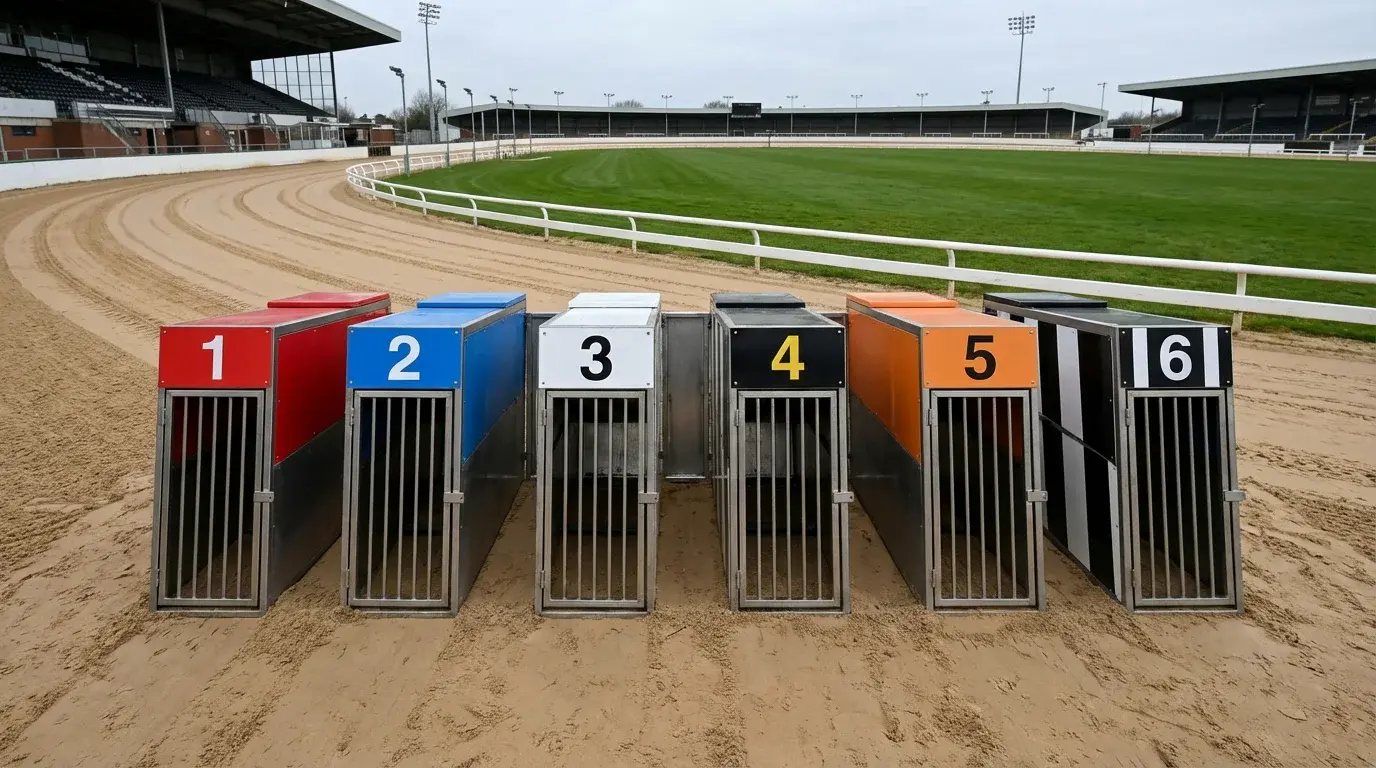
In graded UK races, traps are allocated by seeding. The racing manager assigns boxes based on each dog's running style: railers to the low-numbered traps (1 and 2), middle runners to the centre (3 and 4), and wide runners to the outside (5 and 6). This is designed to reduce first-bend interference by giving each dog a clear channel on its natural line. When the seeding works as intended, six dogs run six separate trajectories and the best animal wins. When it breaks down — a railer drawn in trap 5, three middle runners sharing adjacent boxes, or an unseeded open race with random allocation — the first bend becomes a collision zone. Dogs baulked, crowded, or forced off-line lose two to three lengths in the opening seconds. In a sprint, that deficit rarely comes back.
The betting angle is straightforward: identify dogs drawn against their running style, or races where the seeding creates structural clashes, and adjust your assessment accordingly. A well-drawn dog with moderate form will outperform a better dog in the wrong box more often than most punters expect.
Well-Drawn Dog
- Natural railer in Trap 1
- Fastest sectional in the field — 5.14s
- No other railer inside to cause crowding
- Form: 1-1-2-1-1-2 at this track
- Market price reflects ability; probability supports it
Poorly-Drawn Dog
- Natural railer drawn in Trap 5
- Identical sectional speed to the well-drawn rival
- Must cross four lanes to reach the rail
- Historical win rate from Trap 5 for railers: below 10%
- Market still prices on raw form, ignoring draw mismatch
The draw does not guarantee the result. But it dictates the conditions under which ability can operate. A good dog in the wrong trap is not a good bet — it is a good dog in a bad situation. Learning to distinguish between the two is one of the sharpest edges available in greyhound betting.
Trap Bias by Track
Not every UK track penalises wide draws equally. Circuit geometry — bend radius, run-up distance from traps to the first turn, overall circumference — determines how much the inside position matters. At sharp, tight tracks, the first bend arrives fast and inside traps dominate. Romford is the textbook example: its compact 400-metre oval produces a documented trap 1 win rate well above the one-in-six statistical baseline. At galloping tracks with sweeping bends like Towcester or Nottingham, outside runners with early pace can compete effectively even from wide draws.
Track-specific trap bias data is published by Timeform and accessible through the Racing Post. Before backing any dog at an unfamiliar venue, checking the twelve-month trap statistics for that track gives you a baseline that raw form alone cannot provide. A dog with strong form drawn in a historically weak trap at that specific venue is a fundamentally different proposition from the same dog at a neutral circuit. The data is there. Use it.
Running Styles — Railers, Middles, and Wides
Greyhounds do not choose their line mid-race. They run the only way they know. Every dog has an innate preference for a particular part of the track — inside rail, central channel, or outside lane — and this preference is consistent enough that the GBGB uses it as the basis for trap allocation in every graded race. The racecard marks each dog with a seeding letter: r for railer, m for middle, w for wide. It is one of the smallest annotations on the card and one of the most predictive.
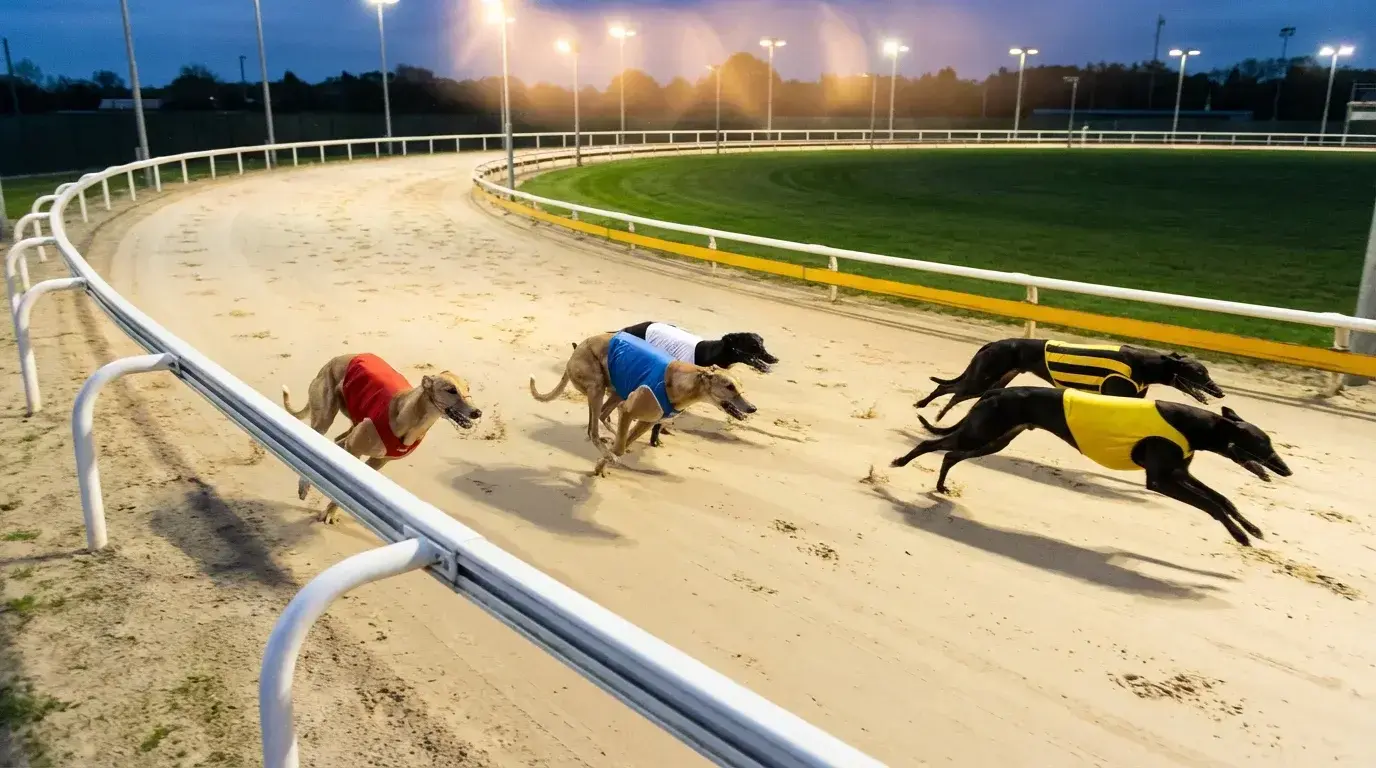
A railer hugs the inside rail from box to finish, taking the shortest route around the track. When drawn in traps 1 or 2 with no other railer inside, the path is clean and the advantage substantial. A middle runner holds a line two to three lanes off the rail, the most adaptable position but also the most exposed — middles cop interference from both sides when adjacent dogs converge at the bend. A wide runner swings to the outside, covering more ground but skirting the first-bend congestion entirely. Wides need strong early speed to compensate for the extra distance, and they thrive at galloping tracks with spacious bends.
Railer
Shortest path. Needs clean inside rail. Best from Traps 1-2. Dominant at sharp, tight circuits. Loses value quickly when drawn wide.
Middle
Central channel. Most versatile but most vulnerable to crowding. Best from Traps 3-4. Consistent across different track types.
Wide
Longest route, avoids traffic. Needs early pace to offset extra ground. Best from Traps 5-6. Strongest at galloping tracks with sweeping bends.
What matters for betting is not the individual running style in isolation — it is the mix of styles within a single race. Six runners with one railer, two middles, and three wides will produce a very different contest from six runners with three railers and three middles. In the first scenario, the lone railer has an uncontested rail; in the second, the three railers crowd each other through the bend and the middles inherit a clear central path. These dynamics are visible on the racecard before the traps open. The seeding letter is small. Its predictive value is not.
Early Speed and the First Bend
The first bend is the single most important moment in a greyhound race. Data across GBGB tracks shows that dogs leading at the first bend win at a rate above fifty percent — roughly three times what a six-runner field would suggest if outcomes were random. The reason is mechanical, not mystical. Once a dog clears the bend in front, it controls the rail, avoids interference, and runs the shortest possible line for the rest of the race. Every dog behind it must negotiate traffic, find running room, and cover extra ground to close the gap. In a thirty-second race, there simply is not enough track for most closers to make it up.
Identifying early-speed dogs from the racecard requires layering multiple data points. The sectional time — the split from traps to the first timing point, typically around five seconds for a 480-metre race — is the most direct indicator. A dog posting 5.14 reaches the bend meaningfully sooner than one posting 5.32. But sectional time interacts with the trap draw: a fast-breaking railer from trap 1 has a cleaner path to the front than an equally fast wide runner from trap 6 who must cover extra width. When sectional speed and ideal trap draw align in the same dog, the probability of that dog leading at the bend — and winning — spikes sharply.
Early speed combined with a clean rail and a favourable trap draw produces the highest-probability selection type in UK greyhound racing.
Not every race features an obvious pace dog. Some fields contain two or three fast breakers in adjacent traps, which creates first-bend chaos as they jostle for position — effectively cancelling each other's advantage. Other races have no clear pace, producing open contests where closers or middle-running dogs pick up the pieces. Recognising the race type from the card is the discipline. When the pace angle is clear and uncomplicated, back it with confidence. When the sectional data shows a crowded first bend, the early-speed edge dissolves, and it is time to look at the race differently — or pass it entirely.
Understanding Greyhound Bet Types
Win bets are the start. What comes next separates casual punters from serious ones. UK greyhound racing offers a broader menu of bet types than most bettors explore, and the six-runner format gives several of those markets a structural edge that larger horse racing fields cannot replicate. Fewer runners mean tighter permutation maths on exotic bets — and that translates directly into accessible returns for those who know how to use them.
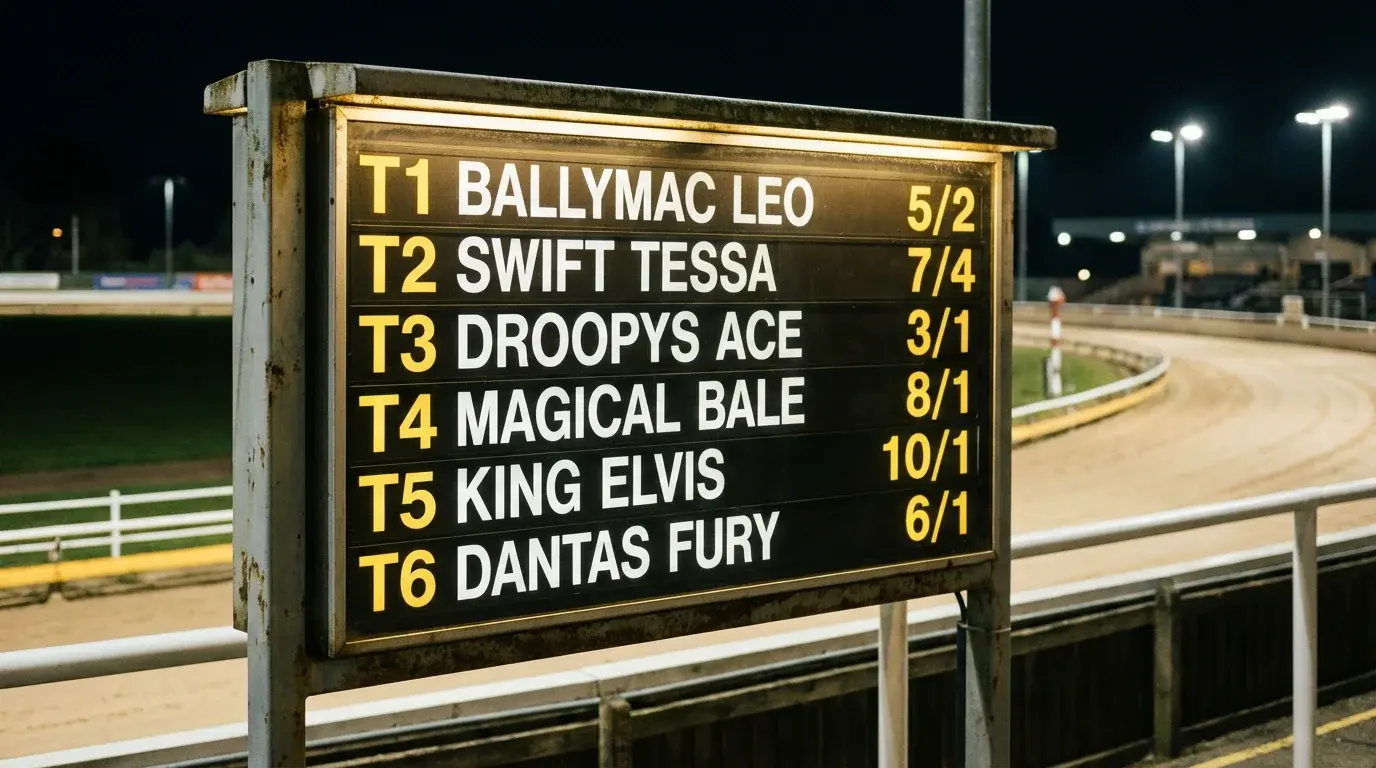
The win bet is the foundation: pick a dog, back it to finish first. Simple, clean, and where most punters stop. A place bet pays out if your selection finishes first or second — but the smaller field size means place terms are tighter than in horse racing. Each way combines a win stake and a place stake at one-quarter the win odds for two places. In practice, this means your place return on a short-priced each-way selection in a six-runner race is often minimal.
Each way terms in six-runner races are tight. With only two places paying at one-quarter odds, the place portion often returns little more than your total stake on dogs at 3/1 or shorter. Each way bets in greyhound racing offer genuine mathematical value only on selections priced around 4/1 or above. At shorter prices, a straight win bet is almost always the cleaner option.
Beyond single-race markets, the trap challenge lets you back a specific trap number across every race on a card — a useful angle when track data reveals a persistent trap bias across an evening. Tote pool bets operate on a pari-mutuel basis, where returns depend on the total pool and the number of winning tickets. Multi-race pools like the jackpot require picking winners across a sequence of races and can produce outsized returns, though the variance is extreme.
Forecasts and Tricasts — Higher Risk, Higher Reward
Naming the first two home in order is hard. That is precisely why it pays so well. A straight forecast requires predicting the first and second finisher in exact order. A reverse forecast covers both possible orderings, doubling your unit stake. A combination forecast lets you select three or more dogs and covers all first-and-second permutations — three selections generate six combinations; four generate twelve.
Tricast bets extend the logic to the first three finishers in exact finishing order. In a six-runner field there are 120 possible tricast outcomes, so even a relatively predictable race can produce substantial dividends. A combination tricast covering four dogs in all possible first-three arrangements costs 24 unit stakes — not cheap, but capable of returning multiples of fifty or a hundred times the outlay when the result lands.
The structural advantage of forecast and tricast betting in greyhound racing is the field size. With only six runners, the number of possible outcomes is dramatically smaller than in an eight- or twelve-runner horse race. If your form analysis identifies two or three dogs that clearly stand above the rest, permutation bets offer a mathematical route to returns that win-only markets simply cannot match. These are the bets that reward deep racecard reading most directly.
Forecast & Tricast Calculator
Own tool · exact-order pricing
Six runners, thirty forecast permutations, a hundred and twenty tricasts. Small enough to price every single one — which is exactly why the field size is an edge rather than a talking point. Enter the six prices and read the fair dividends.
The card
Prices accept either format — 5/2, 3.50 or
evs. Leave a trap blank to treat it as a non-runner.
Runners—
Overround—
Book payout—
Favourite's true chance—
| Trap | Price | Implied | Win | Fair price | Top 2 | Top 3 | Margin loading |
|---|
Straight forecast · all 30 permutations
| Order | Chance | Fair dividend |
|---|
A reverse forecast covers both orderings of one pair — its combined chance is the sum of the two rows, and it costs two units.
Tricast · strongest 15 of 120
| Order | Chance | Fair dividend |
|---|
Combination cost and break-even
Tick the traps you want covered. The break-even dividend is what a single winning permutation has to return, to a one-unit stake, for the whole combination to pay for itself.
Permutations covered—
Total outlay—
Chance of landing—
Break-even dividend—
—
Each way, checked properly
An each-way bet is two bets. The win half costs you the book's margin. The place half is governed entirely by the terms — and those terms treat short and long prices very differently.
Win half—
Place half—
Combined—
Place chance needed—
| Trap | Price | Place return | Place chance | Needed | Place half |
|---|
—
Greyhound Grading — What Class Tells You
A dog dropping from A3 to A5 is not getting worse. It is getting an easier race — and that distinction is where some of the best value in greyhound betting hides. The UK grading system is the organising principle of the sport: every dog at every GBGB-licensed track is assigned a grade that reflects its demonstrated ability, and that grade determines who it races against.
The top tier is A1, reserved for the fastest dogs over standard distances at each venue. Grades descend through A2 to A11, with B grades used for non-standard distances at each venue. Sprint and stayer distances carry their own grading prefixes (D for sprints, S for stayers). The mechanics are simple: win a race and you go up a grade; finish outside the places in consecutive runs and you come down. The racing manager at each track has some discretion, but the general trajectory is consistent — performance dictates class.
For bettors, grade movements are among the most underpriced signals on the racecard. A dog that drops two grades after a string of poor finishes looks like a fading runner. But if those poor finishes came in A2 against near-open-class opposition, and the dog now faces A4 company, it may be significantly faster than anything else in its new field. The market often prices based on the raw form figures — the losing sequence — without fully accounting for the class context. That is the gap to exploit.
Open races operate outside the grading ladder entirely. Entry is by invitation or qualification, and traps are drawn randomly rather than seeded by running style. The GBGB's centenary calendar for 2026 features an expanded programme of fifty category one and twenty-seven category two open events across the circuit, making this the most extensive premium-race schedule in years. Favourites in open races win less frequently than in graded events — the random draw and deeper fields make every runner's path less predictable.
Do
- Back dogs dropping in class whose recent losses came against clearly superior opposition — check the grade of the races they lost, not just the positions.
- Compare the dog's recent times to the standard winning time at the new lower grade. If it is faster, the class drop adds genuine value.
- Factor in freshness. Dogs that drop after a rest often return sharper at the lower level.
Don't
- Assume a grade rise means the dog is improving. It may simply be racing beyond its ceiling for the first time.
- Ignore the reason for a grade drop. Injury-related drops are a different proposition from form-related drops.
- Treat grades as identical across venues. A3 at Nottingham and A3 at a smaller track do not represent the same standard.
Building a Selection Process — Putting It All Together
Stop guessing. Start with a system. Every concept in this guide — racecard reading, trap draw analysis, running style assessment, early speed identification, class calibration — feeds into a single repeatable process for analysing a greyhound race. The punters who profit from the dogs over time are not the ones with the best instincts. They are the ones who apply the same framework to every race and let the accumulated edge do the work.
Six-Point Selection Framework
- Check the trap draw: is each dog drawn on its preferred running line?
- Read the form in context: grade, track, distance, and trend direction.
- Map the running styles: how many railers, middles, and wides, and where are the potential clashes?
- Assess the class level: is any dog clearly racing below its proven ability?
- Identify early speed: which dog reaches the first bend first, and from which trap?
- Check the trainer: does this kennel have a strong record at this track and distance?
Here is the framework applied to a real-format scenario. The 8:15 at Nottingham: six dogs, graded A4, over 480 metres. You open the racecard and begin.
Trap 1 is a confirmed railer with a sectional of 5.16 and recent form of 2-1-1-3-1-1. Trap 3 is a middle runner, sectional 5.24, form 3-3-4-2-2-1. Trap 5 is a wide runner with a best time two-tenths faster than anything else in the field, but a sectional of 5.31 — this dog finishes fast but is not a front-runner. The remaining three dogs show inconsistent form and no standout indicators.
Step through the checklist. Trap draw: the railer is drawn perfectly in 1, the middle in 3, the wide in 5 — seeding looks clean. Running style map: one railer, two middles, three wides — no crowding on the inside. Class: all six dogs have been at A4 for several runs; no recent class droppers. Early speed: Trap 1 has the fastest sectional by a clear margin with no rival railer inside to crowd the rail. Trainer: Trap 1's trainer has a record well above the baseline at Nottingham over 480 metres.
The conclusion is not that Trap 1 will win. Dogs fall, miss the break, or run into traffic that the card could not predict. The conclusion is that Trap 1 represents the highest-probability selection based on every available data point — and the market should be checked to see whether the price reflects that probability or offers an overlay. If it does, you bet. If the price is too short for the risk, you pass. Either way, the decision was systematic, not emotional.
Over a single evening, this process will not make you rich. Over a hundred evenings, applied consistently, it separates disciplined bettors from the rest of the crowd. The framework is the edge. Trust it.
Bankroll Management for the Dogs
The schedule is relentless — and that is what makes discipline non-negotiable. UK greyhound racing runs daily, with most tracks hosting twelve-race evening cards from around 7pm. On a typical Saturday, five or six venues broadcast simultaneously. Forty-plus races are available in a single session. For a punter without a staking plan, the sheer volume becomes the enemy: one losing race rolls into a recovery bet on the next, then the next, and by 10pm the evening budget is gone along with the discipline that was supposed to protect it.
Level-stakes betting is the simplest effective discipline for greyhound racing. Set a fixed unit stake — typically one to two percent of your total bankroll — and apply it to every bet regardless of confidence level. The urge to load up on a strong fancy is real, but it introduces exactly the kind of emotional decision-making that a systematic approach is designed to eliminate. If your selection process produces winners at a rate that generates profit at level stakes, increasing the stake on individual bets only adds variance, not value.
Set a session budget before each evening and enforce it. If you lose the allocation after five races, stop. Do not chase. Do not borrow from tomorrow's bankroll. The dogs run again in twenty-four hours, and the day after that, and every day after that. There is no last-chance race, no must-win moment. The frequency of meetings is a bettor's greatest structural advantage — it provides an enormous sample size over which an edge can compound — but only if the bankroll survives long enough to reach the compound phase. Protect the bankroll. The opportunities will keep coming.
Track your results. Every bet logged — date, track, race, selection, odds, stake, outcome — becomes data you can analyse. You may find that your win rate on forecasts significantly exceeds your single-bet returns, or that certain tracks consistently produce better selections for you. Without records, you are guessing about your own performance. With them, you are running a feedback loop that sharpens the process over time.
UK Greyhound Tracks — A Quick Reference
Around twenty tracks, meetings every day, year-round except Christmas. The GBGB-licensed circuit spans England and Wales, and each venue has its own geometry, surface, race programme, and statistical profile. Knowing the track matters as much as knowing the dog — a proven A3 winner at Monmore may struggle at Romford because the bends are tighter, the run-up shorter, and the trap biases completely different.
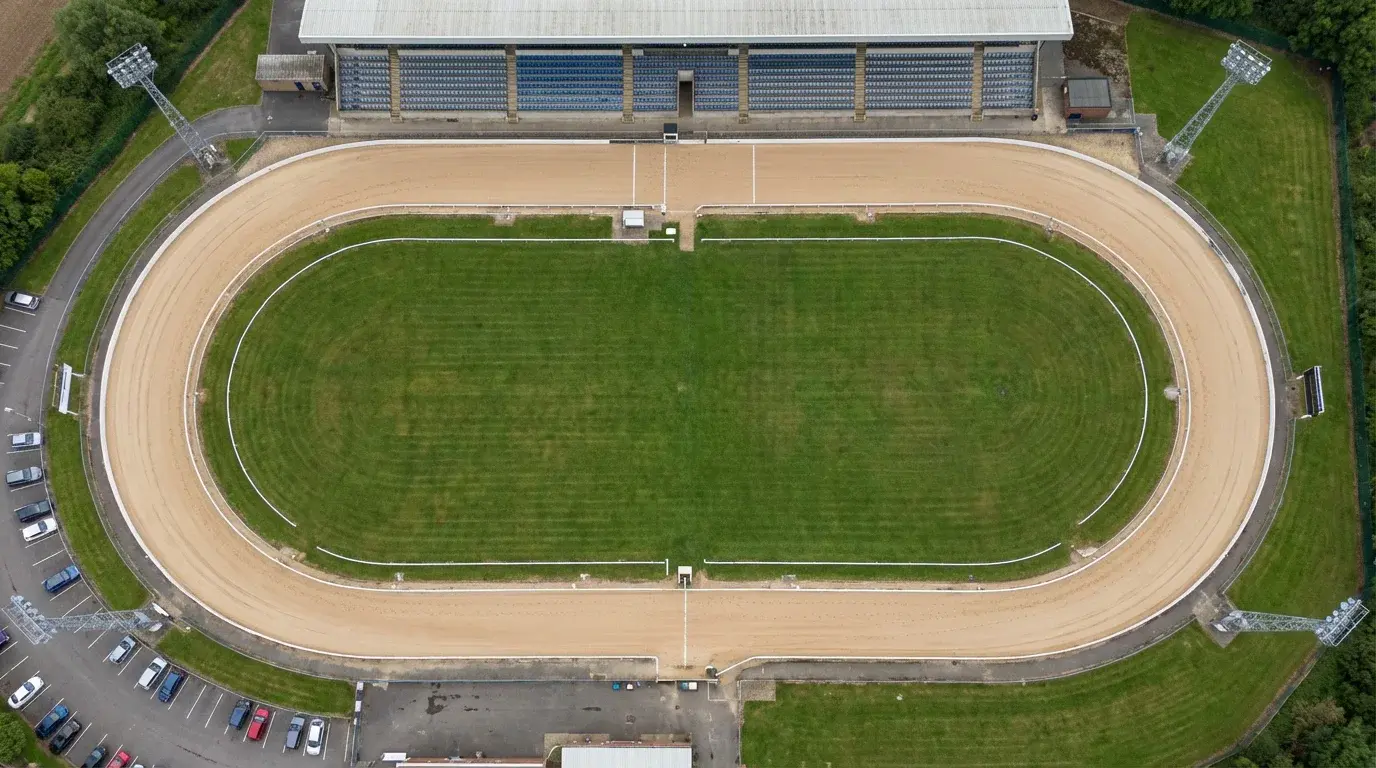
The 2026 racing calendar marks the centenary of British greyhound racing — a hundred years since the first modern meeting at Belle Vue, Manchester, in July 1926. The GBGB has responded with an expanded programme of fifty category one and twenty-seven category two open events distributed across the licensed circuit, giving punters more premium racing than any recent season. The table below covers the major venues and their core characteristics. It is not exhaustive — smaller tracks like Kinsley, Mildenhall, Harlow, and Great Yarmouth serve regional programmes and offer their own angles — but it provides the starting grid.
| Track | Location | Main Distance | Typical Schedule | Key Characteristic |
|---|---|---|---|---|
| Romford | East London | 400m | Mon, Wed, Fri, Sat evenings | Sharp bends, strong inside-trap bias |
| Nottingham | East Midlands | 500m | Mon, Sat evenings; midweek BAGS | Fair galloping track, hosts Select Stakes |
| Towcester | Northamptonshire | 480m | Selected evenings | Sweeping bends, English Greyhound Derby venue |
| Monmore Green | Wolverhampton | 480m | Mon, Sat evenings | Reliable surface, consistent times |
| Sunderland | Tyne and Wear | 450m | Tue, Thu, Sat evenings | Strong northern circuit venue |
| Doncaster | South Yorkshire | 450m | Evenings, daytime BAGS | Consistent galloping track |
| Brighton and Hove | Sussex | 515m | Evenings | Large circuit, suits stayers |
| Central Park | Sittingbourne, Kent | 450m | Mixed schedule | Balanced layout, moderate bias |
| Oxford | Oxfordshire | 450m | Sat evenings, weekday cards | Revitalised 2026 open-race card |
| Owlerton | Sheffield | 500m | Evenings | Strong crowd atmosphere, evening-dominant |
The core lesson for bettors is that form does not transfer cleanly between tracks. A dog's times, results, and running patterns at one venue should be contextualised — adjusted for distance, bend profile, and surface — before being used to assess its chances at another. Treat each track as its own ecosystem. The dogs that travel well between venues stand out in the data. The ones that do not will punish you if you assume otherwise.
Frequently Asked Questions
How do you read a greyhound racecard?
A UK greyhound racecard displays six runners with the following data for each: trap number (1-6, colour-coded), dog name, trainer, form figures showing finishing positions from the last six races, best recent time over course and distance, sectional time to the first bend, current racing weight, age, days since last run, and a seeding indicator (r for railer, m for middle, w for wide). To read it effectively, start with the trap draw and seeding to identify which dogs are drawn on their natural running line. Then read the form figures in context — check the grade and track for each run, not just the raw positions. Compare sectional times to identify the likely leader at the first bend, and check weight for stability between outings. Free racecards for every licensed UK meeting are available through Timeform, the Racing Post, and individual track websites.
Do favourites win often in greyhound racing?
Favourites in UK greyhound racing win approximately 30 to 35 percent of the time in graded races. This is broadly comparable to favourite strike rates in horse racing, despite the smaller six-runner field. The compressed ability range within each grade means dogs are closely matched, and the trap draw introduces a structural variable that pure form cannot always overcome. In open races, where traps are drawn randomly rather than seeded, favourite win rates tend to be lower. Betting exclusively on favourites across a season is not a profitable strategy in greyhound racing — the value lies in identifying situations where the market has mispriced a selection, whether that selection is the favourite or an outsider.
What do railer, middle runner, and wide runner mean in greyhound racing?
These terms describe a greyhound's preferred running line around the track and are fundamental to how races are structured. A railer naturally hugs the inside rail, taking the shortest route but requiring a clear path with no traffic inside. A middle runner holds a line two to three lanes off the rail, offering adaptability but exposure to crowding from both sides. A wide runner swings to the outside, covering more distance but avoiding the congestion that typically builds at the first bend. In graded UK races, dogs are seeded by style: railers to traps 1-2, middles to 3-4, and wides to 5-6. When a dog is drawn against its running style — a railer in trap 5, for example — the mismatch reduces its winning probability significantly, and this is one of the most reliable angles for identifying value in greyhound betting markets.
Your First Bend Is the Next Race
The card is published. The odds are live. Now it is about what you see that others do not.
Every concept in this guide — form figures, trap draw dynamics, running style analysis, early speed identification, grading context, bet type selection, bankroll discipline — is a lens for reading the same six-dog race. Applied individually, each sharpens one corner of the picture. Applied together, they produce an assessment of the race that most punters never reach, because most punters stop reading after the form column.
Greyhound racing rewards preparation, not intuition. Over thirty seconds there is no room for luck to accumulate, no time for momentum shifts, no space for narrative arcs. The dog that was always going to win — the one with the right form, the right draw, the right pace, the right class — usually does. The data tells you which one that is. The skill is learning to read it faster and more accurately than the market prices it.
Start tonight. Pick one meeting. Open the racecard for a single race. Work through the six-point framework: draw, form, style, class, speed, trainer. Make your selection before you look at the odds. Then compare your assessment to the market price. If the market agrees with you and the dog is short, you have confirmed your reading. If the market disagrees and your analysis is sound, you may have found a bet worth taking.
The dogs are in the traps. The lure is about to run. The racecard is sitting in front of you, dense with data, waiting to be read. Everything you need is already there.
