 dogracingtips
Updated October 2026
Licensed
 Available in US
Fast payouts
18+ Only
Six Runners, Dozens of Ways to Bet
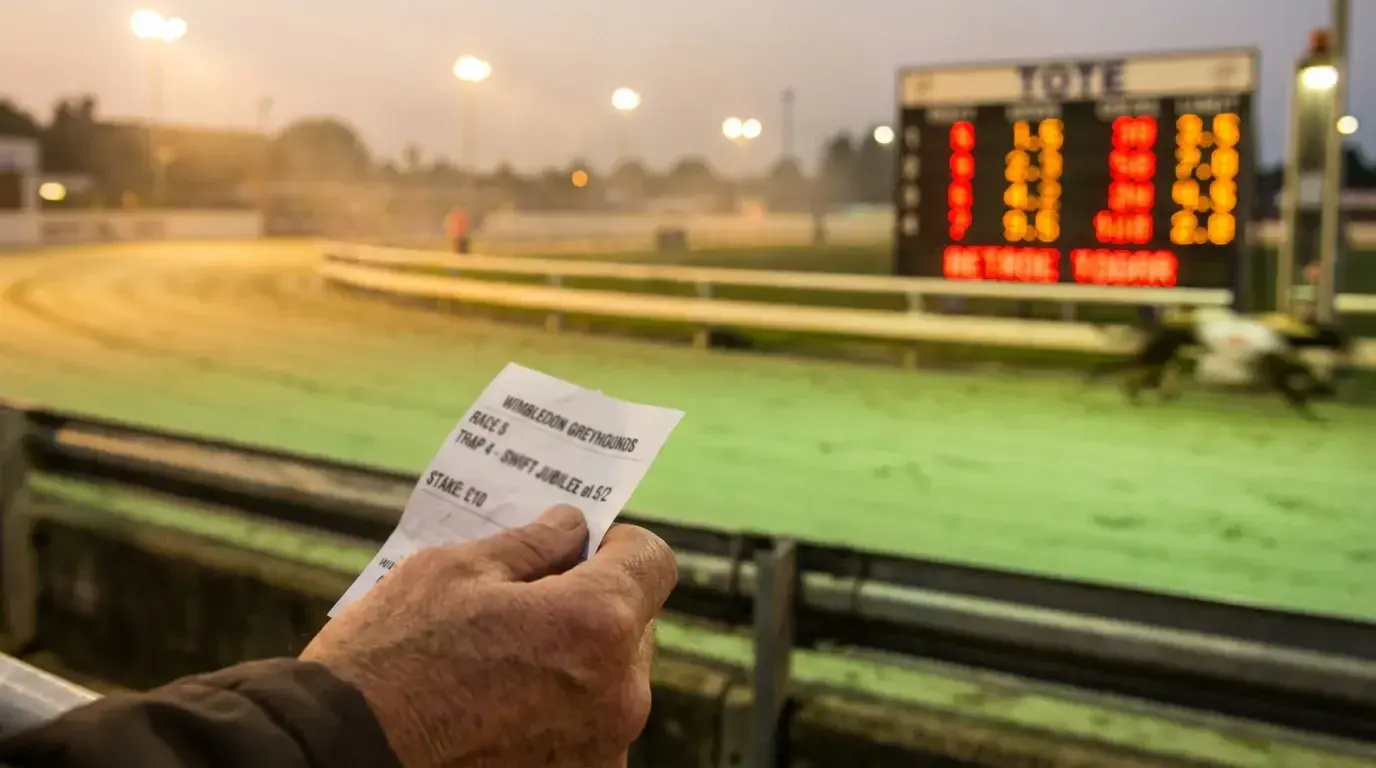
Greyhound racing fields are small. Six dogs, six traps, one winner. That compact structure is deceptive, because the number of ways to bet on those six dogs extends far beyond picking the one that crosses the line first. Win bets are the foundation, but the UK greyhound betting market stretches from simple place bets through forecasts and tricasts to exotic pool wagers that ask you to name the first three home in exact order — or the winners of consecutive races. The range exists because the sport’s frequency and field size create a natural laboratory for bet types that would be impractical in larger-field events like horse racing or impossible in team sports.
For the recreational bettor, understanding the full menu matters because different bet types suit different situations. A race where you are confident about the winner but less sure about the rest of the field calls for a win single. A race where you can identify two strong contenders but cannot separate them calls for a reverse forecast. A race where the entire field looks open and the favourite is short-priced might call for a combination tricast that gives you multiple shots at a big payout for a modest total stake. The bet type is not an afterthought — it is a strategic decision that should follow from your analysis, not precede it.
For the serious bettor, the less common markets — tote pools, exchange back-and-lay positions, and special bets like the Pick 3 or jackpot — offer opportunities that the standard fixed-odds markets do not. Pool betting removes the bookmaker’s margin and replaces it with a shared dividend. Exchange betting allows you to take the opposing side and lay a dog you expect to lose. These alternatives require different skills and carry different risk profiles, but they expand the toolkit available to anyone willing to learn how they work.
This guide covers every standard UK greyhound bet type, from the straightforward to the complex. Each section explains the mechanics, the payout structure, and — most importantly — when to use it and when to leave it alone.
Common Bets — Win, Place, Each Way
The win bet is the simplest and most common wager in greyhound racing. You pick a dog, stake your money, and if it finishes first, you collect at the agreed odds. If it finishes anywhere else, you lose the stake. No complications, no partial returns, no secondary calculations. The purity of the win single is its strength: your analysis either identified the winner or it did not, and the feedback is immediate and unambiguous.
Win singles are also the most efficient bet type in terms of margin. The bookmaker’s overround — the built-in profit margin across all six prices in a race — is typically lower on the win market than on exotic bets, which means a smaller proportion of your stake is going to the house. Over hundreds of bets, that efficiency compounds. Most consistently profitable greyhound bettors use win singles as their primary weapon, and they use everything else sparingly.
The place bet asks your dog to finish first or second. In greyhound racing, place terms are tighter than in horse racing: with only six runners, bookmakers pay out on the first two finishers only, compared to the first three or four in a large horse racing field. The odds for a place bet are typically a fraction of the win odds — usually one quarter of the win price. So a dog at 4/1 to win would pay approximately 1/1 (evens) for a place. Place bets reduce your risk, but they also reduce your potential return significantly, and the mathematics of place betting in six-runner fields is less generous than many casual bettors assume.
The each way bet combines a win bet and a place bet into a single wager at double the unit stake. If you bet one pound each way, you are placing one pound on the dog to win and one pound on the dog to place, for a total outlay of two pounds. If the dog wins, you collect on both the win and the place portions. If it finishes second, you collect on the place portion only. If it finishes third or worse, you lose both stakes.
Each way betting is deeply ingrained in UK betting culture, but in greyhound racing it requires careful evaluation. The place terms — one quarter the odds, first two places only — are tighter than in horse racing, and the arithmetic of when each way pays and when it drains your bankroll is worth examining in detail.
Each Way Terms in Six-Runner Fields
The each way terms in greyhound racing are standardised across UK bookmakers: one quarter the win odds, paying first and second only. This is significantly tighter than the each way terms available in horse racing, where larger fields produce more generous place payouts — often one fifth the odds for the first three or four places. The difference is structural: six runners simply do not generate enough competitive spread to support wider place terms without destroying the bookmaker’s margin.
This matters because it changes the break-even calculation. With each way at quarter odds and two places, a dog needs to either win or finish second for you to see any return. At 3/1, the place portion pays 3/4 — a return of one pound seventy-five on a one-pound place stake, for a profit of seventy-five pence. But you have staked two pounds total (one win, one place), so a second-place finish at 3/1 each way loses you twenty-five pence overall. The win needed to happen for the each way bet to be profitable at that price.
At 6/1, the arithmetic improves. The place portion pays 6/4, returning two pounds fifty on a one-pound place stake. Your total outlay was two pounds, so a second-place finish returns two fifty for a net profit of fifty pence. The win portion at 6/1 returns seven pounds, making a winning result highly profitable. At this price range, the each way bet starts to function as intended — a meaningful safety net if your dog runs well without winning, combined with a strong return if it does.
The practical rule: in greyhound racing, use each way selectively and only at longer odds. At short prices, the place portion is dead money. At medium prices, it is marginal. At 5/1 and above, each way starts to justify the doubled stake. Below that, win-only is almost always the cleaner, more efficient bet.
Forecast Bets — Straight and Reverse
A straight forecast — sometimes called an exacta — requires you to name the first and second-place finishers in the correct order. Dog A first, Dog B second. If A wins and B finishes second, the bet pays. Any other finishing order loses. This is a harder prediction than a simple win bet, and the payouts reflect that difficulty. A straight forecast in a six-runner greyhound race typically pays considerably more than either dog’s individual win odds, because you are predicting two positions, not one, and the order must be exact.
The payout on a straight forecast is not based on pre-set bookmaker odds. Instead, UK greyhound forecasts are settled at the computer straight forecast (CSF) dividend — a formula-derived payout calculated after the race based on the starting prices of the first and second-place dogs. The CSF is published as part of the official result. This means you do not know your exact potential return before the race, but you can estimate it based on the SPs. As a general guide, a forecast combining two short-priced dogs will pay less than a forecast involving a longer-priced runner in one of the two positions. A favourite-second-favourite straight forecast might pay five to eight times the stake. A favourite combined with a 10/1 outsider could pay thirty times or more.
The reverse forecast doubles your coverage by betting on both possible orders: A first, B second, and B first, A second. The cost is double the unit stake — two bets instead of one — but your selection now covers both permutations. If A and B fill the first two positions in either order, you collect on the relevant half of the reverse forecast. This is useful when you are confident about which two dogs will fill the frame but less certain about which one will actually win.
The strategic question with forecasts is confidence allocation. A straight forecast is a high-conviction bet: you believe you know not just the winner but the runner-up, and you are confident enough about the order to back it with your stake. If that confidence is genuine — if your form analysis strongly suggests Dog A has the early pace to lead and Dog B has the finishing speed to claim second — the straight forecast offers superior value because the single-permutation cost keeps the stake low relative to the potential payout.
A reverse forecast is a lower-conviction, higher-coverage alternative. You are saying these two dogs will fill the first two places, but you are hedging on the order. The cost doubles, but the probability of collecting increases. For races where the top two dogs are closely matched — similar form, similar times, drawn in adjacent traps — the reverse forecast is often the more practical choice, because small margins at the first bend can determine which dog leads and which sits second.
One common error is overusing forecasts. They are exciting, they pay well when they land, and they encourage bettors to believe they have a deeper understanding of the race than a simple win selection provides. But the hit rate on forecasts is inherently lower than on win bets, because you need two predictions to be correct rather than one. Using forecasts in every race is a bankroll drain. Using them selectively — in races where you can genuinely identify the likely first and second with above-average confidence — is where the value lives.
Tricast and Combination Bets
The tricast takes the forecast concept one step further: you must name the first, second, and third-place finishers in the exact order. In a six-runner field, this means identifying half the field and placing them in the correct sequence. The probability is low. The payouts, accordingly, can be substantial — tricast dividends in three figures are not unusual when a longer-priced dog fills one of the three positions, and four-figure returns occur periodically when the result confounds market expectations entirely.
Like forecasts, tricasts in UK greyhound racing are settled at the computer tricast (CT) dividend rather than at pre-agreed fixed odds. The CT is calculated after the race based on the starting prices of the first three finishers. This means the payout scales with how unexpected the result is: a tricast featuring the top three in the market will pay modestly, while a tricast involving two outsiders will pay multiples of what the same combination would return as individual win bets.
The combination tricast — sometimes called a full perm tricast — loosens the requirement. Instead of naming the first three in exact order, you select three dogs and cover all six possible finishing permutations of those three. The cost is six times the unit stake, but your bet now pays if your three selections finish in the top three in any order. This is a popular bet for punters who can identify the three most likely runners to fill the frame but cannot confidently order them. At a one-pound unit stake, a combination tricast costs six pounds. The return, if your three dogs fill the first three places, is the full CT dividend for the specific finishing order that actually occurred.
You can also bet combination tricasts with four or five selections, which increases the number of permutations and the cost accordingly. A four-dog combination tricast covers twenty-four permutations (four choices for first, three for second, two for third). At one pound per line, that is a twenty-four-pound bet. A five-dog combination tricast covers sixty permutations and costs sixty pounds at a one-pound stake. The maths scales fast, and the question becomes whether the expected tricast dividend justifies the outlay. In most standard graded races, it does not. In open races with a wide-open field and the possibility of a long-priced CT, it sometimes can — but these situations are rarer than the excitement of a potential four-figure payout might suggest.
The disciplined approach to tricasts is to use them sparingly and structurally. Identify the race types where you have genuine confidence in three runners — typically well-graded evening races at tracks you know well, where the form data is deep and the field separates clearly into tiers. Avoid using tricasts as lottery bets across every race on the card. The maths does not support that approach, and the hit rate will punish it over any meaningful sample.
Exotic and Special Bets
Beyond the standard win, forecast, and tricast markets, UK greyhound racing offers several specialist bet types that appear on specific tracks or through specific operators. These range from manageable multi-race challenges to high-variance jackpot pools that function more like a lottery than a traditional bet.
The trap challenge is a novelty bet offered by some bookmakers on selected meetings. You pick a single trap number and it applies to every race on the card. If your trap produces the most winners across the meeting, you win. This is essentially a bet on trap bias — a wager that the track conditions on a given evening will favour one starting position over others. It is low-skill, low-analysis, and entirely dependent on variables you cannot assess in advance (track surface condition, running-rail position). As entertainment it is harmless. As a betting strategy it has no merit.
Pick 3 and Pick 6 bets require you to name the winner of three or six consecutive races at a single meeting. The payouts escalate with each leg because the combined probability decreases multiplicatively. Getting one race right at a 30% strike rate is normal. Getting three in a row at 30% each gives you a roughly 2.7% probability of a clean sweep. Getting six in a row drops below 0.1%. The jackpot-style payouts reflect this difficulty, but the expected value is typically negative because the pool deductions and low hit rates combine to erode your edge even if your selections are individually sound.
Daily doubles — picking the winners of two nominated races — are a simpler multi-race bet that some tracks and operators offer. These function like a two-leg accumulator with the payout derived from the tote pool or from a bookmaker price. The appeal is that two correct selections is achievable with solid form reading, and the payout is meaningfully larger than two separate win singles would produce. Of the exotic options, the daily double is the one most compatible with a form-based approach, because it only requires two successful analyses rather than three or six.
The general principle across all exotic and special bets is straightforward: the more outcomes you need to predict correctly, the lower your probability of success, and the more the house edge compounds against you. Use them for occasional recreation if you enjoy them. Do not build a betting strategy around them.
Accumulators and Multiples
Greyhound accumulators combine two or more selections into a single bet where the winnings from each leg roll into the next. A double links two selections. A treble links three. Larger multiples — four-folds, five-folds, and beyond — are available at most UK bookmakers. The appeal is obvious: a treble at 3/1, 4/1, and 5/1 returns one hundred and nineteen pounds on a one-pound stake if all three win. The equivalent three win singles return a combined thirteen pounds in profit. The accumulator magnifies the payout by multiplying the odds across legs.
The problem is that it also magnifies the risk in the same proportion. Each additional leg reduces the probability of the entire bet succeeding. If each of your three selections has a 30% chance of winning, the probability of all three winning is 0.30 multiplied by 0.30 multiplied by 0.30, which equals 2.7%. You will land roughly three in every hundred attempts. The payout is large when it hits, but it hits so rarely that the long-run return is almost always negative — particularly after the bookmaker’s overround is compounded across each leg.
Greyhound racing adds a specific layer of accumulator risk that horse racing and football do not share. The races happen in rapid succession — every eight to ten minutes at a single track — which means a greyhound accumulator across one evening card can be built and settled within an hour. This frequency encourages punters to construct accumulators impulsively, adding a dog from the next race because the previous legs are winning and the momentum feels good. That impulse is the enemy of sound selection. The fourth leg of an accumulator deserves exactly the same analytical rigour as the first, and if the racecard for the fourth race does not produce a qualifying selection, the correct response is not to bet the accumulator at all rather than to compromise on the final leg.
Doubles are the most defensible form of accumulator in greyhound racing. They require only two correct predictions, the combined probability is manageable for dogs with genuine chances, and the payout uplift over two singles is meaningful without being fantastical. Beyond doubles, the probability curves drop steeply and the expected value follows. Most professional greyhound bettors do not use accumulators at all. Those who do restrict themselves to doubles, and only when both legs are races they would have bet as singles anyway.
Tote and Pool Betting
Tote betting — also called pool betting or pari-mutuel — works on a fundamentally different model from fixed-odds bookmaking. Instead of the bookmaker setting prices and absorbing the risk, all stakes are pooled together and the total pool, minus a deduction (typically between 15% and 30% depending on the bet type and operator), is shared among winning ticket holders. Your payout depends not on odds set before the race but on how many other bettors backed the same dog. If you picked the winner and few others did, the dividend is large. If half the pool backed the same dog, the dividend is small.
UK greyhound tracks operate on-course tote systems with standard pool types: tote win, tote place, tote forecast, and tote tricast. Some tracks and operators offer jackpot pools — typically requiring the winners of four or six consecutive races — that can accumulate to significant figures when the pool rolls over from meetings where no one achieves a clean sweep. The jackpot pool is the closest thing in greyhound racing to a lottery, and the payouts when someone hits can run into thousands of pounds for a modest unit stake.
The strategic question is when tote betting offers better value than fixed odds. The answer depends on the race and the crowd. In a race where a strong favourite attracts the majority of fixed-odds money but the tote pool is more evenly distributed, the tote win dividend on the favourite might be lower than the fixed-odds price. Conversely, in a race where the tote crowd has piled onto a popular selection but the fixed-odds market offers a better price on an alternative, the tote becomes unattractive. There is no universal rule — you need to compare the tote pool indicators (available on-screen at the track and sometimes on bookmaker platforms) against the fixed-odds prices to determine which offers the better return.
Tote forecast and tricast dividends can occasionally outpay the computer straight forecast and computer tricast, particularly when the result involves a combination that the fixed-odds crowd did not anticipate. These are isolated opportunities rather than a systematic edge, but for bettors who attend live meetings and can monitor the tote board, they add an extra layer to the decision-making process that online-only bettors do not have access to.
Exchange Betting on Greyhounds
Betting exchanges — Betfair being the dominant platform in the UK — allow you to both back and lay greyhounds. Backing works identically to a traditional bookmaker bet: you select a dog and stake money on it to win. Laying is the opposite: you act as the bookmaker by offering odds against a dog, profiting if it loses and paying out if it wins. This two-sided market creates opportunities that fixed-odds bookmakers cannot provide, most notably the ability to bet against a dog you believe is overpriced by the market.
The practical challenge with greyhound exchange betting is liquidity. Greyhound markets on Betfair carry significantly less money than horse racing markets, and the depth of available odds is thinner, particularly on afternoon BAGS cards and at smaller tracks. On a major evening meeting at Romford or Nottingham, the exchange market may have enough volume to match a reasonable lay bet. On a Monday morning meeting at a smaller venue, the market may be so thin that your bet sits unmatched or is only partially filled. Before committing to exchange betting on greyhounds, check the matched volume on the race — if the total matched is in single figures, the market is too thin to rely on.
Betfair SP (starting price) is an alternative that avoids the liquidity problem for backers. By requesting BSP, you accept whatever price the exchange market settles at as the race starts. The advantage is that BSP is almost always available. The disadvantage is that you surrender control over the price — on thin markets, BSP can produce erratic returns that bear little relation to the fixed-odds prices available at bookmakers.
For lay betting — identifying dogs that the market has priced too short — the exchange is the only mechanism available in the UK. Laying the favourite in greyhound racing at certain tracks where the favourite win rate sits around 28-30% can be a viable strategy, but it requires disciplined liability management. A lay bet that goes wrong costs you the full payout, not just the stake. Managing that exposure across a card of twelve races is a skill in itself, and it is not suited to beginners.
Choosing the Right Bet for the Right Race
The bet type should be the last decision you make, not the first. Too many greyhound bettors decide they want to bet a forecast before they have even looked at the racecard. This reverses the correct process. The racecard tells you what you know about the race. What you know determines how confident you are. Your confidence level determines the appropriate bet type.
High confidence — you have identified a clear selection with strong form, a favourable draw, early pace, and a track-specific trainer advantage — calls for a win single. This is the most efficient bet, the lowest margin, and the purest expression of your analysis. The temptation to dress it up as a forecast or a first-scorer-and-forecast combination adds complexity without adding value when your primary analysis points clearly to one dog.
Medium confidence — you can separate two dogs from the field but cannot choose between them, or you believe a dog will be competitive without being certain it will win — opens the door to each way bets (at appropriate odds), reverse forecasts, or combination forecasts. These bet types acknowledge that your view of the race has two plausible outcomes and structure the bet to profit from either. A reverse forecast on two dogs you expect to dominate the field is a bet that says you know the frame but not the order. That is a legitimate and common analytical conclusion in greyhound racing, and the reverse forecast is designed precisely for it.
Low confidence — the race is open, the form is inconclusive, and you cannot separate more than half the field — is where combination tricasts live, if you choose to bet at all. A three-dog combination tricast in a wide-open race is a speculative bet that pays handsomely when it lands but requires three correct finishing positions from a field of six. The hit rate is low, the stakes are higher per bet (six permutations at minimum), and the expected value over a long series of such bets is difficult to sustain in positive territory. Many experienced bettors would argue that low-confidence races are better left alone entirely.
The framework is simple. Confidence drives bet type. Win singles for strong views. Forecasts for dual-selection scenarios. Tricasts for speculative plays in genuinely open races. And no bet at all when the racecard does not give you an edge worth risking your money on. Match the bet to your conviction. Not the other way around.
