 dogracingtips
Updated October 2026
Licensed
 Available in US
Fast payouts
18+ Only
The GBGB Circuit — A National Network
The Greyhound Board of Great Britain licenses and regulates every professional greyhound track in England and Wales. As of 2026, the GBGB circuit comprises eighteen active stadiums, spread from Newcastle in the north-east to Brighton and Hove on the south coast, with a concentration in the Midlands and Greater London. There are no GBGB-licensed tracks in Scotland — the last, Shawfield in Rutherglen, closed in 2020 — and one in Wales, Valley Greyhound Stadium in Ystrad Mynach, though the Welsh Government announced plans in 2025 to ban greyhound racing entirely.
The circuit is not static. Tracks close and, occasionally, new ones open. Crayford, one of the London circuit’s most recognisable venues, held its final meeting in January 2025. Perry Barr in Birmingham closed in August 2025 after nearly a century of racing, replaced by the purpose-built Dunstall Park Greyhound Stadium at Wolverhampton Racecourse, which opened its doors the following month. Henlow in Bedfordshire, one of the oldest tracks in the country, shut permanently in January 2024. The circuit contracts and reshapes, but the volume of racing remains remarkably high — on a typical weekday evening, six to eight tracks run simultaneous cards, producing over a hundred races before the lights go off.
Each track holds a GBGB licence that mandates compliance with the Rules of Racing, covering everything from kennel standards and veterinary oversight to drug testing and race integrity. For bettors, the licensed status means that results are official, form data is reliable, and the regulatory framework governing the sport is consistent from Romford to Sunderland. Independent tracks — unlicensed venues operating outside the GBGB system — have largely disappeared, with the last closing in early 2025. The betting landscape for UK greyhound racing is now almost entirely defined by the GBGB circuit, and understanding that circuit is the starting point for any track-level analysis.
Track Distances and Surface Types
Every UK greyhound track offers a range of race distances, and no two tracks share an identical set. The distances are determined by the physical dimensions of the circuit — the circumference, the length of the straights, and the radius of the bends — which means a 480-metre race at one track bears little resemblance to a 480-metre race at another in terms of how it rides, how the bends affect speed, and how the trap draw influences the outcome.
Standard sprint distances at most tracks fall between 250 and 300 metres — short, sharp races that reward raw acceleration and early pace. The most common middle distance is between 400 and 500 metres, which is where the bulk of graded racing takes place across the circuit. This is the distance range that produces the deepest form data and the most reliable analysis, because dogs race over these trips week in, week out. Middle-distance races at 600 to 700 metres introduce a stamina element: the extra bend and longer straights test a dog’s ability to sustain speed, and the form profiles diverge from sprint specialists. Staying distances — 700 metres and above — are the preserve of a smaller pool of dogs bred and trained for endurance, and staying races attract dedicated followers who treat them as a distinct discipline within the sport.
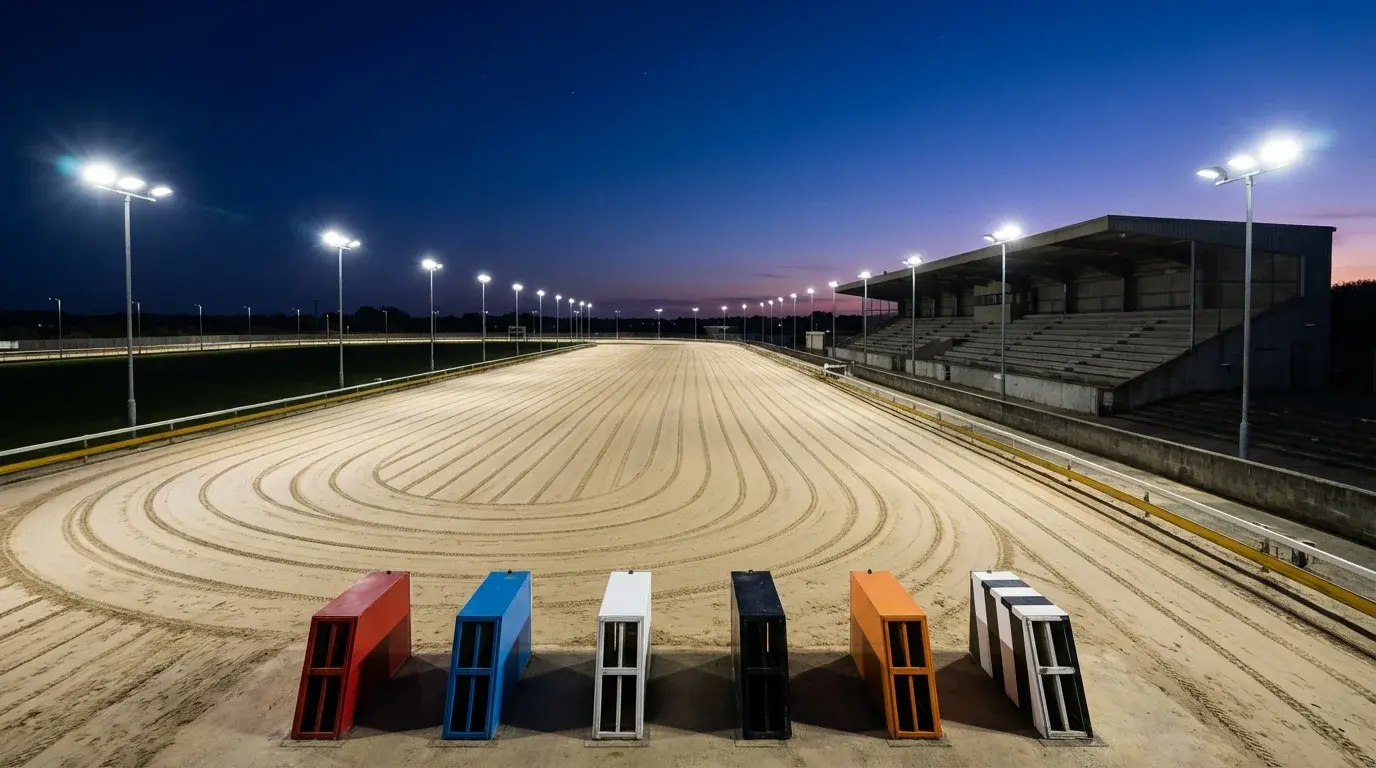
All GBGB-licensed tracks in the UK use sand-based surfaces. The specific composition varies — grain size, moisture retention, and drainage characteristics differ between venues — and these variations affect running times, going conditions, and how the track plays in different weather. A wet sand surface runs slower and heavier, which tends to favour stronger, more powerful dogs at the expense of lighter, speedier types. A dry, well-maintained surface runs fast and rewards early pace. Track maintenance crews water and harrow the surface between races, but conditions can change during a meeting if rain arrives or temperatures shift.
The practical consequence for bettors is that times and form achieved at one track do not transfer directly to another. A dog that runs 29.40 over 480 metres at Romford, where the bends are tight and the circuit is compact, is operating in a different environment from a dog that runs 29.40 at Towcester, where the track is more expansive and the bends are wider. Cross-track comparison requires adjustment — either through experience, through time-comparison methods using track averages, or through rating systems like Timeform that normalise performances across venues. Raw times, compared across different circuits, are misleading.
Major Tracks — Profiles
Each track on the GBGB circuit has a personality — a combination of geometry, surface behaviour, scheduling, and the quality of dogs that race there regularly. Knowing the characteristics of the major venues is not trivia. It is a betting advantage, because track knowledge informs every other part of your analysis: how to interpret times, how to weight the draw, which running styles are favoured, and which form lines carry the most predictive value. What follows is a profile of the five tracks that matter most to UK greyhound betting, plus a summary of the circuit beyond them.
Towcester
Towcester is the most important venue in UK greyhound racing. It sits within Towcester Racecourse in Northamptonshire, where a purpose-built greyhound track was constructed inside the horse racing circuit and opened in December 2014. It is the home of the English Greyhound Derby — the sport’s blue-riband event, run over 500 metres — and hosts a disproportionate share of the major open races on the calendar. Standard racing distances are 260, 480, 500, 655, 686, and 906 metres.
The track’s defining characteristic is space. The circumference is 420 metres, the bends are wide, and the run to the first turn is longer than at most UK tracks. This geometry favours galloping, middle-running dogs with sustained pace rather than the explosive early-speed railers who dominate on tighter circuits. Towcester form is its own category — times and running styles that look moderate at Romford or Monmore can look entirely different on this more expansive layout. The big-screen display on the home straight, introduced when the track opened, also changed the spectator experience and remains unusual at UK greyhound venues.
For bettors, Towcester demands a recalibration. Trap bias is less pronounced than at smaller tracks because the wider bends give outside runners more room. Open races here tend to reward dogs with middle-distance stamina and a proven track record at the venue — familiarity with Towcester’s dimensions is a measurable advantage, and dogs making their first visit to the track often underperform their form from elsewhere.
Romford
Romford is London’s last remaining greyhound stadium, following the closure of Crayford in January 2025. It sits in the London Borough of Havering and is operated by Ladbrokes Coral, with a capacity of over 1,700 and a refurbished grandstand that reopened in 2019 after a ten-million-pound investment. The track is 350 metres in circumference with race distances of 225, 400, 575, 750, and 925 metres. Six race meetings take place each week.
Romford is a speed track. The tight bends and compact circuit put a premium on early pace and clean trapping. Dogs that lead through the first bend at Romford tend to hold their position more often than at wider venues, which gives inside-trap railers with quick break speeds a structural advantage. The sprint distances — 225 and 400 metres — produce fast, attritional racing where fractions of a second separate the field. The longer trips at 575 and 750 metres introduce more tactical variety, but even at these distances, the track’s geometry rewards dogs who can gain position early.
Major events at Romford include the Essex Vase, the Champion Stakes, the Golden Sprint, and the Romford Puppy Cup. The exchange markets tend to carry stronger liquidity here than at most other UK tracks, which makes it one of the better venues for bettors who use Betfair alongside fixed odds.
Nottingham
Nottingham Greyhound Stadium is one of the most respected venues on the circuit, with a long history that includes hosting the English Greyhound Derby when Towcester was temporarily unavailable in 2019 and 2020. Standard distances are 305, 480, 500, 680, and 880 metres. The track stages evening meetings on Monday and Saturday as part of the Premier Greyhound Racing schedule, and additional BAGS meetings fill out the weekly card.
The track’s reputation is built on balance. The circuit geometry is fair — neither as tight as Romford nor as expansive as Towcester — which means it produces reliable form data and relatively little trap bias. Dogs from a range of running styles can win here, and the consistency of the surface and scheduling makes Nottingham form one of the most trustworthy datasets on the circuit. For bettors who focus on graded racing, Nottingham’s Saturday night cards are among the best-analysed meetings of the week.
Brighton and Hove
Brighton and Hove Greyhound Stadium runs evening meetings on Thursday nights as part of the Premier Greyhound Racing schedule, and its open races regularly attract some of the strongest fields outside the Derby. The track races over distances of 285, 515, 695, and 880 metres. Thursday-night cards at Hove are appointment viewing for serious greyhound punters, because the quality of the open racing means the form lines generated here carry weight for weeks afterwards.
The track is known for hosting category one and category two events that serve as preparatory races for the major championship competitions. Dogs who perform well at Hove on Thursday evenings often go on to contest the Derby, St Leger, and other showpiece events. The surface is well maintained and runs consistently, and the slightly wider bends compared to tracks like Romford give middle runners a fairer chance than they would get on a tighter circuit. For bettors, Hove open-race form is premium data — results from Thursday nights at this venue are among the most predictive in UK greyhound racing.
Monmore Green
Monmore Green in Wolverhampton is the Midlands’ flagship greyhound venue, operating since the 1920s and now the longest continuously running track in the region. Race distances are 264, 480, 630, 684, and 835 metres. The track stages evening meetings as part of the Premier Greyhound Racing schedule, with BAGS cards supplementing the weekly programme.
Monmore is a versatile track that produces strong racing across all distance categories. The 480-metre trip is the workhorse distance for graded racing, and Monmore’s A1 graded races over this trip are among the most competitive regularly scheduled events in the country. The track also has a strong staying programme over 835 metres that attracts specialists from across the circuit. Major events include the Gold Cup, the Summer Stayers Classic, and the Ladbrokes Puppy Derby. Trainer form at Monmore tends to be concentrated — a handful of locally based kennels dominate the results, which makes trainer data particularly useful here.
Other Notable Tracks
Owlerton in Sheffield is one of the largest stadiums in the north, with a capacity of 4,000 and a weekly programme that includes BAGS cards and evening meetings. Doncaster stages regular racing and benefits from its central geographic position. Newcastle provides the north-east’s primary greyhound venue, with evening and BAGS racing across distances from 285 to 875 metres.
Central Park in Sittingbourne — also known as Sittingbourne — is one of the venues in the south-east that absorbed racing activity after the closure of Crayford, and it has taken on some of the open-race events that formerly rotated through the London circuit. Harlow, in Essex, runs a full BAGS and evening schedule and is another track that gained dogs and trainers following Crayford’s closure. Kinsley in West Yorkshire provides northern racing with a consistent weekly card.
Dunstall Park Greyhound Stadium in Wolverhampton is the newest addition to the circuit, having opened in September 2025 as a purpose-built replacement for Perry Barr. Constructed within Wolverhampton Racecourse by the Arena Racing Company, it races over distances of 270, 480, 660, 715, and 925 metres. The facility represents the first new GBGB-licensed track in over a decade and was awarded the English Greyhound Oaks shortly after opening. Sunderland, Yarmouth, Swindon, Oxford, Pelaw Grange, and Suffolk Downs round out the active circuit, each with its own character and its own dedicated following.
Favourite Win Rates by Track
One of the most frequently quoted statistics in greyhound betting is the favourite win rate — the percentage of races won by the shortest-priced dog in the market. Across the UK circuit, the industry-wide average for favourite wins in graded racing sits somewhere around 30 to 33 per cent, depending on the year and the methodology used to calculate it. That average, however, conceals significant track-by-track variation that bettors can exploit.
Some tracks produce favourite win rates in the mid-30s. These tend to be the venues with the fairest geometry, the most consistent surfaces, and the deepest grading structures — tracks where the racing manager does a thorough job of matching dogs to races, which allows form to hold and gives the market a reliable basis for pricing. Other tracks produce favourite win rates in the mid-20s, typically because the circuit shape introduces more first-bend interference, the grading is looser, or the conditions are more variable. The difference between a 35 per cent and a 25 per cent favourite win rate is enormous over a season of betting — it is the difference between a venue where form-based selection works and one where the randomness of the first bend overrides analysis.
Open races produce lower favourite win rates than graded racing at every track. This is structural: open races feature the best dogs drawn randomly into traps rather than seeded by running style, which increases the probability of first-bend crowding and form reversals. In open races, the favourite wins closer to 25 per cent of the time, and betting strategies that rely on backing the market leader need to adjust for this reduced strike rate by seeking higher average odds or by being more selective about which open-race favourites to support.
The practical application of favourite win-rate data is in filtering. If you know that a particular track consistently produces favourite win rates above 33 per cent in graded racing, that track is a more favourable environment for form-based backing strategies. If another track’s favourite win rate is consistently below 28 per cent, that venue is either structurally unpredictable or underserved by the market, and you should either approach it with lay strategies or avoid it until your track knowledge improves.
Track-Specific Betting Angles
Every track on the circuit has quirks that produce betting opportunities that most punters who treat all venues as interchangeable never notice. These angles emerge from the interaction between track geometry, distance configuration, surface conditions, and the local dog population, and they are often hidden in plain sight within the form data.
At Romford, the tight bends and short run to the first turn create a measurable inside-trap advantage at sprint distances. Dogs drawn in traps one and two with early pace and a railer seeding win at a higher rate than the statistical baseline, and the effect is strongest over the 400-metre trip. This is not a secret — the market knows it — but the degree to which the market fully prices the advantage varies from race to race. When a railer in trap one has improving form and a fast sectional time, the market sometimes underestimates the compounding effect of draw, style, and pace all pointing in the same direction.
At Towcester, the galloping track and wider bends reduce trap bias but create a different angle: track familiarity. Dogs making their first start at Towcester run measurably slower than dogs who have raced there before, and this effect persists across multiple visits until the dog adjusts to the dimensions. Backing dogs on their Towcester debut — particularly those transferring from tight tracks — carries a quantifiable risk that the form from their previous venue will not translate. Conversely, backing a dog with a strong Towcester record against a debutant at the same grade is an angle the data supports.
At Monmore, the staying distances produce a concentrated pool of specialists. The 835-metre trip attracts dogs with staying form that the market often struggles to price accurately, because the sample sizes are smaller and the competitive references are fewer. A dog with two strong runs over 835 metres at Monmore is holding data that most casual bettors will not have evaluated carefully, and the early prices on staying races at Monmore can offer value that the sprint and middle-distance markets have already squeezed out.
The general principle is straightforward: the more you know about a specific track, the more the data reveals that the market has not fully accounted for. Specialisation pays in greyhound betting. Knowing three tracks well is worth more than knowing eighteen tracks superficially.
The Circuit Beyond the Stadium
The evening cards at the major venues are only part of the UK greyhound racing schedule. BAGS racing — Bookmakers’ Afternoon Greyhound Service — fills the daytime hours with meetings designed primarily to service betting shops and online bookmakers. These meetings run from late morning through the afternoon at tracks across the circuit, and they produce a volume of racing that dwarfs the evening programme.
BAGS meetings are graded in the same way as evening racing, and the results appear in the same databases. But the quality of analysis available is typically lower — fewer specialist tipsters cover the afternoon cards, the racecard data receives less public scrutiny, and the exchange markets carry thinner liquidity. For experienced bettors, this reduced coverage can be an advantage. The market is less efficient on BAGS cards, which means that dogs whose form warrants a shorter price sometimes drift to longer odds because fewer eyes are on the meeting. The trade-off is that the form itself can be less predictable — BAGS fields sometimes include dogs returning from long breaks or switching tracks with limited course form, which introduces uncertainty that evening graded racing largely avoids.
BAGS racing is where the circuit truly earns its reputation as a seven-day-a-week sport. From early morning until evening, there is greyhound racing somewhere in the UK every single day except Christmas. For bettors who are prepared to do the analysis, the afternoon schedule is an untapped resource. For those who prefer the structure and reliability of evening racing at the major tracks, it is background noise. Either way, understanding that it exists — and that it shapes the competitive landscape by keeping dogs fit and producing form data between evening meetings — is part of understanding the circuit as a whole.
