 dogracingtips
Updated October 2026
Licensed
 Available in US
Fast payouts
18+ Only
What Sectional Times Measure
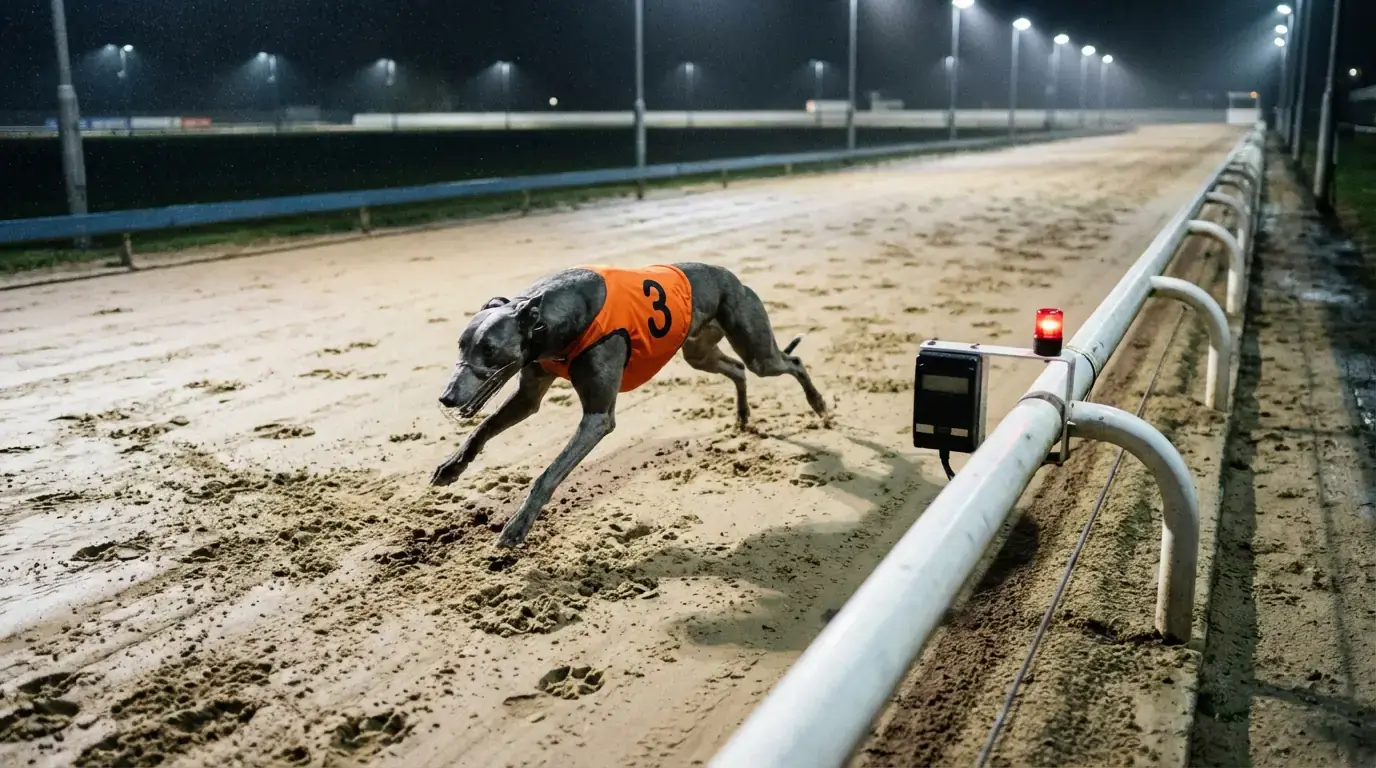
A greyhound’s overall finishing time tells you how fast it completed the race. Sectional times tell you how it ran the race — where it was quick, where it was slow, and how its effort was distributed across the course. That distinction is the difference between a headline and a story.
Sectional times break the total race distance into segments, typically measured at specific points around the track: the run to the first bend, the back straight, the second bend, and the finishing straight. Each segment receives its own time, recorded in hundredths of a second. A dog that clocks 4.72 seconds to the first bend and 17.38 seconds for the middle section has a different performance profile from a dog that records 5.10 and 16.95 over the same segments — even if their overall finishing times are identical.
The first sectional — the time to the first bend — is the most scrutinised number in greyhound race analysis. It identifies early-speed dogs with precision that form comments and running-style labels cannot match. A dog that consistently records fast first-bend splits is a confirmed front-runner, regardless of what its form figures suggest. Conversely, a dog with slow opening splits that produces fast closing sectionals is a confirmed closer — it runs from behind and finishes strongly.
Understanding these profiles is essential for predicting race shape. If you know which dogs are fast early and which are fast late, you can visualise how the race is likely to unfold: who leads at the first bend, who sits in behind, who is likely to be finishing strongest in the final straight. Sectional times convert that visualisation from guesswork into evidence-based projection.
How to Access Sectional Data
Sectional times are not as universally available as overall finishing times, but they are increasingly accessible through the major data providers. Timeform publishes sectional data for many GBGB-licensed meetings, incorporating split times into their racecard analysis and post-race result breakdowns. The Racing Post also carries sectional data, though the depth of coverage varies by track and meeting.
At track level, the timing systems installed at GBGB venues record sectional data automatically. The precision depends on the system in use — most modern UK tracks use electronic timing that captures splits to hundredths of a second, though older installations at smaller venues may be less granular. The data exists for the vast majority of races; the question is how easily you can access it in a usable format.
Some tracks publish sectional times on their own websites or social media channels, particularly for feature meetings and open races. This information is free but can be inconsistent — not every track publishes with the same regularity or in the same format. For a more systematic approach, subscription-based services from data providers like Timeform offer structured sectional databases that allow you to compare splits across races and tracks.
If you are serious about using sectional analysis as part of your betting process, investing time in finding a reliable data source is a prerequisite. The information is out there. It is not always conveniently packaged, and it sometimes requires digging through results pages rather than being presented on the main racecard. But the edge it provides — knowing not just how fast a dog ran, but how it ran — repays the effort many times over.
Speed Ratings vs Raw Times
Raw times and speed ratings serve different purposes, and confusing them is a common error. A raw sectional time is exactly what it sounds like — the number of seconds a dog took to complete a segment of the track. It is objective, precise, and entirely dependent on the conditions under which it was recorded. A raw time of 16.80 seconds over the back straight at Romford on a dry Tuesday evening is not the same performance as 16.80 seconds at Romford on a wet Saturday — the track surface, weather, and even the lure speed can differ.
Speed ratings attempt to standardise performance by adjusting raw times for these variables. Timeform’s speed ratings, for example, account for the going, the track, and the race grade to produce a figure that represents the quality of a performance rather than the raw clock. A Timeform rating of 85 at Romford and a Timeform rating of 85 at Towcester are supposed to represent equivalent levels of performance, even though the raw times at those tracks will be completely different because of their different distances and configurations.
For practical betting purposes, speed ratings are more useful than raw times when comparing dogs across different tracks or over different distances. Raw times are more useful when comparing dogs at the same track over the same distance — the most common scenario in graded racing, where the six runners in a race have usually been competing over the same course recently. In that context, the dog that has been clocking faster raw sectionals over the same segments of the same track is, by definition, running faster than its rivals.
The ideal approach uses both. Speed ratings provide the broad comparison — is this dog competitive at this level? Raw sectional times provide the fine detail — is this dog faster to the first bend than its rivals in tonight’s race? Ratings tell you about class. Sectionals tell you about mechanics. Both layers contribute to a more complete assessment than either one alone.
One caution: do not treat speed ratings as infallible. Every rating system involves assumptions and adjustments that may not perfectly capture real-world conditions. A rating is a useful tool, not an oracle. Use it to filter and rank, then apply your own judgement to the specifics of the race in front of you.
Using Sectionals to Compare Dogs Across Tracks
Comparing dogs across tracks is one of the hardest problems in greyhound betting, and sectional times — when properly adjusted — are the best tool available for solving it. The challenge is that every UK track is different: different circumferences, different bend radii, different straight lengths, different surfaces. A dog’s raw time at Monmore tells you nothing about how it would perform at Hove unless you have a way to translate between the two.
Speed ratings, as discussed above, are the primary translation mechanism. But sectional times add a layer that overall ratings miss. A dog with a fast first-bend split at a sharp track like Romford may not replicate that early speed at a galloping track like Towcester, where the first bend is further from the traps and the running geometry is entirely different. By examining the sectional profile — not just the total figure — you can assess whether a dog’s strengths are likely to transfer to a different venue.
Dogs that show strong closing sectionals — fast times over the final straight — tend to transfer more reliably between tracks than dogs that depend on a quick break from the traps. Closing speed is less track-dependent because finishing straights, while varying in length, all reward the same attribute: the ability to sustain pace. Early speed, by contrast, is heavily influenced by the distance from the traps to the first bend and the tightness of that bend, both of which differ significantly across the UK circuit.
When evaluating a dog that is racing at a new track — after a transfer, for instance, or in a feature event — look at its sectional profile rather than its overall time. Ask whether the segments where it excels match the segments where the new track rewards speed. A front-runner with blistering early splits moving to a track with a long run to the first bend may find its advantage diluted. A strong closer moving to a track with a long finishing straight may find the opposite. The sectionals give you the diagnostic information to make that judgement.
The Clock Doesn’t Lie
The clock doesn’t lie, but it doesn’t tell the whole truth either. Sectional times are among the most objective pieces of data in greyhound racing — they are measured electronically, they are not subject to interpretation, and they describe what actually happened on the track. In a sport where so much analysis involves subjective judgement, that objectivity is valuable.
But times exist in context. A fast sectional recorded in a race where the dog had a clear, unimpeded run may not be repeatable in a race where it faces crowding at the first bend. A slow closing split may reflect a dog that was tiring, or it may reflect a dog that had already built an unassailable lead and was easing down. The numbers are facts. The interpretation requires knowledge of the circumstances.
Used with that awareness, sectional times are one of the sharpest analytical tools in greyhound betting. They reveal the mechanics of a dog’s performance in a way that form figures and overall times cannot. They identify early-speed dogs, closers, and dogs that distribute their effort unevenly. They enable meaningful comparisons between runners at the same track and, with appropriate adjustment, between runners at different tracks. Learn to read them, learn where to find them, and they will consistently give you information that the majority of the betting public does not bother to access.
