 dogracingtips
Updated October 2026
Licensed
 Available in US
Fast payouts
18+ Only
What Running Style Actually Means
A greyhound’s style is hardwired. It doesn’t change between races, it doesn’t adjust based on the draw, and no amount of training will turn a railer into a wide runner. Understanding this is fundamental to reading any greyhound race, because style determines the path each dog will take from the moment the traps open to the moment it crosses the line — or doesn’t.
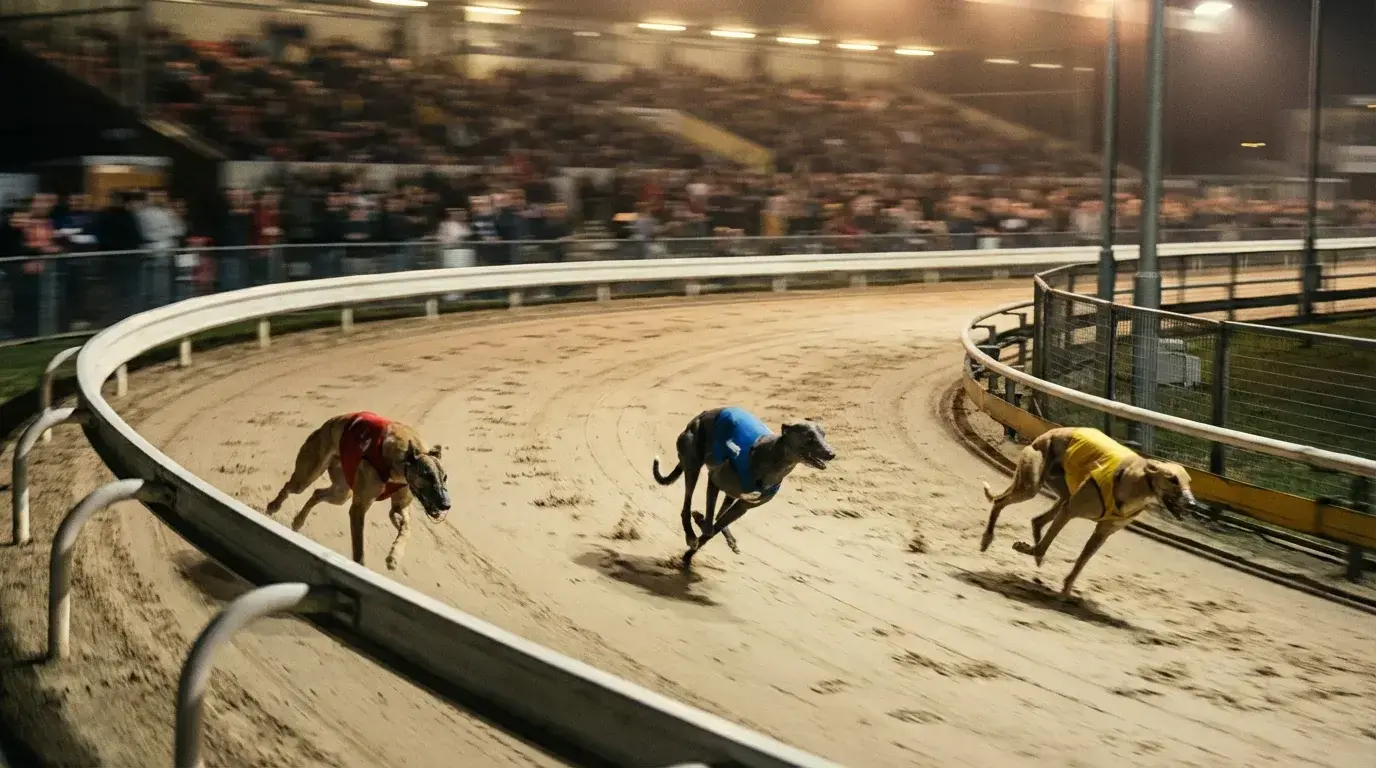
There are three recognised running styles in UK greyhound racing. A railer is a dog that hugs the inside rail, taking the shortest route around the track. A wide runner gravitates to the outside, covering more ground but typically running in cleaner air with fewer obstacles. A middle runner sits between the two, neither clinging to the rail nor swinging wide, occupying the central portion of the track.
These styles are not chosen by the dog in the way a jockey might choose a racing line. They are behavioural tendencies, established during early training and trialling, that reflect how each greyhound instinctively responds to the mechanical lure and the track environment. A railer is drawn to the rail the way a sheepdog is drawn to the flock — it is in the dog’s wiring. Trainers can identify a dog’s style within its first few trial runs, and once classified, the designation rarely changes throughout a racing career.
For bettors, the implication is direct: you are not assessing whether a dog will run the rail tonight. You are assessing whether the conditions of tonight’s race suit a dog that always runs the rail. The style is fixed. Everything else — trap draw, competition, distance — is variable.
How Running Styles Are Marked on the Racecard
Three letters. Three entirely different approaches to the track. On a standard UK greyhound racecard, running style is indicated by a single lowercase letter in parentheses after the dog’s name: (r) for railer, (m) for middle runner, and (w) for wide runner. Some sources abbreviate differently — you may see Rls, Mid, or Wd — but the meaning is identical.
The classification is assigned by the track’s racing manager based on how the dog has performed in trials and early races. It is not a rigid scientific measurement; it is an informed judgement. Occasionally a dog’s designation may be updated if its behaviour changes consistently over several outings, but this is rare. For practical purposes, if the racecard says a dog is a railer, treat it as a railer.
Not every card makes the style designation equally visible. Printed racecards at the track itself tend to include the notation clearly. Online platforms like the Racing Post and Timeform display it as part of the detailed racecard view, though you may need to expand each runner’s profile to see it. Betting apps from major bookmakers vary — some show running style prominently, others bury it in secondary data. Before placing a bet, make sure you know each dog’s style. If the platform you are using doesn’t display it, find one that does.
One additional point: some commentators and racecard analysts will describe a dog as “rails to middle” or “middle to wide.” These hybrid descriptions indicate a dog that doesn’t fit neatly into one category. A rails-to-middle dog might hug the rail on the straights but drift slightly wider on the bends. These nuances are worth noting, particularly in tight races where half a length of positional adjustment can be the difference between a clear run and a baulked one.
Running Style and Trap Draw Interaction
A sole wide runner in trap 6 is the closest thing to a systematic edge in greyhound racing. That is not an exaggeration — it is a pattern borne out across thousands of races at dozens of tracks. When the trap draw aligns perfectly with a dog’s running style and no other dog in the field shares that line, the result is a clear, unimpeded run. In a sport where interference decides as many races as ability, a clear run is an enormous advantage.
The interaction between style and draw works in both directions. A railer drawn in trap 1 has the shortest route and the inside rail to itself, provided no other railers are drawn alongside it. A wide runner in trap 6 can sweep around the outside without contesting space. These are the ideal scenarios, and they occur regularly enough in graded racing — where the seeding system tries to match style to trap — that you should always check for them.
The problems arise when the alignment breaks down. A railer in trap 4 faces a dilemma it cannot consciously resolve: it will instinctively cut inward towards the rail, across the paths of dogs in traps 1, 2, and 3. If those dogs are also railers, the first bend becomes a collision point. A wide runner in trap 2 will drift outward, potentially impeding a middle runner in trap 3 or a wide runner in trap 4. These cross-path scenarios are the leading cause of trouble in running, and they are entirely predictable from the racecard.
The sole-seeded-runner pattern deserves special attention. When you see five railers and one wide runner, or five wides and middles with a single railer, you have a structural imbalance. The sole-seeded dog is almost certainly going to have a cleaner run than anything else in the field. Check its form, check its times, and if both are reasonable, consider it seriously regardless of its odds. These situations are the closest greyhound racing comes to offering a repeatable edge — not a guaranteed winner, but a dog running in conditions that systematically favour it.
The flip side is the dog with style and draw in direct conflict. A railer drawn wide in an open race, where the draw is randomised, faces a race-long disadvantage. It will expend energy cutting across the track, arrive at the rail later than it would from a low trap, and risk interference on the way. Unless the form is overwhelmingly superior, these dogs represent poor betting propositions.
Crowding, Baulking, and Style Clashes
Three railers in traps 1, 2, and 3 — that’s not a race, it’s a traffic jam. When multiple dogs with the same running style are drawn next to each other, the first bend becomes congested. All three dogs want the same piece of track, and the laws of physics dictate that only one can have it. The result is crowding: dogs bumping shoulders, checking their stride, losing momentum, and sometimes being knocked off balance entirely.
Baulking — where one dog’s path is blocked by another — is the most common form of trouble in running, and it is overwhelmingly caused by style clashes at the first bend. A dog that is baulked loses between one and three lengths in a fraction of a second. In a race that covers 480 metres in under thirty seconds, that deficit is often irrecoverable. The dog may have been the fastest in the field on raw times, but the baulk removed it from contention before the race was halfway done.
You can predict these scenarios by reading the racecard carefully. Count the number of railers, middles, and wides in the field. If the distribution is heavily skewed — four railers, one middle, one wide — then the inside of the track is going to be crowded and the wide runner will likely get a free run. If there are three wides drawn in traps 4, 5, and 6, the outside becomes the congested area and the railer in trap 1 benefits.
Experienced bettors often describe this process as “drawing the race” — mentally visualising how the six dogs will move from the traps through the first bend. It sounds abstract, but it becomes intuitive with practice. After watching a few hundred greyhound races, you start to see the trouble before it happens. The racecard gives you the information. Your job is to simulate the first five seconds of the race in your head and decide which dog emerges from the bend in front with the clearest path forward.
Style Is the Dog’s Blueprint
You don’t bet on a running style. You bet on a running style in the right trap, in the right race, against the right opposition. Style is a filter, not a signal. It tells you how a dog will behave, not whether it will win.
The practical application is to use running style as the first layer of analysis after checking the trap draw. Once you know which dogs are well drawn for their style, you can move on to form, times, class, and trainer with a shorter list of realistic contenders. A dog with strong form but a style-draw mismatch is a risky bet. A dog with moderate form but a perfect style-draw alignment — especially if it is the sole-seeded runner on its line — is worth a closer look than its odds might suggest.
Running style is the one variable in greyhound racing that never changes. Form fluctuates, fitness varies, class shifts with promotion and demotion. But a railer is always a railer, and a wide runner always runs wide. That consistency is what makes it so valuable as an analytical tool. It is the fixed point in a sport full of moving parts — and once you learn to read it, you will never look at a racecard the same way again.
