 dogracingtips
Updated October 2026
Licensed
 Available in US
Fast payouts
18+ Only
How Tote and Pool Betting Works
Tote betting — also known as pool betting or pari-mutuel — operates on a fundamentally different principle from fixed-odds bookmaker betting. When you place a fixed-odds bet, you agree to a specific price at the moment of your wager, and that price determines your return if you win. When you place a tote bet, your stake goes into a communal pool along with every other bet on that race. The total pool is then divided among the winning bettors after a deduction for the operator’s commission. Your return depends not on a pre-agreed price but on how much money was bet overall and how many other people backed the same outcome.
The commission — known as the takeout — varies by pool type and operator but can be as high as 34 per cent of the total pool on UK greyhound tote bets, with some venues and special events offering lower deductions. After the takeout is deducted, the remainder is shared proportionally among winning tickets. If you hold the only winning ticket, you receive the entire net pool. If ten people backed the same winner, the net pool is divided ten ways. The dividend — the payout per unit staked — is declared after the race and published alongside the result.
This structure means the tote dividend is unknown until after the race. You are betting into a pool whose final size and composition are determined by the collective behaviour of every other bettor. A dog that attracts heavy tote support will produce a lower dividend because the pool is split among more winners. A dog that attracts little support will produce a higher dividend for the same reason. The crowd, not the bookmaker, sets the effective price.
For greyhound bettors, the tote represents an alternative to the fixed-odds market — one with different strengths, different risks, and different situations where it offers the better deal.
UK Greyhound Tote Markets
The UK greyhound tote offers several standard pool types. The win pool is the simplest: you select the winner. The place pool asks you to select a dog to finish in the first two. The forecast pool requires first and second in the correct order, and the tricast pool requires the first three in order — mirroring the fixed-odds forecast and tricast markets but with pool-based dividends. Details of available greyhound pools and deduction rates are published by the pool operators.
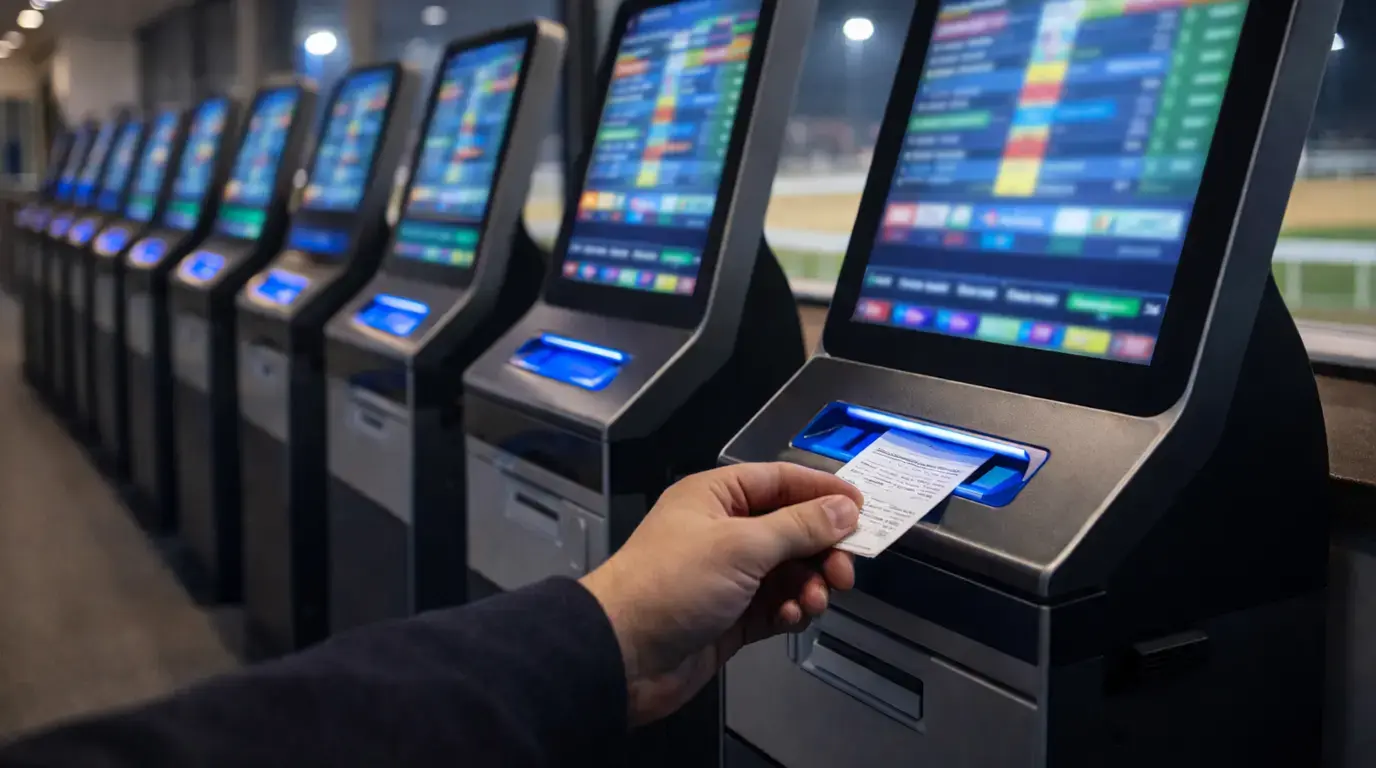
Tote betting on greyhounds is available at the track itself, through on-course tote windows and self-service terminals, and online via the Tote website and app. Some bookmakers also offer access to tote pools as part of their greyhound betting product, integrating the pool markets alongside their own fixed-odds prices. Availability varies by meeting — larger evening fixtures at major tracks tend to attract deeper tote pools than smaller daytime BAGS cards.
The depth of the pool matters. A tote pool with a few hundred pounds in it can produce volatile dividends that swing dramatically based on a single large bet placed late in the market. A pool with several thousand pounds is more stable and produces dividends that better reflect the collective assessment of the field. On a quiet BAGS afternoon, the greyhound tote pool may be too thin to produce reliable dividends. On a busy Saturday evening at a major track, the pools are deep enough to function as a genuine alternative to fixed odds.
One mechanical difference from fixed-odds betting: tote bets are placed without a confirmed price. You hand over your stake knowing only that the return will be determined after the race. This absence of a pre-agreed price makes the tote uncomfortable for bettors accustomed to knowing their return in advance. It also creates the conditions for value — because the dividend is set by the crowd, not by a bookmaker’s pricing model, there are times when the crowd undervalues a dog and the tote pays more than the fixed-odds market.
Jackpot and Accumulator Pools
Beyond the standard win, place, and forecast pools, greyhound tote betting includes accumulator-style pools that offer the chance of substantial payouts from a small stake. The most prominent is the jackpot pool — sometimes called the Scoop6 or a similar brand name depending on the operator — which typically requires selecting the winner of six consecutive races at a designated meeting.
The jackpot pool works like a progressive lottery. If nobody correctly picks all six winners, the pool rolls over to the next qualifying meeting, growing larger each time. When a rollover accumulates across several meetings, the pool can reach figures that dwarf anything available from a standard single-race bet. The appeal is obvious: a one-pound or two-pound entry stake with a potential five-figure return. The probability of success, equally obviously, is very low.
Placepot pools offer a slightly more achievable target. Instead of picking the winner of each race, you need a placed dog — first or second — in each leg. The wider qualifying criteria produce more winning tickets and smaller dividends, but the hit rate is substantially better than the jackpot. Placepots reward consistent form reading and the ability to identify dogs that will be competitive without necessarily needing them to win.
Multi-race pools are entertainment products. They are not strategies for regular profit. The takeout percentages are typically higher than single-race pools, the variance is extreme, and the probability of landing all six legs is very low. Treat them as what they are — a small-stake punt with a disproportionate potential reward — and allocate a fixed, minimal portion of your session budget to them. If you hit one, it is a bonus. If you don’t, and you won’t most of the time, the cost should be trivial relative to your overall bankroll.
When Tote Pays More Than Fixed Odds
The tote pays more than fixed odds when the betting public underestimates a dog’s chance. This happens more often than you might expect, because the tote pool reflects the collective behaviour of all bettors — including casual punters who back favourites without analysing the race, regular tote users with fixed habits, and latecomers who follow the crowd. When the crowd piles onto one or two dogs, the remaining runners receive a disproportionately small share of the pool. If one of those overlooked dogs wins, the tote dividend can significantly exceed the fixed-odds starting price.
The pattern is most pronounced in races with a dominant favourite. When a short-priced favourite attracts 40 or 50 per cent of the tote pool, the remaining five dogs share the other half. If a 6/1 outsider wins, its share of the thinly spread pool can produce a tote dividend equivalent to 8/1 or 9/1 — well above the bookmaker’s fixed price. In this scenario, the tote bettor receives better value for the same selection than the fixed-odds bettor.
Conversely, the tote pays less when the winning dog is heavily backed in the pool. A popular favourite that wins will produce a tote dividend that is often lower than the fixed-odds SP, because the pool is crowded with winning tickets and the payout per ticket is diluted. Backing favourites on the tote is almost always a losing proposition compared to backing them at fixed odds, because the takeout commission eats into a dividend that is already compressed by heavy support.
The strategic lesson is clear: use the tote when you are backing an unfancied runner. If your analysis points to a dog that the public is overlooking — a mid-priced or longer-priced selection that you believe has a better chance than the market reflects — the tote pool may offer a better return than the bookmaker. If you are backing the favourite, stick to fixed odds, where your price is locked in and not subject to pool dilution.
The Crowd Sets the Price
The crowd sets the price — and the crowd is not always right. That is the fundamental attraction of tote betting for the analytical bettor. In a fixed-odds market, the bookmaker sets the price using a combination of form analysis, market management, and liability control. The bookmaker is a professional pricer. In a tote pool, the price is set by the aggregate betting behaviour of the public, and the public is not a professional pricer. It is a collection of individuals with varying levels of knowledge, varying motivations, and a well-documented tendency to overvalue favourites and undervalue outsiders.
This collective behaviour creates systematic pricing inefficiencies that do not exist in the same way in fixed-odds markets. The favourite-longshot bias — where favourites are marginally overpriced and outsiders are marginally underpriced in fixed-odds markets — is reversed in tote pools: favourites receive too much of the money, which compresses their dividend, while outsiders receive too little, which inflates theirs. For a bettor who specialises in identifying undervalued mid-range and longer-priced dogs, the tote is a natural home.
Tote betting is not for everyone. The absence of a pre-race price, the commission deduction, and the dependence on pool depth make it a less straightforward product than fixed odds. But for the bettor who understands its mechanics and uses it selectively — targeting unfancied dogs in deep pools at major meetings — the tote is another edge in a sport where edges are built from accumulated small advantages. The crowd sets the price. Your job is to bet when the crowd has set it wrong.
