 dogracingtips
Updated October 2026
Licensed
 Available in US
Fast payouts
18+ Only
Track Profile — Romford at a Glance
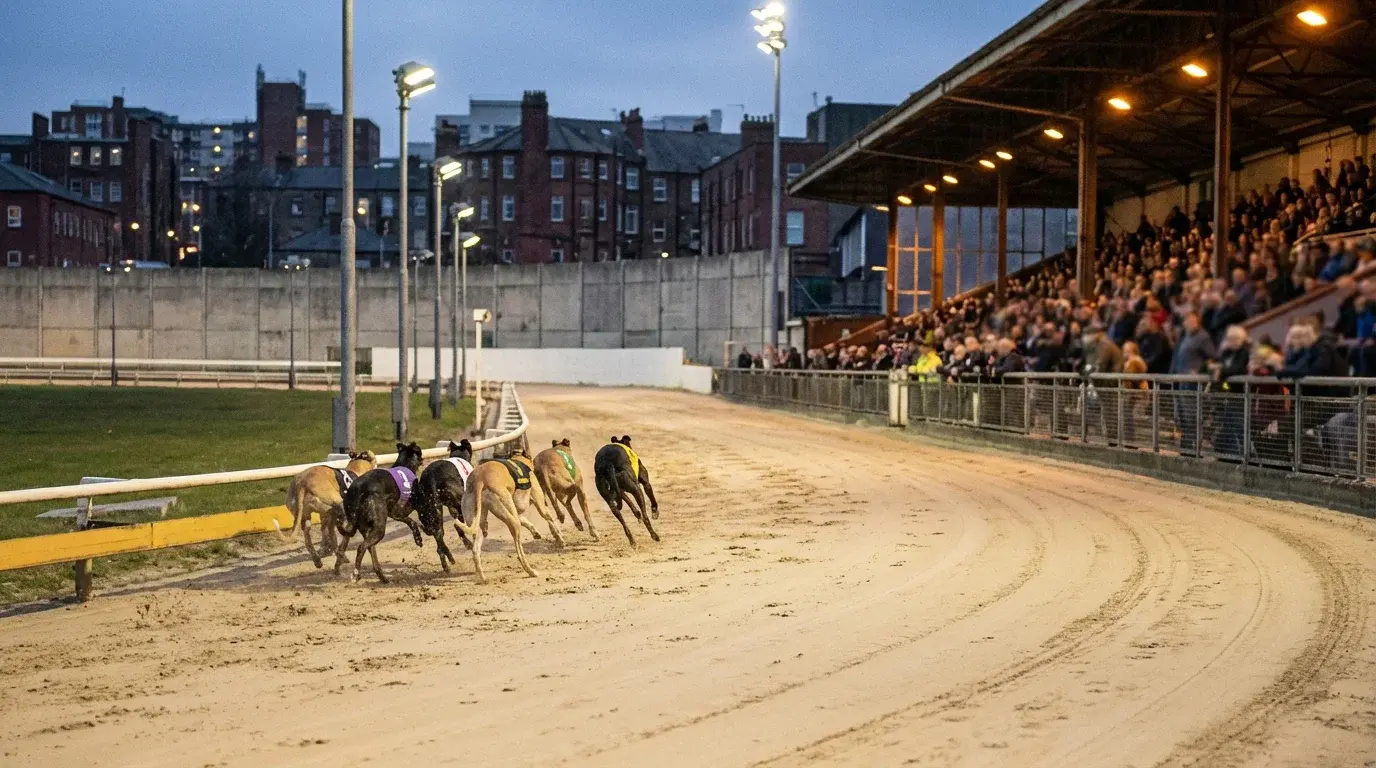
Romford is one of the busiest greyhound tracks in the UK, staging regular evening and afternoon fixtures throughout the year. Located in east London, the stadium has been a fixture of British greyhound racing for decades and draws a large betting audience both on-course and online. For bettors looking to specialise at a single venue, Romford offers the volume and data depth to make that specialisation worthwhile.
The track is a tight, sharp circuit — one of the smallest circumferences on the GBGB calendar, at 350 metres. The bends are sharp rather than sweeping, which means dogs are changing direction aggressively and the inside rail carries a significant positional advantage. A dog on the rail through the bends covers less ground and maintains more momentum than a dog running wide. This geometry shapes everything about how races at Romford unfold, from the trap draw to the running style that suits the track.
Romford’s sand-based surface is well maintained and generally produces consistent times across a card, barring significant weather changes. The track drains reasonably well, though heavy persistent rain can soften the surface and slow times, as at any UK venue. Evening meetings under floodlights are the main product, but Romford also hosts BAGS fixtures during the afternoon, providing daytime racing for the betting-shop market.
The standard of racing ranges from D-grade on the afternoon cards to open races on feature evenings. The breadth of the programme means that whatever level of racing you prefer to bet on — competitive lower grades, mid-range B and C class, or the strongest evening fields — Romford has a card that fits.
Distances and Race Types
Romford’s primary distances are 225, 400, and 575 metres. The 400-metre trip is the standard distance for the majority of graded races and carries the highest volume of data for form analysis. The 225 is a pure sprint — a blast from the traps to the line with minimal bending — that places enormous emphasis on early speed and trap position. The 575 is the staying distance, adding an extra circuit and testing stamina alongside speed.
The 225-metre sprint is Romford’s most distinctive race type. The short distance compresses everything into a handful of seconds: a fast break, a sharp first bend, and a short finishing straight. There is almost no time for a dog to recover from a slow start or a poor first-bend position. The trap draw is decisive — dogs in low traps with rail-seeking tendencies have a structural advantage because the sprint distance gives wide runners almost no opportunity to use their wider arc to make up ground.
The 400-metre trip is the standard graded-race distance and the one most bettors will encounter regularly. Races over this distance feature the full range of running styles and tactical dynamics: early speed matters at the first bend, but there is enough distance for closers to make up ground on the back straight and finishing straight. The 400 at Romford is fast and sharp — typical winning times for competitive graded races sit around 24 to 25 seconds, reflecting the tight circumference and the short straights.
The 575-metre distance adds a stamina element that changes the analysis. Dogs that fade over 400 metres may thrive over 575 if their issue is a lack of early speed rather than a lack of overall ability. Conversely, dogs whose form is built on fast trap breaks may not sustain their advantage over the longer trip. When assessing form at Romford, always check which distance the previous runs were over — a dog’s 400-metre form does not automatically translate to 575, and vice versa.
Trap Stats and Bias Data
Romford’s tight track geometry produces a measurable inside-rail bias. Over large sample sizes, traps 1 and 2 outperform traps 5 and 6 in terms of win percentage. The effect is most pronounced in sprint races over 225 metres, where the short run to the first bend gives low-drawn railers an immediate positional advantage that the outside dogs rarely overcome. Over the standard 400-metre trip, the bias is still present but less dominant — enough distance exists for wide runners with good early speed to compensate for the wider arc.
The seeded draw in graded racing places railers in low traps and wide runners in high traps, which partially aligns running style with the track’s bias. However, the alignment is not perfect. When a race contains more railers than there are low traps available, some rail-seeking dogs end up drawn in traps 3 or 4 — positions that force them to cross the path of dogs drawn inside them. These cross-path scenarios increase the risk of first-bend crowding and are a common source of form reversals at Romford.
Open races, where the draw is random, amplify the trap bias considerably. A railer drawn in trap 6 at Romford is at a genuine disadvantage that the dog may not be able to overcome, regardless of its overall quality. Conversely, a wide runner that lucks into trap 1 may find itself on the rail for the first time, which can either benefit it — if it adapts — or hinder it if it naturally drifts away from the rail and loses ground.
Use Romford’s trap data as a first filter, not a final verdict. Check whether each dog’s running style matches its drawn position. If the match is good — railer in 1, wide runner in 6 — the form is likely to hold. If the match is poor, discount the dog’s chance accordingly, even if the recent form looks strong. At Romford more than at most tracks, the draw is destiny for a significant percentage of races.
Seasonal variation also affects Romford’s bias. In winter, when the surface tends to be heavier and rain more frequent, the inside rail can hold water and slow down, temporarily reducing the inside advantage. Check conditions on the night rather than relying solely on annual bias statistics.
Betting Angles for Romford
The strongest betting angle at Romford is early speed in low traps. A dog with fast sectional splits to the first bend, drawn in trap 1 or 2, with a railer’s running style, is ticking every box that the track rewards. These dogs do not always win — greyhound racing is never that simple — but the structural alignment is as favourable as it gets at this venue. When the form also supports the selection, you have a high-conviction bet.
Forecast betting suits Romford well, particularly over the 400-metre distance. The tight bends compress the field, and the inside bias means that dogs on the rail tend to occupy the front positions at the first bend. If you can identify the likely first-bend leader and a consistent placer running on a non-conflicting line, the forecast combination has a solid structural foundation. Pairing a low-trap railer with a wide runner in trap 5 or 6 is a classic Romford forecast structure — two dogs on different lines, each with a clear path, unlikely to interfere with each other.
Lay betting on wide runners in sprint races is another Romford-specific angle. A dog drawn in trap 5 or 6 for a 225-metre sprint, regardless of its overall form, faces a structural headwind that the short distance does not give it time to overcome. If the market prices such a dog at short odds based on its recent form at other distances or other tracks, the lay side offers value. The form may be genuine, but the track and distance combination negates much of the dog’s ability.
For staying races over 575 metres, shift your focus from trap draw to stamina profile. The longer distance gives wide runners more time to find their stride, and dogs that close strongly over the final straight gain an advantage that the track’s tight geometry would deny them over 400 metres. Check the dog’s finishing sectionals — strong closing splits at any track suggest a staying ability that Romford’s 575 will reward.
Speed Rules at Romford
Speed rules at Romford. The track’s tight geometry, short straights, and sharp bends all favour the dog that reaches the first bend first and holds the rail through the turns. Early speed is the dominant performance characteristic at this venue, more so than at larger, more galloping circuits where dogs can make up ground on the long straights.
If you are going to specialise at one track — and specialisation is the most reliable path to profitable greyhound betting — Romford offers everything you need: frequent fixtures, deep data, and a clear set of principles that reward disciplined analysis. Learn the trap bias. Study the sprint form. Identify the front-runners. Match running style to draw. Apply those filters consistently, and Romford becomes a track where your homework translates directly into better selections.
The volume of racing at Romford means opportunities appear on almost every card. You do not need to bet on every race to profit. Wait for the races where the form, the draw, and the speed profile align in your favour, and leave the rest alone. At a venue that rewards speed and structure as clearly as Romford does, the patient bettor with the right framework will always find an edge.
