 dogracingtips
Updated October 2026
Licensed
 Available in US
Fast payouts
18+ Only
Track Profile — Nottingham at a Glance
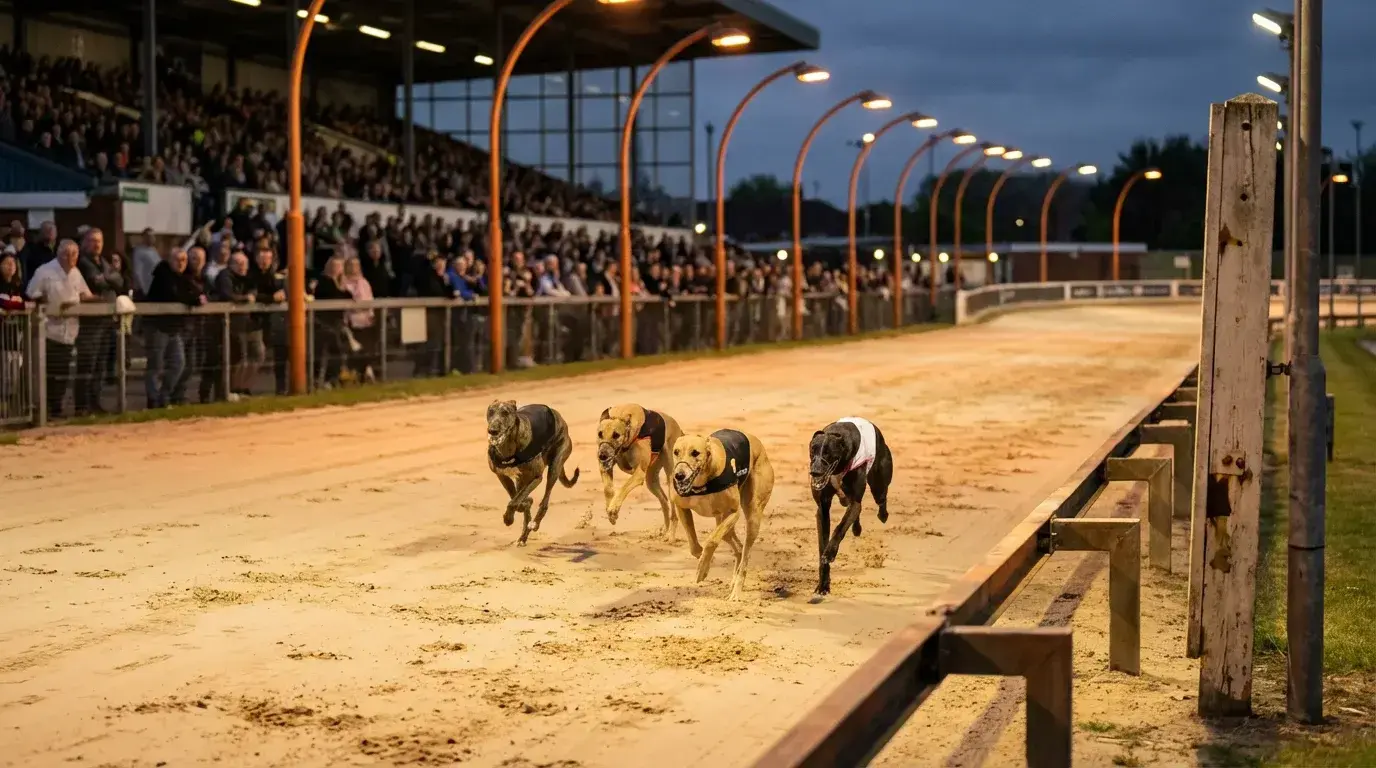
Nottingham is a mid-sized track in the East Midlands that offers a balanced racing experience — neither as tight as Romford nor as expansive as Towcester. The circuit sits comfortably in the middle of the UK track spectrum, with bends that are firm but not brutally sharp and straights that offer enough room for closers to make late ground without being so long that the front-runners are routinely caught.
The track has a strong local following and a stable racing programme that produces consistent fixtures throughout the year. For bettors, consistency is Nottingham’s greatest asset. The surface is well maintained, the racing quality is solid across the grade range, and the form at the venue tends to be reliable — dogs that run well at Nottingham usually run well at Nottingham again, provided the grade and distance are similar. This reliability makes the track one of the better venues for systematic, form-based betting.
Nottingham’s location in the Midlands places it within reach of several major training centres, meaning the quality of entries is generally good. The track attracts competitive fields across its grading structure, from the lower C and D categories through to B and A class racing on its stronger evenings. Feature events appear regularly on the calendar, and the track occasionally hosts rounds of national competitions that bring visitors from other venues.
The stadium facilities have been modernised in recent years, and the track benefits from good floodlighting for its evening cards, reliable timing systems for sectional data, and a solid online presence through the major data providers. Racecards and results are readily available through the Racing Post, Timeform, and bookmaker platforms, giving bettors comprehensive information for pre-race analysis.
Meeting Schedule and Race Types
Nottingham stages regular evening meetings throughout the week, supplemented by afternoon BAGS fixtures on selected days. The evening cards are the primary product, typically featuring ten to twelve races across a range of grades and distances. BAGS meetings offer additional betting opportunities during the afternoon but tend to attract lower-grade fields with less depth of form.
The standard graded-race distance at Nottingham is 480 metres, which is the most common trip on the card and carries the highest volume of historical form data. Sprint races over a shorter distance provide a change of pace and a test of pure early speed, while staying races over a longer trip appear periodically and attract dogs with proven stamina. The 480-metre distance is the one to focus on if you are building expertise at the venue — it is where the most data exists and where the form is most predictable.
Graded racing forms the backbone of the schedule. The grading system at Nottingham follows the standard GBGB framework, with the racing manager adjusting grades based on recent performances at the track. Promotions and demotions happen on a weekly basis, creating the same churn of opportunities that exists at every UK venue — dogs dropping in grade after struggling at a higher level, dogs moving up after consecutive wins, and dogs transferring from other tracks being regraded for Nottingham.
Open races and feature events appear on selected evenings, particularly around major dates on the greyhound calendar. These events draw visiting runners and produce competitive fields where the form from other tracks must be weighed against the specific demands of Nottingham’s circuit. For the regular Nottingham bettor, these feature nights are both the most challenging and the most rewarding cards of the month.
Trap Stats and Form Trends
Trap bias at Nottingham is moderate. The track’s mid-range circumference produces a first-bend dynamic that is less extreme than at a tight track like Romford but more pronounced than at a galloping circuit like Towcester. Low traps carry a modest advantage — trap 1 typically posts a higher win percentage than trap 6 over large samples — but the gap is not so wide that the draw alone determines the result. Dogs in any trap can win at Nottingham if they have the form and the running style to support their position.
The bias data is most useful in combination with running-style information. A railer in trap 1 at Nottingham has a clear structural advantage — it is on its preferred line from the moment the traps open. A railer in trap 4, however, faces the task of cutting across to the rail before the first bend, which may bring it into conflict with the dogs inside. The seeded draw in graded racing usually prevents extreme mismatches, but races with an imbalanced style mix — too many railers, not enough wide runners — can produce first-bend crowding that the bias statistics alone do not predict.
Form trends at Nottingham reward consistency. Because the track is mid-sized and the surface is well maintained, dogs that perform at a certain level tend to reproduce that level over multiple runs. A dog whose last three finishing positions at Nottingham are 2-1-2 is very likely to be competitive again tonight. A dog with erratic form — 1-5-2-6 — is harder to trust, and the erratic pattern is often a sign of either an inconsistent runner or a dog being placed in races where it does not fit.
Sectional data at Nottingham is available through the standard providers and is worth consulting, particularly for the first-bend split. Dogs with fast opening sectionals have a consistent edge at this venue because the run to the first bend is not long enough for slow starters to recover comfortably. The back-straight and closing sectionals are useful for identifying closers that may be able to make up ground in the run-in, but the first-bend time remains the single most predictive sectional for Nottingham races.
Grade-change patterns are a productive area of focus. Dogs dropping down a grade at Nottingham after two or three below-par runs often bounce back, particularly if the recent poor form was caused by a bad draw or first-bend trouble rather than a genuine decline in ability. Checking the race comments alongside the finishing positions — something Timeform and the Racing Post both provide — separates the dogs that were unlucky from the ones that were simply beaten on merit.
Betting Angles for Nottingham
The best betting angle at Nottingham is backing consistent dogs at the right grade. The track’s reliable surface and moderate geometry mean that form holds true more often than at venues where extreme trap biases or volatile conditions introduce additional randomness. A dog in the right grade, with recent form that shows competitive finishes and stable weights, is a stronger proposition at Nottingham than at a track where external factors can override the form.
Grade-droppers are a particularly strong play. When a dog drops from B2 to B3 after a couple of narrow defeats at the higher level, the racecard may show form of 3-4 — uninspiring at first glance. But if those two runs were at a harder grade, the drop puts the dog back among opposition it has already proven it can beat. These dogs are frequently underpriced because the casual bettor sees the recent losing form without adjusting for the grade context. At Nottingham, where the grading is applied consistently and the competition at each level is predictable, grade-droppers with competitive recent form are a systematic value source.
Forecast betting works well at Nottingham for mid-grade races where the fields are evenly matched. B and C grade races at this venue often contain three or four dogs that could realistically fill the first two places, with one or two weaker runners that can be eliminated on form or draw grounds. Narrowing to three contenders and building a combination forecast on that trio is an efficient approach — the cost is manageable, and Nottingham’s predictable form patterns make the top two more identifiable than at more volatile venues.
Avoid over-reliance on the draw at Nottingham. While trap 1 has a statistical edge, the advantage is not large enough to override strong form from a higher trap. A dog with three consecutive wins from trap 4 is a better bet than an inconsistent dog drawn in trap 1 with mediocre form. At this venue, form outweighs draw more often than the reverse.
Consistency Defines Nottingham
Consistency defines Nottingham — in the track’s surface, in its grading, and in the form of the dogs that race there. It is not the most glamorous venue on the circuit. It does not host the Derby or attract the same national attention as the bigger southern tracks. What it offers instead is a reliable, well-run racing programme where the analytical principles of greyhound betting — form, draw, grade, condition — work as they are supposed to.
For a bettor building expertise, Nottingham is an excellent venue to specialise at. The form is reproducible, the data is accessible, and the racing programme provides enough volume to generate a meaningful sample of bets over a season. The market is competitive without being ruthlessly efficient, meaning value opportunities exist for the bettor who studies the racecards carefully and applies the filters that this particular track rewards.
Trust the form. Check the grade. Confirm the draw. At Nottingham, those three steps — applied consistently across every race you consider — produce a hit rate that keeps you profitable. The track does not demand brilliance from you. It demands process, patience, and the discipline to bet only when the evidence supports the selection. Give it that, and it gives back.
