 dogracingtips
Updated October 2026
Licensed
 Available in US
Fast payouts
18+ Only
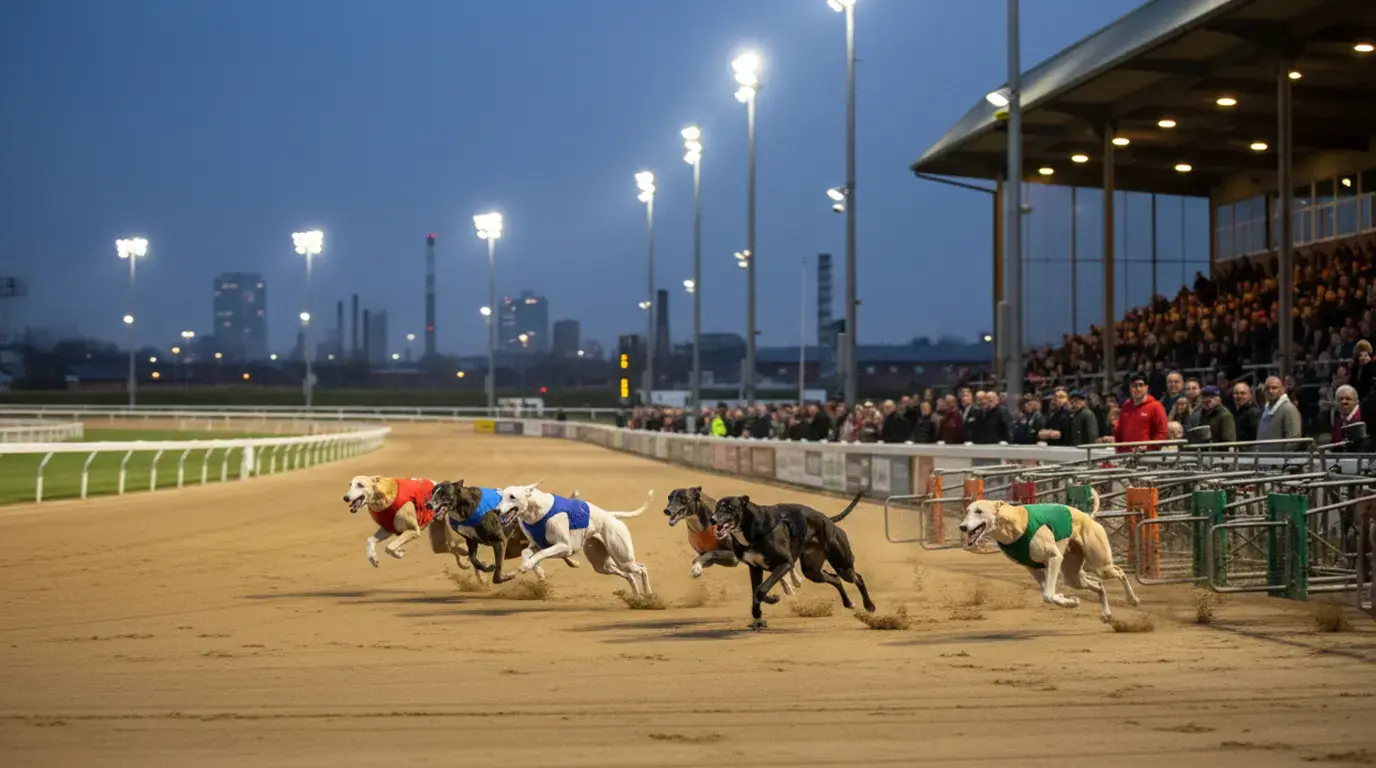
Track Profile — Monmore at a Glance
Monmore Green, commonly known as Monmore, is one of the strongest greyhound tracks in the West Midlands and one of the most respected venues on the GBGB circuit. Located in Wolverhampton, the stadium has a long racing history and remains a central fixture in the UK greyhound calendar, staging multiple evening meetings each week alongside selected afternoon BAGS cards.
The track is a medium-sized circuit with a character that sits between the sharp, tight venues of London and the galloping expanses of Towcester. The bends are firm without being severe, and the straights provide enough room for closers to make ground without giving them the luxury of extended run-ins. This balanced geometry produces racing that tests both early speed and sustained effort — a combination that rewards versatile dogs and punishes one-dimensional runners.
Monmore’s sand surface is well maintained and generally produces reliable racing. The track drains adequately in wet conditions, though persistent rain can slow times and shift the competitive balance towards more powerful, striding dogs over lighter, quicker ones. Evening meetings under floodlights are the primary product, with the strongest cards drawing competitive fields across the grade range from A class to D class.
The venue benefits from its proximity to several established training kennels in the West Midlands and beyond. The entry quality is consistently strong, and the grading structure at Monmore is considered fair and well managed. For bettors, this means the form at Monmore is generally reliable — dogs are placed at appropriate grades, and the competitive balance within each race tends to be genuine rather than artificial.
Open Racing on Thursday Nights
Thursday evenings at Monmore are the flagship fixture. The card typically includes open races alongside the graded programme, attracting visiting dogs from other tracks and producing the strongest fields of the week. These open events are the highlight for serious bettors — the quality is high, the market interest is deeper than on routine graded nights, and the analytical challenge is greater because the fields mix dogs from different venues with different form profiles.
Open races at Monmore follow the standard format: no grade restrictions and a random trap draw. The random draw is particularly significant at a track where the bends are firm enough to produce a meaningful rail advantage — a railer that lucks into trap 1 in the open draw has a genuine structural benefit that a railer in trap 5 does not. Checking running styles against the draw is essential for every open race at Monmore, more so than for the graded races where the seeded draw already handles most of the alignment.
The Thursday-evening open programme also attracts bigger betting volumes. Exchange liquidity is noticeably deeper on these nights than on a standard Tuesday graded card. Bookmaker markets are more competitive, best-odds-guaranteed promotions are more likely to apply, and the starting prices are sharper. For bettors who use exchanges or who seek BOG, Thursday at Monmore is the day to target.
Beyond the opens, the graded programme on Thursday evenings includes strong B and A class races that feature dogs on the cusp of open-race level. These races are worth watching closely — the dogs that win consistently at the top grades on Thursday nights are the candidates for future open-race entries, and identifying them early can give you an informational edge when they step up.
Distances and Trap Data
Monmore’s standard distances include 264, 480, and 630 metres. The 480 is the workhorse distance for graded racing and carries the deepest form database. The 264 is a sharp sprint that emphasises trap position and breakaway speed. The 630 is a genuine staying test that introduces stamina as a significant variable and separates stayers from sprinters in a way that the standard 480 does not.
Over the 480-metre trip, Monmore’s trap statistics show a moderate inside bias. Trap 1 typically produces the highest win percentage over large samples, with a gradual decline through to trap 6. The bias is real but not overwhelming — it is less pronounced than at Romford but more evident than at Towcester. Dogs in trap 1 or 2 with rail-seeking running styles hold a structural edge, particularly in races where the field contains multiple dogs that want to run on the same line.
The 264-metre sprint amplifies the draw bias. The short distance gives dogs almost no time to recover from a slow start or a poor first-bend position. Low-trap railers dominate the sprint statistics at Monmore, and backing them at reasonable prices is one of the simplest angles at the venue. Conversely, wide runners drawn in trap 5 or 6 for a 264-metre race face an uphill battle that raw form rarely overcomes.
The 630-metre staying distance shifts the emphasis away from the draw and towards stamina and race fitness. Over this longer trip, the field spreads out, the influence of first-bend position diminishes, and the ability to sustain speed through the back straight and into the second circuit becomes decisive. Dogs with strong closing sectionals and a proven ability to see out the trip are the ones to focus on at 630, regardless of their trap number.
When comparing form across Monmore’s different distances, treat them as separate datasets. A dog’s 264-metre form tells you about its sprint speed. Its 480-metre form tells you about its all-round racing ability. Its 630-metre form tells you about its stamina. These are different skills, and a dog that excels at one distance may be ordinary at another. Always check which distance previous runs were recorded over before drawing conclusions about tonight’s race.
Betting Angles for Monmore
The strongest betting angle at Monmore is the grade-dropper with track experience. Dogs that have been racing at the venue consistently — building up a bank of runs at the same distances and on the same surface — produce more reliable form than dogs transferring from elsewhere. When such a dog drops a grade after a spell at a higher level, the combination of familiarity with the track and softer opposition makes it a strong candidate to bounce back.
Forecast betting on Thursday-evening open races is another productive approach. The open-draw format and the quality depth of the fields mean that the top two finishing positions are contested more evenly than in graded racing, producing richer computer forecast dividends. If you can identify two dogs with non-conflicting running lines and strong individual form — a railer in a low trap and a wide runner in a high trap, for example — the forecast combination has a structural foundation that open-draw randomness cannot easily undermine.
For sprint races over 264 metres, back the low-trap early-speed specialist and accept the shorter prices. These races are structurally biased in favour of dogs that break fast from the inside, and fighting that bias by backing outsiders in high traps is a losing strategy over time. The value in sprint races at Monmore is not in finding a long-priced winner — it is in identifying the right favourite and backing it consistently.
For staying races over 630 metres, look for dogs that have already proven their stamina over the trip at Monmore specifically. Staying ability is partly about raw endurance and partly about knowing the track — knowing when to extend effort and when to conserve it through the longer circuit. A dog with two or three completed 630-metre runs at Monmore is a more trustworthy selection than a dog stepping up to the distance for the first time, regardless of what the form at shorter trips suggests.
Midlands Racing Rewards Homework
Midlands racing rewards homework. Monmore is not a track that yields easy profits to casual punters dipping in and out of the form. The venue’s balanced geometry, fair grading, and consistent surface mean that the dogs best suited to the track are the ones that perform at the track — and knowing which dogs those are requires regular attention to the venue’s racecards, results, and patterns.
Specialise. Study the Thursday open-race fields. Build a mental library of dogs you have watched at Monmore across multiple outings. Note which trainers send their strongest runners on which nights. Track how grade-droppers perform on their first run back in softer company. These investments of time cost nothing and compound over weeks and months into an understanding of the venue that no racecard data on its own can replicate.
Monmore is a track that gives back what you put in. The form is honest, the grading is fair, and the racing programme provides enough variety — sprints, standard trips, staying races, open events — to keep the analysis interesting and the opportunities flowing. Do the homework, trust the process, and Monmore is one of the most consistently rewarding venues in the Midlands and beyond.
