 dogracingtips
Updated October 2026
Licensed
 Available in US
Fast payouts
18+ Only
What Form Figures Represent
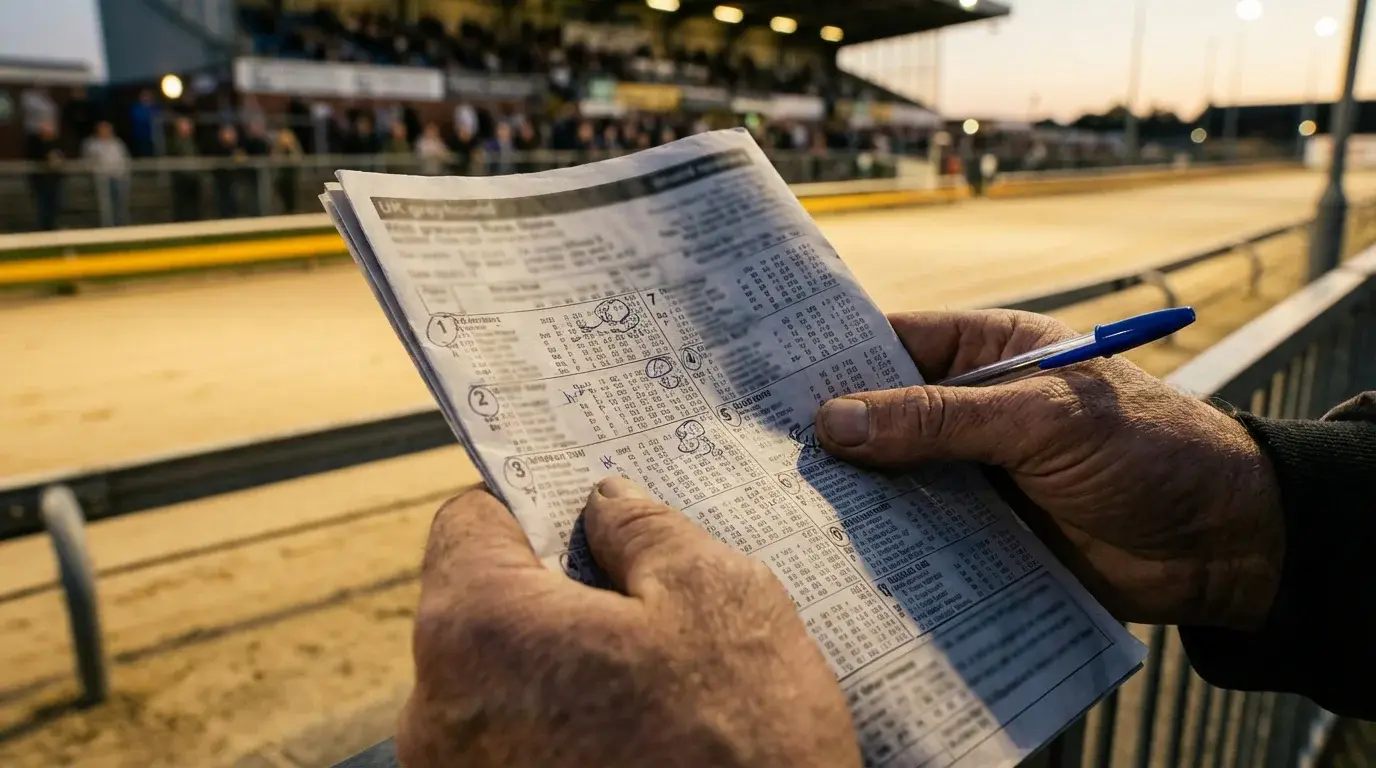
Every greyhound racecard carries a compressed biography of each runner’s recent career. The form figures — that string of numbers, letters, and occasional symbols beside each dog’s name — are the most information-dense element on the entire card. They encode finishing positions, track history, trouble in running, and gaps between races into a shorthand that experienced bettors read as fluently as text. Learning this shorthand is one of the most valuable skills available to anyone who wants to move beyond guesswork.
Form figures in UK greyhound racing typically show the results of a dog’s last six races, read from left to right with the most recent run on the right-hand side. Each character in the string represents one race. A number indicates the dog’s finishing position — 1 for first, 2 for second, through to 6 for last. Letters and symbols indicate track changes, non-completions, or other specific events. The string gives you an immediate snapshot of recent performance without requiring you to look up full race results.
What makes form figures particularly useful is their speed. A quick scan of six form strings — one per dog in the race — takes seconds. In that time, you can identify which dogs have been winning, which have been consistently placed, which have been struggling, and which have irregular patterns that warrant further investigation. The figures do not tell the whole story, but they narrow the field faster than any other single piece of data.
The key is knowing how to read them properly. A string of numbers is only useful if you understand what context sits behind each digit — and what the non-numeric characters are actually saying.
Number Sequences Explained
The numerical core of form figures is straightforward: each digit is a finishing position from a previous race. A form line of 2-1-1-3-1-2 tells you this dog has won three of its last six races, been placed in the other three, and never finished worse than third. That is strong, consistent form by any measure. Compare it to 5-6-4-6-3-5: a dog that has finished in the bottom half of the field in five of its last six races, with a solitary third-place effort providing the only hint of competitiveness.
Reading form sequences is not just about spotting winners and losers. It is about identifying trends. A dog whose form reads 5-4-3-2-2-1 is improving sharply — each run is better than the last, culminating in a win. This is the form profile of a dog that is either peaking in fitness, benefitting from a grade drop, or finally finding its preferred conditions. A sequence like 1-1-2-3-4-5 tells the opposite story: a dog that peaked two months ago and has been in decline since, possibly due to fatigue, injury, or an increase in class.
The position of the numbers within the six-run sequence matters enormously. The rightmost figure is the most recent. A dog with form of 6-6-5-4-2-1 looks poor on a quick glance — four of six runs outside the top three — but the trend is sharply upward. The most recent runs suggest this dog is coming to hand and could win again. Conversely, 1-1-2-4-5-6 starts brilliantly and collapses. The first two wins are history. The current reality is something else entirely.
Experienced bettors tend to weight the last three runs most heavily, with particular attention to the most recent one. Form older than three races can indicate underlying class, but greyhound fitness and sharpness fluctuate more rapidly than in most sports. A run from eight weeks ago may reflect a different level of conditioning to a run from last Tuesday. Always read the form from right to left, prioritising the latest evidence.
Also pay attention to the spacing between runs. A dog that has raced every four or five days is match-fit and in a regular rhythm. One that shows a gap of two or three weeks between races may have been rested, injured, or re-trialled. Gaps are not necessarily negative — a trainer might rest a dog deliberately before a target race — but they require explanation. If no obvious reason is available, treat the dog with caution until it proves its fitness in the current outing.
Letter Codes and Symbols
Beyond the numbers, form lines contain letters and symbols that indicate events outside standard finishing positions. These markers are critical — they explain why a dog finished where it did, which is often more important than where it actually finished.
A hyphen or dash (-) between form figures typically indicates a break in racing. This could be a rest period, a change of kennel, or recovery from an injury. The dash tells you the dog didn’t race during that window, and the runs either side of it may not be directly comparable.
Track abbreviations sometimes appear within or alongside form figures on expanded racecards. These tell you where each previous race took place. A dog whose last six races were all at the same track has a known affinity with that venue. One whose form includes three or four different track codes has been moving around — possibly because the trainer is looking for conditions that suit, or because the dog failed to perform at its previous venue.
The letter T in some form notation systems denotes a trial — a non-competitive run used to assess fitness or prepare a dog for a return to racing. Trials do not carry the same weight as race results because there is no competition and no tactical element. However, a fast trial time can indicate that a dog returning from a break is ready to perform. If you see a T followed by a strong finishing position, the dog was likely race-fit when it returned.
Other symbols you may encounter include F for fell, R for refused to chase, and various track-specific notations for incidents like running on (failing to follow the lure cleanly) or being hampered. These symbols explain poor form figures. A dog with a 6 in its form followed by a comment noting it was badly baulked at the first bend is a different proposition to a dog that finished sixth because it simply wasn’t fast enough. The number looks the same, but the underlying information is completely different.
This is why reading beyond the raw figures matters so much. A quick scan of the numbers shows you the surface pattern. The letters and symbols show you the story underneath. Both layers together give you the form picture that actually informs a betting decision.
Form Patterns That Signal Value
Certain form patterns recur frequently enough to become reliable betting signals. Recognising them doesn’t guarantee winners, but it shortens the odds of making a well-informed selection rather than a blind one.
The improving pattern — finishing positions that get progressively better over the last three or four runs — is the most consistently valuable. A dog showing 4-3-2 or 5-3-1 is moving in the right direction. It may be recovering from an injury, settling into a new grade after a drop, or simply gaining fitness through regular racing. Whatever the cause, the trend itself is the signal. Improving dogs at prices longer than 3/1 are often worth backing, particularly if the draw and running style align.
The bounce-back pattern catches dogs whose most recent run was uncharacteristically poor after a run of good form. Form of 1-2-1-1-5 prompts a question: what happened last time? If the answer is trouble in running — baulked at the first bend, bumped at the second, or hampered by a faller — then the 5 is an anomaly, not a trend. The dog’s true form is closer to the four runs before it. Backing a bounce-back dog at an inflated price because the market has overreacted to one bad run is a classic value play.
The decline pattern is equally useful, though in the opposite direction. A dog with form of 1-2-3-4-5 is deteriorating visibly. It may be losing fitness, struggling with a grade rise, or simply reaching the end of its competitive peak. Decline patterns are warnings. The dog might be the shortest price in the race based on its earlier wins, but the current trajectory suggests otherwise. Opposing declining favourites — either by backing something else or simply leaving the race alone — is a profitable discipline over time.
Finally, watch for the consistent placer: form of 2-3-2-2-3-2. This dog is rarely winning but almost always running well. In a forecast or tricast market, it is an excellent candidate for the second or third slot. In the win market, it is a chronic near-miss — the kind of dog that looks good value on paper but keeps finding one too good. Understanding the difference between a dog that wins and a dog that places is crucial for selecting the right bet type.
Form Is History, Not Prophecy
Form is a record of what has happened. It is not a contract for what will happen next. This distinction is worth repeating, because the single biggest trap in greyhound betting is treating past results as guarantees of future performance. Dogs are animals, not machines. They have good days and bad days. They respond to track conditions, draw positions, and the unpredictable behaviour of five other dogs sharing the same patch of sand.
The value of form figures lies in probability, not certainty. A dog with outstanding recent form is more likely to run well than a dog with poor form. A dog with an improving trend is more likely to continue improving than to suddenly collapse. These are tendencies, supported by the weight of evidence across thousands of races. But tendencies break. The unbeaten favourite gets baulked at the first bend. The out-of-form outsider has its best night in months.
What form figures give you is the ability to make informed decisions rather than random ones. They compress weeks of racing data into a format you can process in seconds, highlight trends that are invisible without structured data, and provide a common language for discussing a dog’s chances. Master the shorthand, learn to read beyond the raw numbers into the symbols and context beneath them, and you will approach every racecard with a clarity that most casual bettors never achieve. The figures are the raw material. The analysis — and the discipline to act on it properly — is yours to build.
