 dogracingtips
Updated October 2026
Licensed
 Available in US
Fast payouts
18+ Only
What a Forecast Bet Is
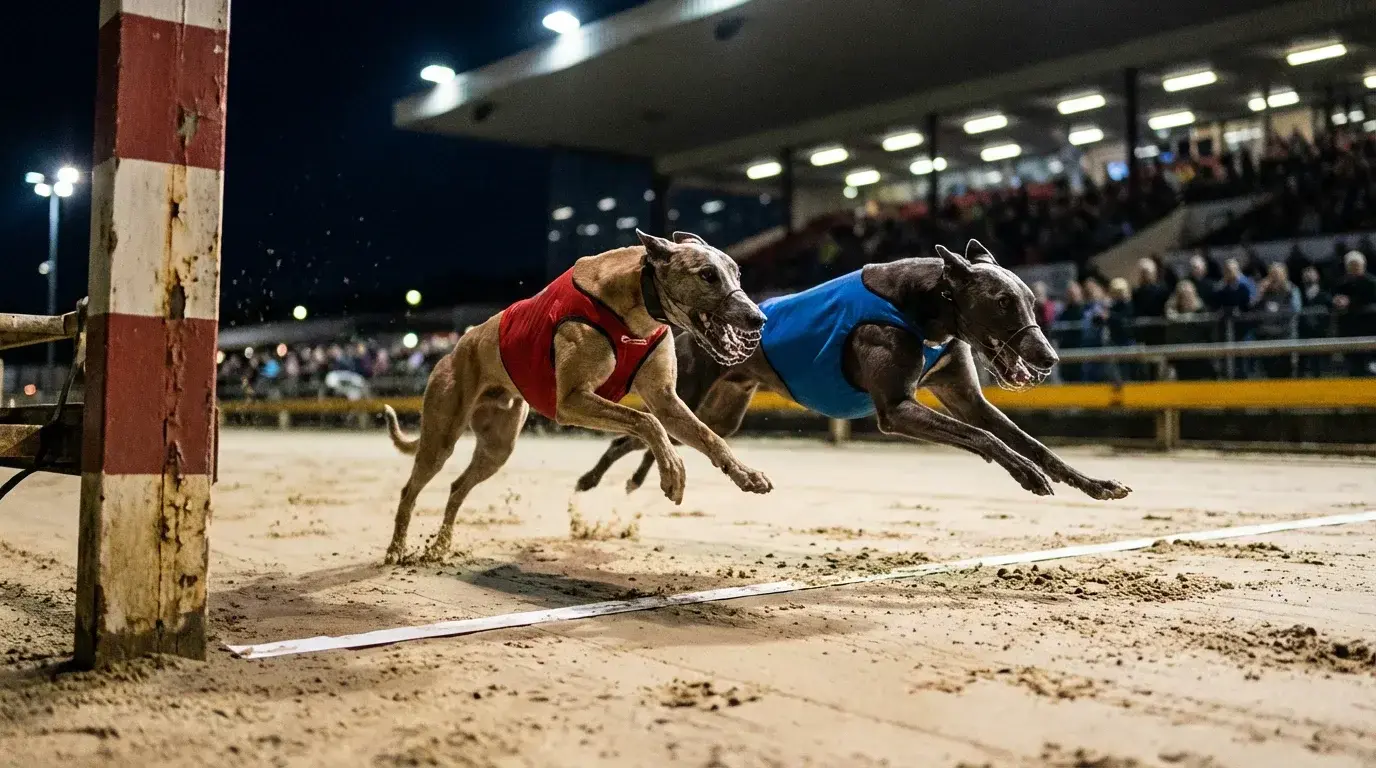
A forecast bet asks you to predict which two dogs will finish first and second in a greyhound race. That is the entire proposition — no handicaps, no margins, no complications beyond selecting two runners and deciding in what order they will cross the line. It is the natural step up from a straightforward win bet, and in a six-runner field it offers something that win-only betting rarely can: significantly larger returns without requiring an unlikely result.
The logic is simple. In a six-dog race, predicting the winner alone gives you a one-in-six theoretical chance before form, draw, and class enter the equation. Predicting first and second in the correct order compresses that to one in thirty. The bookmakers price accordingly — forecast dividends are typically much larger than the win odds on either individual dog, because you are asking for two things to happen in sequence rather than one.
Greyhound racing is particularly well suited to forecast betting for a structural reason that separates it from horse racing: the fields are small. Six runners means six possible winners and thirty possible first-and-second combinations. In an eight-runner horse race, that number jumps to fifty-six. The smaller pool in greyhound racing makes the forecast more approachable — you can realistically assess every combination in the field, something that becomes impractical as field sizes grow.
Forecasts are settled either at a declared bookmaker price or, more commonly in greyhound racing, at the computer straight forecast dividend. This dividend is calculated after the race based on the starting prices of the first two finishers and the overall market. It is not a fixed price you lock in before the off. That distinction matters, because the return you receive depends on how the market priced the two dogs, not on any odds you were quoted at the time of placing the bet.
Straight vs Reverse Forecast
The straight forecast is the purest form: you name the dog that will finish first and the dog that will finish second, in that exact order. Get the order wrong — your first pick finishes second and your second pick wins — and the bet loses. There is no partial payout, no consolation return. You need the precise finishing sequence you predicted.
This severity is also what makes the straight forecast lucrative. Because the bet demands exactness, the returns are higher than any alternative that offers flexibility. A straight forecast paying thirty or forty times your stake is not unusual in a competitive six-dog race, and when a longer-priced dog fills one of the two positions, the dividend can climb well beyond that. The reward reflects the difficulty — and the difficulty, in truth, is less extreme than it sounds in a field of just six runners.
The reverse forecast relaxes the order requirement. You select two dogs to finish first and second in either order. If dog A wins and dog B finishes second, you collect. If dog B wins and dog A finishes second, you also collect. The price you pay is double the stake of a straight forecast, because a reverse forecast is functionally two straight forecasts combined — one with A first and B second, the other with B first and A second.
The reverse forecast is the more popular option among recreational bettors because it halves the precision required. You still need to identify the top two finishers, but you no longer need to separate them by finishing position. For a bettor who has strong views on two dogs in a race but is uncertain which of them will beat the other, the reverse forecast is the natural choice. It costs twice as much but covers twice the ground.
Choosing between the two comes down to conviction. If your analysis points clearly to one dog winning and another filling the runner-up spot — perhaps the likely winner has overwhelming early speed and the second pick is a consistent placer — the straight forecast is the sharper bet. If the two dogs are closely matched and the finishing order is genuinely uncertain, the reverse forecast offers protection without abandoning the core prediction.
Combination Forecasts
A combination forecast extends the principle further. Instead of selecting two dogs, you select three or more and cover every possible first-and-second permutation among them. With three selections, you cover six straight forecasts. With four, you cover twelve. The stake multiplies accordingly — a one-pound combination forecast on three dogs costs six pounds, because there are six possible finishing orders for those three dogs in the first two positions.
The appeal of combination forecasts is coverage. If you believe the first two places will come from a pool of three or four dogs but cannot confidently rank them, the combination approach ensures you are covered regardless of the order. The trade-off is cost. Each additional dog you add to the combination increases the number of permutations — and your total outlay — rapidly. Four dogs produce twelve permutations. Five dogs produce twenty. At that point, you are staking a significant amount to cover increasingly marginal scenarios.
The practical limit for most bettors is three selections. A three-dog combination forecast in a six-runner field means you have identified the three likeliest contenders and are betting that two of them will fill the first two places. Given that greyhound fields are small and at least one or two runners can usually be eliminated on draw or form grounds, narrowing to three is a realistic target. Going beyond three dogs erodes the value proposition — the additional permutation cost often exceeds the additional probability of landing the bet.
One tactical point: you can weight a combination forecast by putting more stake on the permutations you consider most likely. For example, if you think dog A is almost certain to win but dogs B and C are fighting for second, you could place a larger straight forecast on A-B and A-C, and smaller amounts on the reverse combinations. This is not a standard combination bet — it requires placing individual straight forecasts manually — but it allows you to express a nuanced view of the race rather than treating all permutations as equally probable.
Strategies for Forecast Selections
Forecast betting rewards a specific kind of analysis — the ability to separate the first two from the rest of the field, rather than just picking a winner. This requires a slightly different approach to form reading. Instead of asking “which dog wins this race?” you are asking “which two dogs are most likely to be at the front when it matters?”
Start with elimination. In most six-runner greyhound races, one or two dogs can be ruled out on the basis of draw, form, or class. A dog with a running style that conflicts with its trap position, or one dropping in form over its last three runs, is unlikely to fill a forecast place. Removing those runners narrows the field to the three or four genuine contenders, which is exactly the pool from which your forecast selections should come.
Next, look for the consistent placer. Every racecard contains dogs whose form figures show repeated second and third-place finishes — animals that are competitive but rarely win. These dogs are gold for forecast betting. Pairing a likely winner with a habitual placer is one of the most reliable forecast structures. The winner provides the sharpness at the front; the placer provides the reliability in second.
Draw and running style become especially important in forecast selection. Two dogs on different racing lines — a railer in trap 1 and a wide runner in trap 6, for instance — are less likely to interfere with each other than two railers drawn side by side. Non-interfering pairs make stronger forecast combinations because each dog can run its own race without compromising the other’s chance. When both dogs have clear runs, the probability of them finishing first and second rises compared to two dogs that might crowd each other at the first bend.
Forecasts Reward Conviction
Forecast betting is not for every race. It works best when you have a strong opinion on two runners and reasonable confidence that the rest of the field is weaker. In wide-open races where any of four or five dogs could realistically finish in the top two, forecasts become expensive to cover and difficult to land. The bet thrives on clarity — the clearer your view of the likely first and second, the more efficiently you can stake.
There is a discipline to forecast betting that win-only punters sometimes lack. Because the returns are larger, the temptation is to bet on every race, reasoning that one big dividend will recover a string of losses. It rarely works that way. Forecasts hit less frequently than win bets by definition, and the losing runs can be longer. The sustainable approach is selectivity: wait for races where the form, draw, and class point clearly to two dogs, and leave the rest alone.
When those races appear — and they appear several times on most UK greyhound cards — the forecast is one of the best-value bets available in the sport. Six runners, a clear top two, and a dividend calculated from the market rather than fixed by the bookmaker. It rewards the bettor who does the work, trusts the analysis, and places the bet with conviction rather than hope.
