 dogracingtips
Updated October 2026
Licensed
 Available in US
Fast payouts
18+ Only
The Tricast Bet Explained
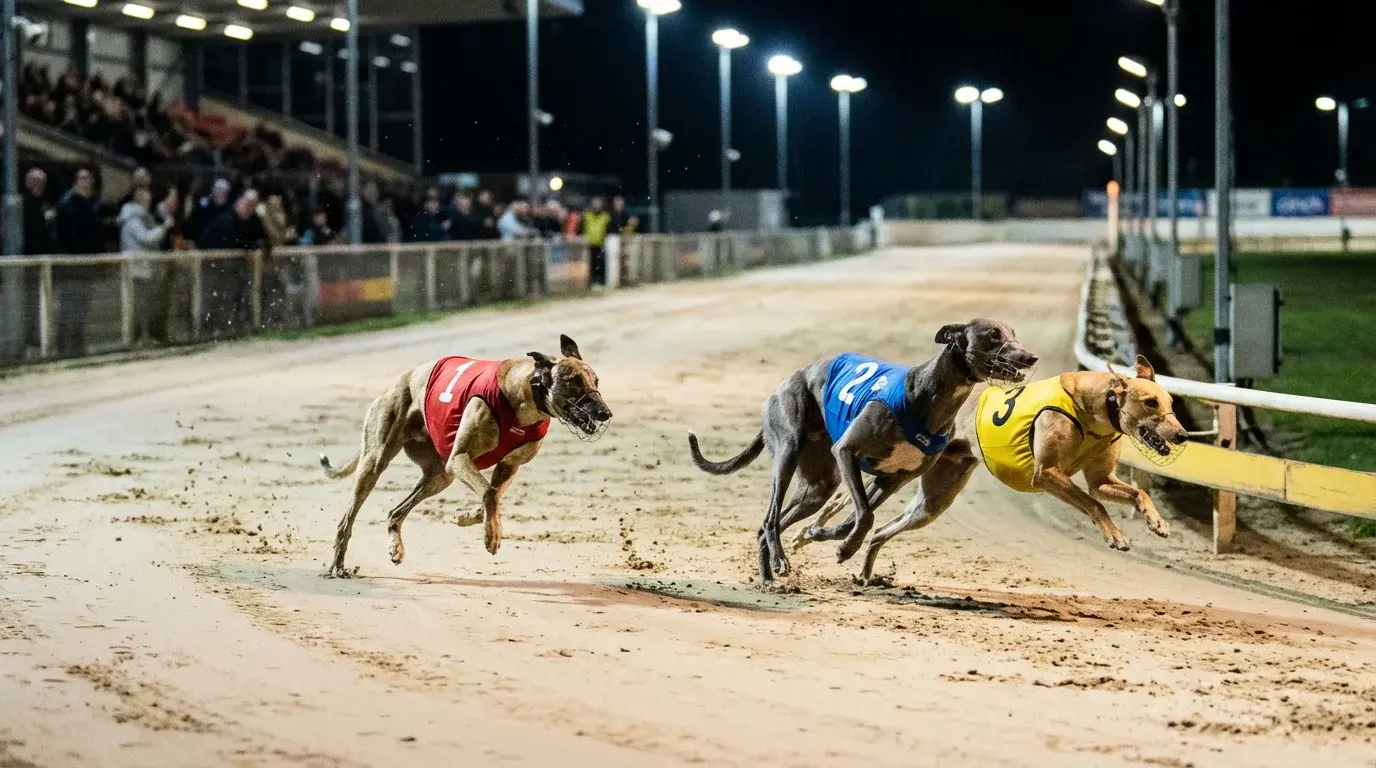
A tricast bet requires you to predict the first three finishers in a greyhound race in the exact order. First, second, and third — all correct, all in sequence. It is the most demanding standard bet type available in greyhound racing, and the dividends reflect that demand. Where a forecast might return thirty or forty times your stake, a tricast can pay hundreds, occasionally thousands, depending on the prices of the three dogs involved.
In a six-runner greyhound race, there are 120 possible permutations for the first three finishing positions. That is the mathematical reality of what you are attempting: to identify one specific outcome from 120 possibilities. Before form analysis, draw assessment, and class evaluation narrow the field, the raw odds are against you. After those filters are applied, the picture can look considerably more manageable — but the tricast remains a bet that hits infrequently by design.
Tricast dividends in UK greyhound racing are typically settled at the computer tricast price, which is calculated after the race based on the starting prices of the first three finishers. Like the forecast, this is not a fixed return you agree upon before the race. The actual payout depends on how the market priced each dog and the resulting combination. A tricast involving three short-priced runners will pay modestly. One that includes a 10/1 outsider in the mix will pay substantially more.
This variability is part of the appeal. The tricast transforms a routine Tuesday-night graded race into something with genuine payout potential. But it also means you are accepting a bet where the return is unknown until after the result — a feature that suits bettors comfortable with uncertainty and uncomfortable with small, predictable margins.
Combination Tricasts and Permutation Costs
A straight tricast is a single bet on one specific finishing order: dog A first, dog B second, dog C third. If any of those three finishes in a different position — even if all three make the top three — the bet loses. The cost is one unit stake, and the return is the full computer tricast dividend.
A combination tricast covers every possible finishing order among your selected dogs. With three selections, there are six permutations: A-B-C, A-C-B, B-A-C, B-C-A, C-A-B, and C-B-A. Your stake is multiplied by six. With four selections, the permutations jump to twenty-four, and with five they reach sixty. The maths scales quickly, and so does the cost.
This is the central tension of combination tricasts: broader coverage versus higher outlay. A three-dog combination at one pound per permutation costs six pounds. If the tricast dividend is sixty pounds, your net profit is fifty-four — a healthy return. But if you extend to four dogs at one pound per permutation, you are staking twenty-four pounds. The same sixty-pound dividend now returns only thirty-six in profit. Add a fifth selection and you are staking sixty pounds to win sixty — breakeven at best.
The practical ceiling for combination tricasts is almost always three selections. At three dogs, you are covering every possible ordering of your top three picks in a six-runner field — half the runners. That is a realistic analytical target. You have effectively said: I believe these three dogs are the best in the race, and I want to profit regardless of which order they finish in. Going beyond three dogs in a tricast combination erodes returns so aggressively that the bet loses its purpose.
Some bettors use a hybrid approach: a full combination on their top three selections, supplemented by one or two straight tricasts that include a fourth dog in the third-place slot. This keeps the core cost at six units while adding speculative lines that pay off handsomely if a particular outsider sneaks into the frame. It is a more surgical way to expand coverage without committing to a full four-dog combination.
When Tricasts Offer Value
Tricasts offer the best value in races with a clear top two and an open battle for third place. When you can confidently identify the likely winner and runner-up, the tricast question reduces to: which of the remaining four dogs will finish third? That is a far more tractable problem than predicting the entire top three from scratch, and it is the scenario where tricast betting becomes a genuine value proposition rather than a lottery ticket.
Competitive graded races — particularly at mid-table level, where the fields are closely matched — tend to produce the richest tricast dividends. The starting prices are more evenly spread, meaning the computer tricast calculation generates higher payouts than in races with a dominant favourite. A tricast involving three dogs priced between 3/1 and 7/1 will pay considerably more than one involving a 4/6 favourite, even if the finishing order is equally predictable. The market structure matters as much as the race structure.
Races with troubled fields also present tricast opportunities. When two or three dogs have draw or style problems that make interference likely, the remaining runners — those with clear racing lines — are disproportionately likely to fill the first three places. You are not predicting which dog is fastest in absolute terms. You are predicting which dogs will have clean runs, and clean runs correlate strongly with top-three finishes.
Conversely, tricasts offer poor value in races dominated by a short-priced favourite. If the market favourite is 4/6 and duly wins, its low price drags down the entire tricast dividend. You might correctly call the first three home and receive a payout that barely covers a three-dog combination stake. Before placing a tricast, glance at the likely market. If one dog is expected to start at odds-on, the race is probably better suited to a forecast or a simple win bet.
Building Tricast Selections
Building tricast selections requires layered analysis. The first layer is elimination — which dogs in the six-runner field are unlikely to finish in the top three? A dog with a severe draw-style mismatch, a dog returning from a long absence without a recent trial, or a dog that has finished last in three consecutive outings can usually be removed from consideration. In most races, you can eliminate one or two runners on these grounds, leaving four or five realistic contenders.
The second layer is ranking. Among the remaining dogs, which is most likely to win? Which is the strongest candidate for second? And which has the profile of a third-place finisher — competitive enough to stay in the frame but unlikely to lead? This ranking should draw on early speed for the first position, consistency and placing form for the second, and general competitiveness for the third. A dog that frequently finishes second or third but rarely wins is a classic tricast component — the kind of runner that holds its position without threatening the front two.
The third layer is interference assessment. Visualise the first bend. Which dogs are on conflicting racing lines? If two of your three selections are both railers drawn in adjacent low traps, there is a risk that they interfere with each other, knocking one or both out of contention. The ideal tricast trio features dogs on separate racing lines — a railer, a middle runner, and a wide runner — each with a clear path that doesn’t cross the others. These non-conflicting trios are more likely to fill the top three positions than three dogs competing for the same patch of track.
Once you have your three selections, decide between a straight tricast and a combination. If your ranking is confident — you are fairly sure dog A beats dog B, and dog B finishes ahead of dog C — a straight tricast at one unit is the sharpest bet. If the three dogs are closely matched and the finishing order is uncertain, the six-unit combination is the safer structure. Most experienced tricast bettors lean towards combinations, accepting the higher cost in exchange for flexibility on the exact order.
High Variance, High Reward
Tricast betting is inherently high-variance. You will lose more often than you win — that is the mathematical reality of predicting three finishing positions from six runners. The question is whether the wins, when they arrive, are large enough to compensate for the losing runs. Over a meaningful sample of well-chosen tricasts, the answer is usually yes, provided you exercise discipline on which races you bet and how much you stake.
The critical discipline is selectivity. Not every race suits a tricast. Some fields are too open, some too dominated by a single runner, some too riddled with draw conflicts to predict with any confidence. The races that suit tricasts are the ones where your analysis produces a clear top three — not a guaranteed top three, but a plausible, defensible one supported by form, draw, and class. If you cannot articulate why each of your three selections should finish in the top three, you are guessing, and guessing at 120-to-1 is an expensive habit.
Stake management matters more in tricast betting than in almost any other bet type. Because the losing runs are frequent and the wins are irregular, staking too much per tricast erodes your bankroll before the dividends arrive to replenish it. Treat tricast stakes as a small, ring-fenced portion of your overall betting budget — money you can afford to invest repeatedly without needing a return from any single race. When the tricast lands, and the dividend is measured in triple figures, you will understand why the patience was worth it.
