 dogracingtips
Best Greyhound Betting Sites – Bet on Greyhounds in 2026
Loading...
The First-Bend Rule
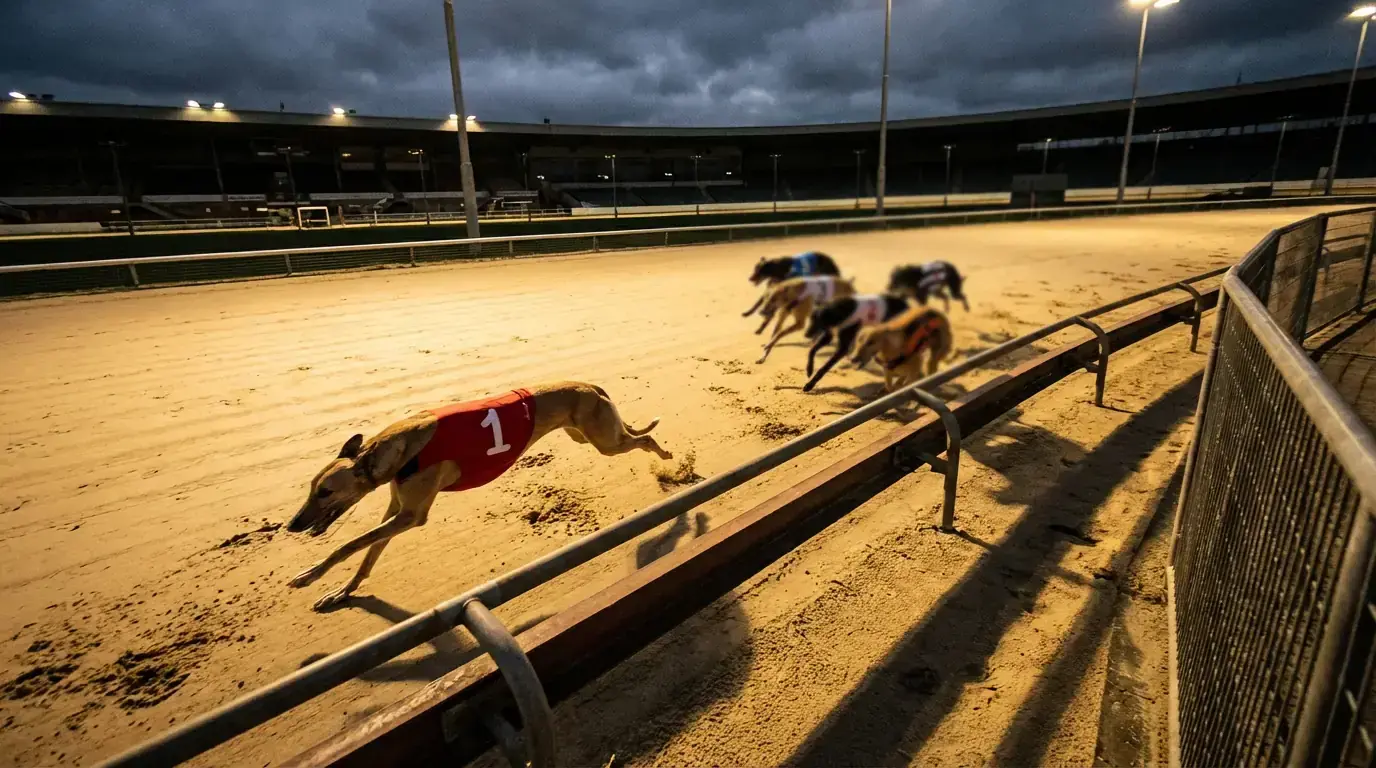
Lead at the first bend and the probability flips in your favour. That is not a slogan — it is the single most statistically supported observation in greyhound racing analysis. Across every GBGB-licensed track in the UK, dogs that reach the first turn in front win their races at a rate significantly higher than any other positional group. The exact figures vary by track and distance, but the pattern is universal: front-runners convert leads into victories far more reliably than dogs that come from behind.
The reason is structural, not mystical. Greyhound racing takes place on oval tracks with tight bends. The first bend is typically reached within three to four seconds of the traps opening, at which point the six runners are still closely bunched. The dog that arrives first claims the racing line it wants — usually the rail, which is the shortest path through the turn. Every other dog must either follow it, go around it, or try to squeeze past it. In a race that lasts under thirty seconds, the time lost navigating around a front-runner is almost never recovered.
There is also the interference factor. Dogs behind the leader at the first bend are running in traffic. They risk being baulked, checked, or bumped by other runners competing for position. The leader faces none of these hazards. It has clean air, a clear sightline to the lure, and no obstacles ahead. This is the fundamental asymmetry of greyhound racing: the first bend separates the dog that races unimpeded from the five that race in turbulence.
For bettors, this creates a clear analytical priority. Before evaluating a dog’s overall form, its finishing times, or its class, it is worth asking a simpler question: does this dog have the early speed to lead at the first bend? If the answer is yes, and the draw supports it, you already have a strong candidate. If the answer is no, the dog needs to overcome a structural disadvantage that eliminates more contenders than any other factor in the sport.
This does not mean that every front-runner wins. Dogs that lead but lack the stamina to maintain the pace can be caught in the closing stages. Dogs that lead on the wrong racing line — a railer leading on the outside, for instance — may surrender the advantage when they drift to their preferred path. But as a starting point for selection, early speed is more predictive than any individual piece of form data.
Identifying Early-Speed Dogs
The racecard won’t say “fast breaker” — but the data will. Identifying early-speed dogs requires reading between the lines of the form and understanding what the available metrics are actually measuring. There is no single column on a standard UK racecard labelled “early pace.” Instead, you build a picture from several indicators.
Sectional times are the most direct source. Some tracks and data providers publish split times — the time a dog takes to reach specific points on the track, most usefully the time to the first bend. A dog that consistently posts fast first-split times is a confirmed early-pace runner. Timeform and the Racing Post both incorporate sectional data into their racecard analysis, though the level of detail varies by race and provider. Where sectional times are available, they are the most reliable indicator of early speed.
When sectional data is absent, you can infer early pace from the form comments and race summaries. Phrases like “led early,” “disputed lead,” “prominent first bend,” or “fast away” all indicate a dog with breakaway speed. Conversely, “slow away,” “hampered first bend,” or “came from behind” indicate a dog that typically settles in behind the pace. These descriptions are published for most races and are available on the Racing Post and Timeform race results pages.
Running style also provides indirect evidence. Railers drawn in low traps are structurally set up to reach the first bend quickest — they have the shortest route. But not all railers have early speed. Some are steady runners that hug the rail without contesting the lead. The distinction matters. A railer with confirmed early speed and a low draw is the ideal profile. A railer without early speed in the same trap will still benefit from the draw but may not capitalise on it.
Trap draw and early speed interact powerfully. A fast breaker in trap 1 or 2 is almost certain to reach the first bend in front unless there is another equally fast dog alongside. A fast breaker in trap 5 or 6 faces a longer path and needs to overcome the geometry — possible for a very quick dog, but harder. When you identify a confirmed early-pace runner, always check its draw. The combination of breakaway speed and a favourable inside draw is one of the strongest predictive signals available in greyhound race analysis.
When Early Speed Isn’t Enough
Two fast breakers drawn side by side often cancel each other out. This is the most important caveat to the early-speed thesis, and ignoring it is one of the most common mistakes in greyhound betting. When two or more dogs with strong early pace are drawn in adjacent traps, they contest the lead into the first bend — and contested leads produce trouble. One dog may bump the other. Both may run wider than intended. The interference costs both dogs time and position, creating an opening for a mid-pack runner to inherit the lead by default.
Scanning for contested-pace scenarios is as important as identifying early speed in the first place. Count the number of fast breakers in the field and note their trap positions. If two early-pace dogs are in traps 1 and 2, or traps 5 and 6, expect a duel for the lead. That duel benefits whichever dog in the field is positioned to pick up the pieces — typically a mid-speed runner in a central trap, or a strong closer that can exploit the disruption.
Distance also matters. In sprint races over 480 metres or less, early speed is overwhelmingly dominant because there is so little time for dogs behind the pace to recover. In middle-distance races around 630 metres, the advantage is still significant but slightly reduced — there are two more bends and a longer straight for closers to make up ground. In staying races over 640 metres, early speed remains valuable but is no longer the defining factor. Stamina, class, and the ability to sustain pace through multiple turns become more important.
Weather and track conditions can also diminish the early-speed advantage. A heavy track after rain slows the initial breakaway, compresses the field into the first bend, and makes it harder for a leader to establish separation. On firm, fast tracks, early speed is devastating. On wet, holding surfaces, the advantage narrows. Check the going report before placing too much emphasis on a dog’s first-split times recorded on a different surface.
Breaking First, Thinking Last
Speed gets them to the front. The draw, the class, and the dog’s heart keep them there. Early speed is the most powerful single variable in greyhound racing, but it operates within a system of interacting factors, not in isolation. A dog that breaks fast from a poor draw may reach the bend in second rather than first. A dog that leads but faces a class upgrade may be overhauled by a stronger finisher. The first-bend advantage is enormous, but it is not invincible.
The practical lesson is to start your analysis with early speed but not end it there. Identify the likely leader at the first bend based on sectional times, running style, and trap draw. Then ask: can this dog sustain the pace against this level of competition over this distance on this surface? If the answer is yes across most of those variables, you have a strong betting proposition. If doubts appear on two or more fronts, the early-speed advantage may not be enough to carry the dog through.
What early speed gives you, as a bettor, is a prediction about the race shape. If you can accurately forecast which dog will lead at the first bend, you can assess the race from that dog’s perspective — is the field strong enough to catch it, or will the front-runner control the race unchallenged? That forecast, combined with odds assessment, is the foundation of profitable greyhound betting. The dog that breaks first doesn’t always win. But more often than not, the race is decided in those first three seconds — and the dog that gets them right has already done the hardest part.