 dogracingtips
Best Greyhound Betting Sites – Bet on Greyhounds in 2026
Loading...
How Handicap Greyhound Races Work
Handicap races in greyhound racing aim to neutralise the speed differences between runners by giving slower dogs a physical head start. Instead of all six dogs breaking from the same line of traps, the starting positions are staggered — faster dogs start further back, slower dogs start further forward. The idea is that all six should, in theory, arrive at the first bend together, making the race a test of racing skill rather than raw speed.
Handicap races are less common on the UK greyhound calendar than standard graded racing, but they appear regularly at several GBGB-licensed tracks, particularly as feature events or novelty races designed to add variety to an evening card. They are distinct from both graded and open races in their mechanics, and they require a different analytical approach. The tools you use to assess a standard flat race — form figures, sectional times, grade comparisons — still apply, but they need to be recalibrated for a format where starting position varies.
The handicapper, usually the racing manager at the track, assigns each dog a mark based on its recent racing times. The fastest dog in the field receives the highest mark and starts from the furthest point behind the standard trap line. The slowest dog receives the lowest mark and starts closest to, or on, the standard line. The gaps between starting positions are calculated from the differences in the dogs’ marks, translated into metres of track distance.
For bettors, the critical question is whether the handicapper’s assessment is accurate. If it is, every dog in the field has an equal chance and the race is a lottery. If it is not — and it often is not perfectly calibrated — the errors create opportunities. Finding those errors is the foundation of profitable handicap betting.
Staggered Starts Explained
The stagger is expressed in metres. A dog on the scratch mark — the furthest back — starts at the standard trap position. A dog given a head start of, say, eight metres begins that distance ahead of scratch. The range of the stagger depends on the quality gap between the fastest and slowest dogs in the field. In a tightly grouped handicap, the total spread might be only four or five metres. In a wide-open one, it can stretch to ten or twelve.
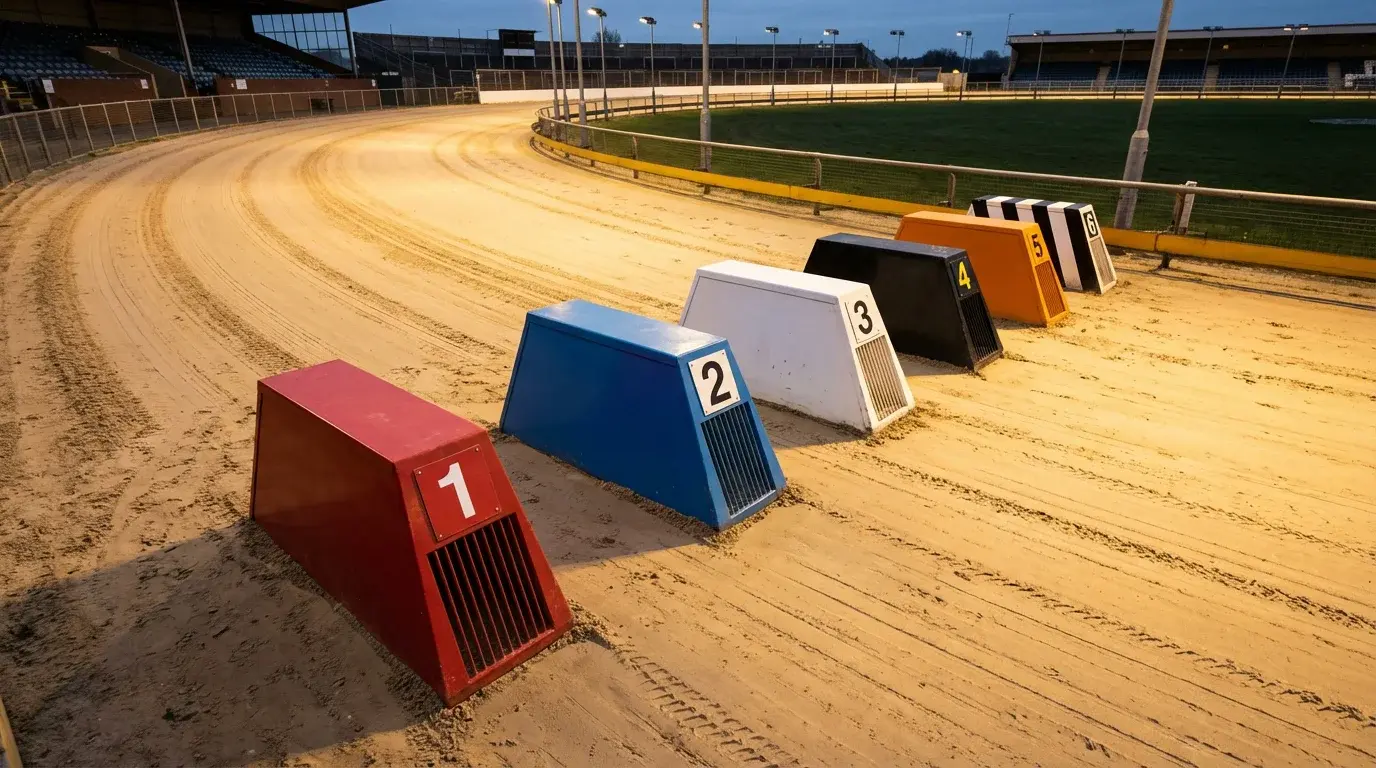
The physical setup varies by track. Some venues use a single set of traps with the positions adjusted along the straight, while others use separate starting boxes positioned at the appropriate intervals. The visual effect is distinctive: instead of a uniform row of six traps, you see a staircase of starting positions stretching along the run-up to the first bend.
The stagger fundamentally alters the dynamics of the first bend. In a standard flat race, all six dogs leave the traps together and the first bend is a contest of early speed and positional advantage. In a handicap, the dogs with the biggest head starts arrive at the bend first, but they are, by definition, the slower animals. The faster dogs start behind and must use their superior pace to close the gap before the bend — or get blocked in traffic if they fail to do so.
This creates a specific tactical dynamic: front-runners benefit even more in handicaps than in flat races, because the dogs at the front have a head start and a clear run into the first bend. A slow dog with a generous start that leads into the first turn can be very difficult to catch, even for a faster rival starting several metres behind it. The first bend remains the decisive point, but who reaches it first is shaped by the handicap marks as much as by raw early speed.
Assessing the Handicapper’s Marks
The handicapper bases the marks on recent finishing times, adjusted for distance and sometimes for running conditions. In principle, if a dog’s best time over 480 metres is 29.50 seconds and another’s is 30.10, the slower dog should receive a head start that compensates for that 0.60-second difference — roughly six to seven metres at racing speed.
The quality of the handicap depends on which times the handicapper uses and how many recent runs are factored in. If the marks are based on the last two or three runs, a dog whose form is improving rapidly may be under-handicapped — its mark reflects its slower earlier runs rather than its current ability. Conversely, a dog whose form is declining may carry a mark based on its better performances, making it over-handicapped and starting further back than its current ability warrants.
This lag effect is where the most frequent handicap betting opportunities arise. The handicapper is working with historical data. The bettor who has studied the dog’s recent trajectory — not just its last two times but the direction of travel — can identify dogs whose mark does not reflect their current level. An improving dog with a generous start is the classic handicap value play. A declining dog off a flattering mark is the classic one to avoid, no matter how short the bookmaker prices it.
Weather and track conditions introduce another source of handicap error. If the marks are based on times recorded in dry conditions and tonight’s meeting is running on a rain-softened surface, the time adjustments may not hold. Heavier going tends to reduce the gap between fast and slow dogs — the surface levels the playing field naturally, on top of the handicap. Lighter dogs and strong finishers can gain an advantage on wet tracks that the handicapper did not anticipate when setting the marks days earlier.
Betting Strategies for Handicaps
The first strategic rule for handicap betting is to separate the handicap from the form. In a standard graded race, form figures directly indicate how a dog has performed against similar opposition. In a handicap, form figures still tell you about finishing positions, but the race conditions were different — the starting positions were staggered, and the finishing order reflects the interaction between raw ability and the handicapper’s marks. A dog that won its last handicap did not necessarily beat five faster dogs. It may have received a generous start and led throughout.
Look for dogs near the front of the stagger — those receiving the biggest head starts — that also have early speed. This combination is powerful in handicaps. A dog that starts ahead of the field and breaks fast will reach the first bend with a clear lead, and the faster dogs behind it must close the deficit through the bends, where overtaking is difficult. These front-running, well-handicapped dogs win more handicaps than any other type, particularly at tracks with tight bends where the rail advantage compounds the head start.
The scratch dog — the fastest in the field, starting from the rear — is often the market favourite in handicaps, and it is often a poor bet. The handicapper has given it the biggest burden, and it must pass five other dogs during the race to win. Some scratch dogs are talented enough to do this, but they need a clear run, a straight line to the front, and enough distance to deploy their speed. At tracks with short straights and sharp bends, the scratch dog frequently gets stuck behind a wall of slower runners and cannot find a route through. Favourites in handicap races underperform relative to their graded-race equivalents for exactly this reason.
Forecast and tricast bets can be particularly rewarding in handicaps. The staggered start shuffles the expected finishing order, producing longer-priced dogs in the frame more often than in flat races. If you can identify two or three dogs that are well handicapped — receiving generous starts relative to their current form — a combination bet covering those runners can return dividends that flat-race equivalents rarely match.
Handicaps Level the Field — in Theory
Handicaps level the field — in theory. In practice, they create a different kind of inequality: one based on the accuracy of the handicapper’s marks rather than the raw ability of the dogs. A perfectly calibrated handicap would make every race a coin toss. An imperfectly calibrated one — which is the norm — creates edges for bettors who can spot the discrepancies.
The challenge is that handicap analysis requires a different skill set from standard form reading. You need to assess not just how fast a dog is, but how fast the handicapper thinks it is, and whether those two assessments agree. When they do not — when a dog is better than its mark suggests, or worse — you have found a potential bet. The profit in handicap racing comes from disagreeing with the handicapper and being right more often than wrong.
Handicap races are not for every bettor. They are niche events with smaller sample sizes, less publicly available analysis, and a format that many casual punters find confusing. That confusion is an advantage for those who take the time to understand it. The market for handicap greyhound races is less efficient than the market for graded races, and less efficient markets are where value bettors do their best work.