 dogracingtips
Best Greyhound Betting Sites – Bet on Greyhounds in 2026
Loading...
Why the Trap Draw Is the First Thing to Check
Before form, before times, before odds — check the trap. That single piece of information shapes the first two seconds of a greyhound race, and those two seconds determine where every dog sits heading into the first bend. In a sport where the average race lasts under thirty seconds, positional advantage at the opening turn is worth more than almost any other variable on the racecard.
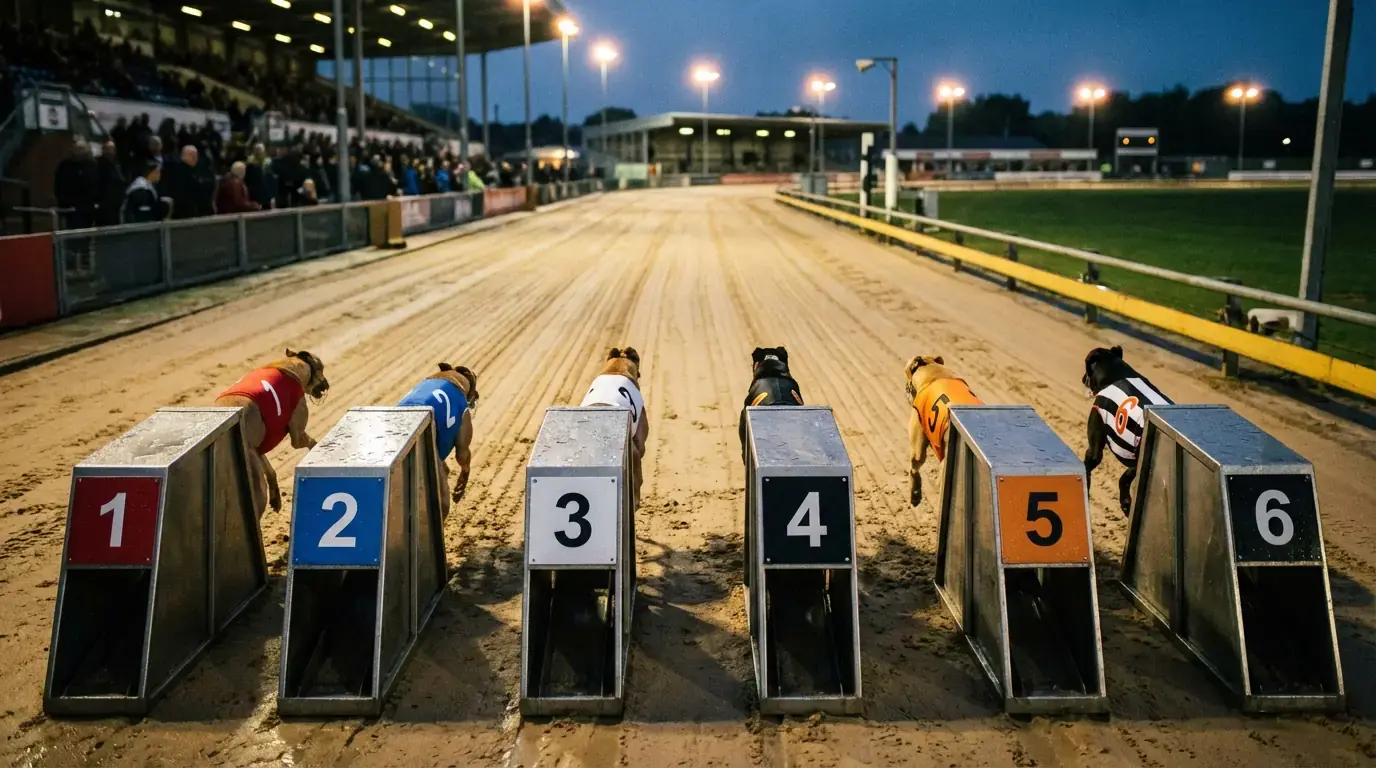
Greyhound racing in the UK uses a six-trap format. Each dog is assigned a numbered starting box — trap 1 on the inside rail through to trap 6 on the outside — and wears a colour-coded jacket to match. The trap position dictates the shortest available route to the first bend for each runner. A dog breaking cleanly from trap 1 has the tightest line; a dog in trap 6 has the widest arc. The geometry is simple but its consequences ripple through every race.
What makes the trap draw particularly significant in greyhound racing, compared to barrier draws in horse racing, is the absence of a jockey. There is no rider to adjust position, steer around traffic, or settle a dog into a pocket. Greyhounds follow their instincts. A railer drawn on the outside will still try to cut towards the rail, creating interference. A wide runner crammed into trap 1 will drift outward, bumping into whatever is beside it. The draw either aligns with a dog’s natural running path or works against it — and the dog cannot adapt on the fly.
This is why experienced greyhound bettors look at the trap draw before anything else. Not because it overrides form or class, but because a bad draw can neutralise both. A dog with outstanding recent form will still struggle if it has to fight against its own instincts for the first hundred metres. The draw is the gateway variable — if it doesn’t fit, nothing else matters as much as it should.
How Seeding Allocates Traps
The seeding system is designed to give every dog a fair run. It doesn’t always work. In graded racing — which accounts for the majority of UK meetings — the racing manager allocates traps based on each dog’s preferred running line. Dogs classified as railers, meaning they naturally hug the inside rail, are seeded into the lower-numbered traps: 1, 2, and sometimes 3. Wide runners, those that prefer the outside of the track, go into the higher traps: 5 and 6. Middle runners slot in between.
The seeding notation appears on the racecard beside each dog’s name, typically as a lowercase letter — r for railer, m for middle, w for wide. Some racecards and websites use slightly different formats, but the principle is universal. If you see a dog marked as w drawn in trap 6, the seeding and the draw are in harmony. That dog should have a clean path on its preferred line. If you see the same w designation in trap 2, you have an immediate red flag: the dog’s instincts will pull it outward, across the paths of other runners.
Open races operate differently. The draw is randomised, meaning a railer could land in trap 6 and a wide runner in trap 1. This is deliberate — open races feature the highest-quality fields, and the random draw adds unpredictability. It is one of the primary reasons why open-race favourites tend to have a lower win rate than their graded-race equivalents. The draw becomes less predictable, and so do the results.
Understanding whether a race is graded or open is therefore essential before interpreting the trap draw. In a graded race, the draw usually reflects the dog’s running style. In an open race, it may contradict it entirely.
Trap Bias — What the Data Shows
Not all traps are equal — the numbers prove it. Across the UK circuit, trap-by-trap win percentages vary by track, and some of those variations are consistent enough to be useful. At sharper tracks with tighter bends, inside traps tend to produce a higher proportion of winners because the geometry rewards dogs that don’t have to cover extra ground around the turn. At wider, more galloping tracks, the bias flattens out and trap 6 dogs can compete on more level terms.
Sharp tracks with tight bends are the textbook example of inside-rail bias. A small circumference and sharp bends compress the field at the first turn, and dogs in trap 1 or 2 that break well have a measurable advantage. Over a full year of results, the inside traps at such tracks consistently return a higher strike rate than the outside. Romford, a sharp track in east London, shows this pattern. Towcester, by contrast, is a galloping oval with sweeping bends — the kind of track where a wide runner in trap 6 can stride around the field without losing ground.
The key is knowing where to find this data and how to interpret it. Sites like the OLBG greyhound section, the Racing Post, and Timeform publish track-specific statistics including favourite win percentages broken down by trap. In 2024, across all GBGB-licensed tracks, the average favourite win rate in graded racing was approximately 35.67 per cent. But that figure conceals enormous variance: Kinsley returned the lowest rate among graded races at around 31.6 per cent, while The Valley hit 42 per cent. These are not trivial differences when you are trying to decide whether to back a short-priced favourite or look elsewhere.
A word of caution, however. Trap bias data needs volume to be reliable. A hundred races at a track in a given year can produce apparent biases that are really just noise. When evaluating trap statistics, look for patterns sustained over at least six to twelve months and ideally across multiple years. A trap that wins more often over a two-year sample is telling you something about the track’s geometry. A trap that had a good month might just be telling you about luck.
Seasonal variation adds another layer. Wet weather can change the running surface, and some tracks become heavier on one side than the other after prolonged rain. A trap bias that holds in summer may dissolve in winter, or vice versa. The best approach is to check the most recent data — ideally the current season’s figures — and compare it against the long-term trend. Where the two align, you have a signal worth acting on.
Using the Draw in Your Selections
A well-drawn 5/1 shot can be better value than a badly-drawn 6/4 favourite. That statement sounds counterintuitive until you start applying it to real races — and watching the results confirm it. The draw is not a standalone betting system, but it is one of the most effective filters for narrowing a six-dog field down to two or three realistic contenders.
The practical framework is straightforward. Start by checking each dog’s running style against its trap number. If a railer is drawn in trap 1 or 2, that is a positive. If the same railer is drawn in trap 5, that is a concern. Next, look for the sole-seeded-runner scenario — a single wide runner in trap 6 while the rest of the field are railers and middles. That wide runner is likely to have a clear run on the outside while the other five dogs scramble for the rail. These setups occur more often than you might expect, and they produce winners at a rate that is disproportionate to their odds.
You can also use the draw to eliminate contenders. A dog with decent form but a draw that contradicts its running style is a candidate to ignore. This is especially useful in graded races where seeding should align with style — if a racing manager has put a known railer in trap 4 or 5, it usually means there were too many railers in the field to seed them all correctly. That dog is at a structural disadvantage.
Weighting the draw against other factors takes practice. As a rule of thumb, the shorter the race distance, the more the draw matters. Sprint races over 480 metres are often decided at the first bend. Staying races over 640 metres and beyond give dogs more time to recover from a poor break or a wide run. Adjust your emphasis accordingly: the draw is critical in sprints, important in middle-distance races, and relevant but less decisive in stayers.
The Draw Only Opens the Door
A good draw gives a dog the chance. What it does with that chance is another question entirely. The trap is the starting point of any race analysis, not the conclusion. A perfectly drawn dog with poor recent form, declining times, or a class that outmatches it will still lose more often than it wins. The draw removes obstacles — it doesn’t create ability.
The most reliable approach is to treat the draw as a first filter. Scan the six runners. Check which dogs have draws that match their running styles and which dogs are fighting the geometry. Eliminate or downgrade those with clear mismatches. Then — and only then — move to form, times, class, and trainer. This sequence keeps the draw in its proper place: foundational, not final.
There is a temptation, particularly among newer bettors, to over-index on trap statistics. A trap that wins 20 per cent of the time at a given track still loses 80 per cent of the time. No single factor in greyhound racing is reliable enough to bet on blindly. But the draw, used correctly, does something that few other factors achieve as efficiently — it tells you, before the race starts, which dogs are running the course they want to run and which are running someone else’s. Start there, and the rest of the racecard makes considerably more sense.