 dogracingtips
Best Greyhound Betting Sites – Bet on Greyhounds in 2026
Loading...
Track Profile — Hove at a Glance
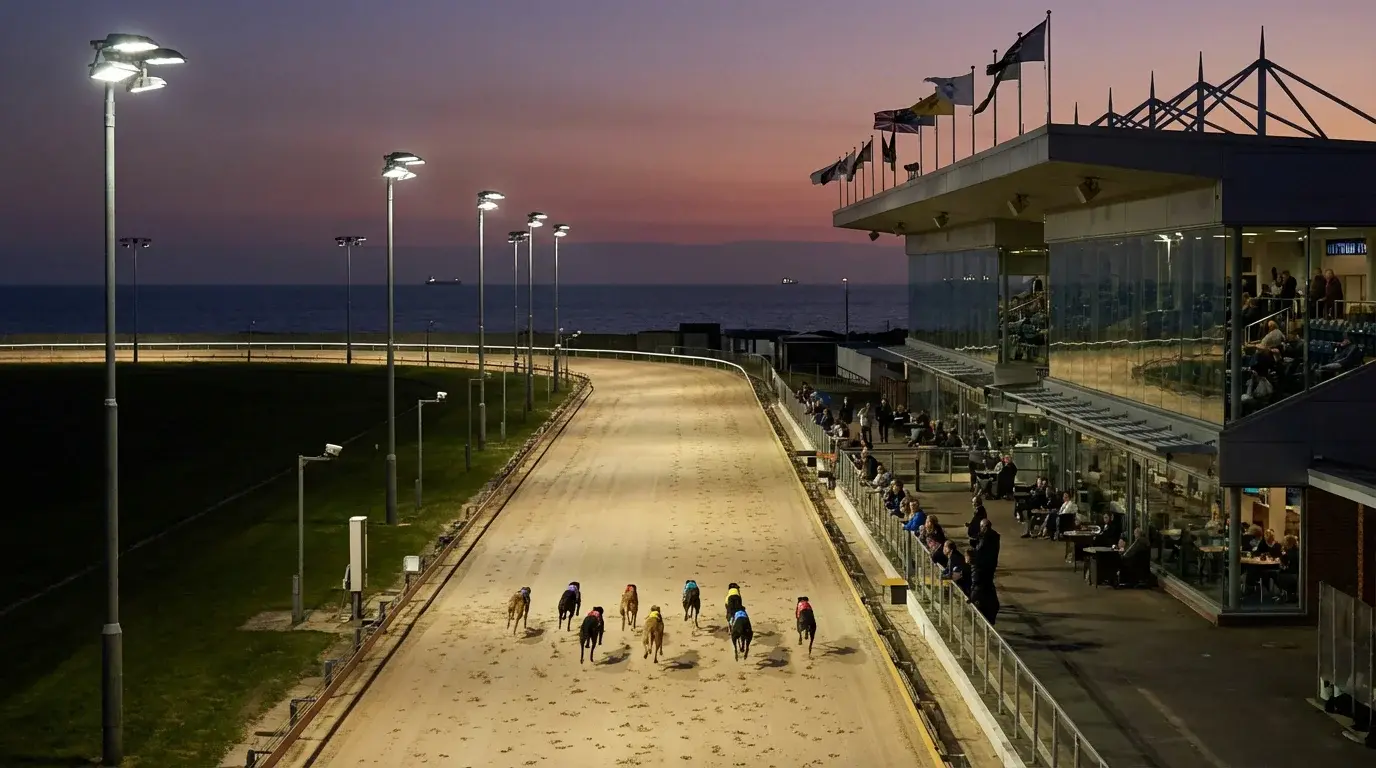
Hove, located on the south coast near Brighton, is one of the premier greyhound racing venues in the UK. The stadium has a long tradition of staging high-quality evening racing and has earned a reputation as one of the strongest tracks outside London for the calibre of its fields and the depth of its racing programme. For many serious greyhound bettors, Hove is a venue that demands attention.
The track is a mid-to-large circuit with sweeping bends and a generous finishing straight. The geometry favours dogs with a blend of speed and stamina — quick enough to be competitive at the first bend but strong enough to sustain their effort through the back straight and into the final run to the line. The bends are not as severe as at Romford or Crayford, giving wide runners a better chance of completing their arc without losing excessive ground. Equally, the track is not so expansive that it removes the advantage of early pace entirely. It is a venue that rewards all-round racing ability.
The sand surface at Hove is well maintained and generally produces fair, consistent times. Coastal weather — Hove’s proximity to the sea brings higher humidity and salt air — can affect the surface subtly, though the track management compensates through regular maintenance. Rain off the English Channel can arrive quickly and change conditions within a single card, particularly during the autumn and winter months. Checking the weather forecast for the Brighton and Hove area before betting is a sensible habit.
Hove’s location on the south coast gives it access to a strong pool of local trainers and also attracts entries from London-based kennels whose dogs can make the short journey down. This dual catchment area contributes to the quality of the fields, particularly on the venue’s feature evenings.
Evening Card Quality and Open Racing
Hove’s evening cards are among the strongest on the UK circuit. The standard weekly programme includes multiple graded races across the full range from A to D, supplemented by open races and feature events that bring the best dogs at the venue into direct competition. The open-race programme runs throughout the year, with designated evenings — often Thursdays — reserved for the venue’s highest-quality cards.
The quality depth at Hove means that even the graded racing is competitive. A B2 race at Hove often contains dogs that would be A-class runners at smaller tracks, because the overall standard at the venue is higher. This has a practical implication for bettors assessing dogs that transfer between tracks: a Hove B-grade dog moving to a lower-quality venue is likely to be undergraded at the new track, while a dog arriving at Hove from a weaker venue may find the grading tougher than expected.
Open races at Hove attract visiting dogs from across the southern circuit and occasionally from further afield. These events produce the most challenging fields for bettors — the runners come from different tracks, different trainers, and different grading systems. Cross-track form comparison is essential, and speed ratings provide the best common currency for evaluating dogs from multiple venues. The random draw in open events adds an extra layer of uncertainty that the seeded draw in graded racing absorbs.
Hove also hosts rounds of national competitions and seasonal feature events that carry higher prize money and draw premium entries. These fixtures are well covered by the Racing Post, Timeform, and RPGTV, meaning racecard data and live streaming are readily available. For bettors, the combination of deep fields, accessible data, and strong market liquidity makes Hove’s feature evenings some of the best-value betting opportunities on the calendar.
Trap Stats and Distance Data
Hove offers racing over several distances, with the standard graded trip sitting around 285 and 500 metres, alongside a middle-distance option and a staying trip for longer races. The 500-metre distance is the backbone of the programme and the one with the most extensive form database. It tests a combination of early speed, bend-running ability, and finishing stamina — the full skill set that Hove’s balanced circuit demands.
Trap statistics at Hove show a moderate inside advantage that is less severe than at sharper tracks but more pronounced than at the largest galloping circuits. Trap 1 produces a higher win rate than trap 6 over substantial samples, and traps 1 and 2 together account for a disproportionate share of winners. The advantage is most evident in sprint races over the shorter distance, where the quick first bend gives low-drawn railers immediate positional superiority. Over the 500-metre trip, the bias is present but mitigated by the longer distance, which gives dogs in wider traps more opportunity to find their stride.
The finishing straight at Hove is one of the longer in UK greyhound racing, which is significant for closers. A dog that is two lengths behind the leader entering the final straight has a realistic chance of catching the front-runner before the line. This makes Hove more friendly to finishing effort than venues where the finishing straight is short and the result is essentially decided by the second bend. When assessing form at Hove, give appropriate weight to closing sectionals — a dog that finishes fast here has the room to use that finishing speed.
Distance data matters when comparing runs. A dog’s sprint form over 285 metres reflects its pure early speed. Its form over 500 metres reflects its overall racing profile. A transition between the two distances changes the competitive dynamic, and a winner over the sprint is not automatically a contender over the standard trip. Check which distance each previous run was recorded over and adjust your assessment accordingly.
Seasonal variation at Hove is worth monitoring. The coastal climate means the track is exposed to sea-borne moisture and wind more than inland venues. Winter cards can be affected by salt-laden air that subtly alters the surface texture, and dogs that race well in summer conditions may not reproduce the same form in the colder, damper months. A dog whose form drops off consistently between October and March may simply be a fair-weather performer rather than one in genuine decline.
Betting Angles for Hove
The primary betting angle at Hove is quality assessment. Because the overall standard of racing is high, the margin between the best dog in a race and the weakest is often narrower than at lower-quality venues. This means favourites at Hove convert at slightly lower rates than at tracks where one dog is clearly superior to the rest. The field quality compresses the odds, and the value tends to lie with the second- and third-favourites rather than with the market leader.
Each way betting finds productive ground at Hove for this reason. A dog priced at 5/1 or 6/1 in a competitive Hove B-grade race has a genuine chance of finishing in the first two, because the fields are closely matched and any of three or four dogs could realistically fill the forecast places. Pairing each way bets on mid-priced runners with strong placing form is a strategy that suits Hove’s competitive environment better than backing short-priced favourites.
For open races and feature events, cross-track form comparison is the essential skill. When the field includes dogs from Romford, Crayford, and Monmore alongside Hove regulars, use speed ratings to find a common level. Dogs whose ratings are competitive at their home tracks should be assessed for how their running style translates to Hove’s specific geometry — the sweeping bends, the long finishing straight, and the balanced emphasis on speed and stamina. A dog that wins by leading all the way at a sharp track may find Hove’s longer straights allow closers to catch it.
Track regulars deserve respect. Dogs that have been racing at Hove consistently and producing competitive form know the track — the bends, the surface, the distances. Against a visiting dog of theoretically equal ability, the track-experienced runner has an edge in familiarity that the form figures alone do not capture. When the market prices a visiting dog and a Hove regular at similar odds, lean towards the regular unless the visitor has a clear draw or class advantage.
Evening Class at Its Finest
Evening class at its finest — that is what Hove represents on the UK greyhound circuit. The venue does not rely on gimmicks or novelty events to attract interest. It relies on the quality of its racing, the depth of its fields, and a programme that consistently delivers competitive races from the first graded event to the last open race on the card.
For bettors, Hove is a venue that demands respect and repays dedication. The fields are too strong for casual form-glancing to produce an edge. You need to know the dogs, know the trainers, and know how the track’s specific geometry — the bends, the finishing straight, the surface — shapes the outcome of each race. That knowledge, built over weeks and months of focused attention, is what separates the profitable Hove bettor from the casual one.
If you are going to follow one evening programme in UK greyhound racing, Hove is a strong choice. The racing quality is high, the data is accessible, the markets are liquid, and the venue rewards the analytical skills — form reading, draw assessment, cross-track comparison — that define good greyhound betting. Apply those skills consistently, and Hove delivers opportunities that match its reputation.