 dogracingtips
Best Greyhound Betting Sites – Bet on Greyhounds in 2026
Loading...
Track Profile — Towcester at a Glance
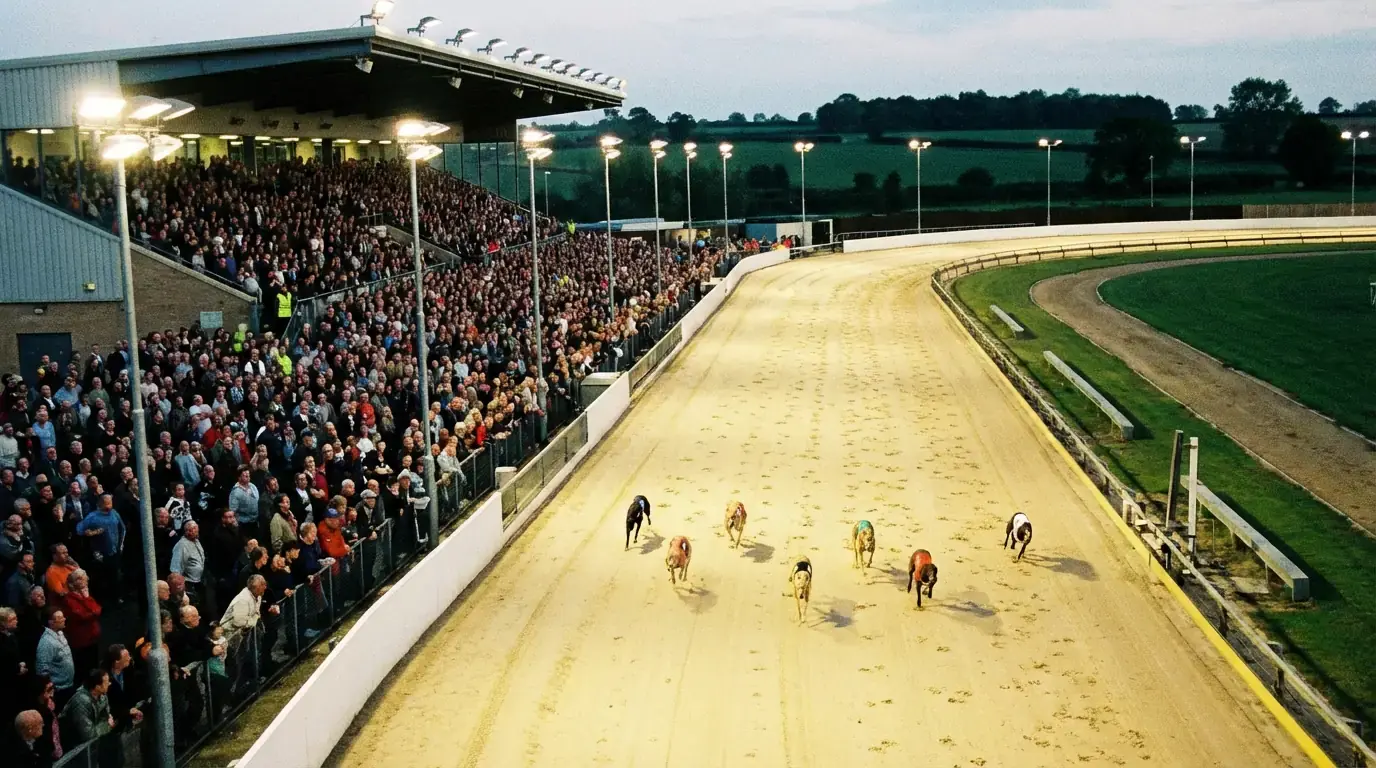
Towcester occupies a unique position in UK greyhound racing. Located in Northamptonshire, the venue is purpose-built to a modern specification with one of the largest track circumferences on the GBGB circuit. The sweeping bends, long straights, and generous run to the first turn produce a style of racing that is fundamentally different from the tight, sharp circuits found at inner-city venues like Romford or Crayford.
The track’s defining characteristic is its galloping nature. The wider bends allow dogs to maintain speed through the turns without the sharp deceleration that tight tracks impose. The longer straights give closers time to reel in front-runners and give wide-running dogs the room to use their arc without being penalised as heavily as they would be on a smaller circuit. Towcester rewards all-round ability — stamina, sustained speed, and the capacity to handle a big track — rather than the pure early pace that dominates at tighter venues.
The surface is sand-based, like all GBGB tracks, and the size of the venue means maintenance is a significant operation. Towcester’s drainage and surface management are generally good, though the track’s semi-rural location and exposure to weather mean that conditions can change noticeably between meetings, particularly during the autumn and winter months. Dogs transferring from smaller urban tracks sometimes need a run or two to adjust to the different surface feel and the altered racing geometry.
For bettors, Towcester is a venue that punishes lazy analysis and rewards genuine understanding of how a big track changes the competitive dynamics. The form from other tracks does not always transfer cleanly to Towcester, and the dogs that win here are not always the same ones that win at venues half its size.
Derby Venue and Open-Race Hub
Towcester is best known as the home of the English Greyhound Derby — the most prestigious event in UK greyhound racing. The Derby has been staged at various venues throughout its history, but its current association with Towcester gives the track a profile and a significance that extends well beyond its regular weekly cards. The Derby, run over 500 metres, attracts the best dogs from across the UK and Ireland and generates the largest betting volumes of any greyhound event on the calendar.
Beyond the Derby, Towcester hosts a programme of open races throughout the year that draws high-quality fields from multiple kennels and tracks. These events attract dogs that may not have raced at Towcester in graded competition, which makes cross-track form comparison essential. A dog graded A1 at Monmore or Hove is entering an environment at Towcester where the track dimensions, the running surface, and the competitive demands are different from anything it has encountered at its home venue.
The open-race programme makes Towcester one of the most analytically demanding tracks for bettors. In graded racing, the six dogs in a field have usually been competing at the same track in similar company, and the form is directly comparable. In Towcester’s open events, the field may contain dogs from four or five different tracks, each with different form profiles recorded over different distances and on different surfaces. Speed ratings and sectional analysis become more important here than at any other type of fixture.
Feature events at Towcester also tend to attract deeper exchange and bookmaker markets than equivalent events at smaller tracks. The betting liquidity is higher, the odds are sharper, and promotions like best-odds-guaranteed are more likely to be available. For bettors, this means the market is more efficient but also more rewarding for those who can find genuine value in a well-priced field.
Distances and Trap Stats
Towcester’s primary distances include 270, 480, and 500 metres, with the 480 serving as the standard graded-race distance and the 500 used for the Derby and other major events. The longer distances suit the track’s galloping layout — the extra ground allows the sweeping bends and long straights to play their full role in shaping the race.
The 270-metre sprint is Towcester’s shortest trip but plays very differently from a sprint at a tight track. The long run to the first bend gives dogs more time to find their stride and more room to manoeuvre before the turn. Early speed still matters, but it is not as overwhelmingly decisive as it is at a venue like Romford, where the first bend arrives almost immediately after the traps open. At Towcester, a dog can afford a slightly slower break and still reach the first bend in a competitive position if it has a high cruising speed.
Trap bias at Towcester is more neutral than at tighter tracks. The wider bends reduce the inside-rail advantage because the angular difference between running on the rail and running wide is smaller on a sweeping turn than on a sharp one. Statistical data across large samples shows a modest advantage for low traps — trap 1 typically has a slightly higher win rate than trap 6 — but the gap is considerably narrower than at Romford or Crayford. This neutrality means the trap draw is less of a deciding factor at Towcester, and form analysis carries relatively more weight.
The 500-metre Derby distance adds a stamina component that the 480 does not quite demand. Twenty extra metres may sound negligible, but on a big track where the pace is sustained and the bends are wide, those metres test the dog’s ability to maintain speed into the final straight. Dogs that fade over the closing stages at 480 may find the 500 even more taxing. Dogs that finish strongly may find the extra distance plays directly to their strength. When the Derby arrives, look for dogs with proven stamina, strong closing sectionals, and an ability to sustain effort over a full circuit of a galloping track.
Betting Angles for Towcester
The primary betting angle at Towcester is stamina and sustained speed over early pace. While a fast break from the traps is an advantage at any track, Towcester’s longer run to the first bend and wider bends mean that a dog does not need to lead at the first turn to win. Dogs that settle behind the early pace and close strongly through the final straight win more frequently at Towcester than at tighter venues. When assessing a race at this track, give more weight to closing sectionals and less to trap-break speed than you would at Romford or Crayford.
Cross-track form comparison is essential for Towcester’s open races and feature events. Use speed ratings rather than raw times when evaluating dogs from different venues. A dog posting fast times at a tight track may not replicate those figures at Towcester because the racing demands are different — the big track rewards a different running action and a different distribution of effort. Look for dogs whose speed ratings are competitive regardless of which track they were earned at, and who show the ability to sustain their pace over a full circuit.
Dogs with experience at other galloping tracks tend to transfer to Towcester more successfully than dogs whose entire career has been spent at compact urban circuits. If a dog has raced competitively at venues with similarly wide bends and long straights, the transition to Towcester is less of a leap. First-time runners at Towcester, particularly those from smaller tracks, should be treated with caution — the adjustment period can cost a run or two before the dog settles into the bigger environment.
For the Derby and other major competitions, ante-post markets open well before the event and can offer significant value. The field is large in the early rounds, the form is evolving as dogs progress through heats, and the market adjusts slowly as each round provides new information. If your analysis identifies a dog improving through the rounds — recording faster times, winning more comfortably — the ante-post price for the final may not yet reflect that trajectory.
The Big Stage Demands Big Dogs
The big stage demands big dogs. Towcester is not a track that flatters one-dimensional runners. A dog with brilliant early speed but limited stamina will lead at the first bend and fade on the long run home. A dog with raw pace but poor racing sense will struggle to navigate the wide bends without losing ground. The dogs that win consistently at Towcester are those with a complete skill set: enough speed to be competitive, enough stamina to sustain it, and enough racing intelligence to handle a big, open circuit.
For bettors, this means the analysis at Towcester is more nuanced than at a sprint-dominated sharp track. You cannot default to trap draw and early speed as your primary filters. You need to evaluate the whole dog — its speed, its stamina, its sectional profile, its experience on galloping tracks, and its ability to handle the unique demands of a venue that is bigger and more demanding than most of the circuits it has raced on before.
Towcester rewards the bettor who invests in that deeper analysis. The market for its biggest events is competitive but not impenetrable. The dogs that win the Derby are not always the pre-tournament favourites. The open races throughout the year regularly produce results that the form suggested but the market undervalued. Do the work, understand the track, and Towcester becomes one of the most rewarding venues in UK greyhound racing to bet on.