 dogracingtips
Best Greyhound Betting Sites – Bet on Greyhounds in 2026
Loading...
How Weather Affects the Track Surface
UK greyhound tracks use sand-based surfaces, and sand responds to weather. Rain saturates the top layer, making it heavier and slower. Prolonged dry spells firm it up, producing faster times. Wind affects the lure speed and can unsettle dogs in exposed sections of the track. Temperature shifts between seasons change how the surface compacts and drains. None of these factors appear on the racecard, but all of them influence the result.
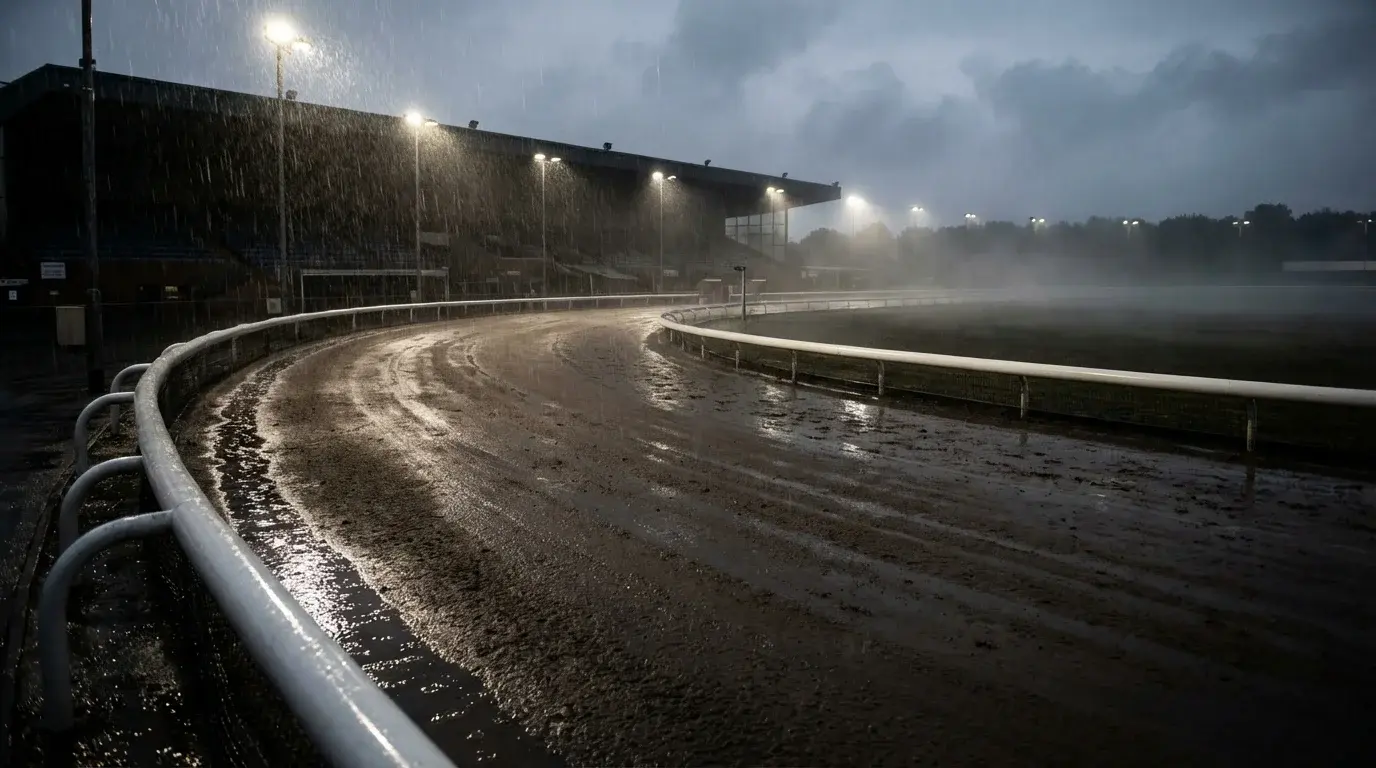
The most significant weather variable is rain. A dry track is fast — the sand is firm, the dogs get good purchase, and finishing times tend to be close to track records. A rain-soaked track is slow — the sand becomes heavy, the dogs work harder with every stride, and times drift upward across the card. The difference between a dry and a wet surface at the same track over the same distance can be half a second or more, which in greyhound racing terms is several lengths.
What matters for bettors is not the weather itself but how it changes the competitive picture. A dog that thrives on a fast surface may struggle when the going turns heavy. A dog with a powerful, driving stride may actually improve on softer ground because its running action suits the deeper surface. The form you have studied — finishing times, sectional splits, finishing positions — was recorded on a specific surface in specific conditions. If tonight’s conditions are different, the form may not transfer cleanly.
Seasonal patterns are worth noting. UK greyhound racing runs year-round, and the surface condition at a January meeting is rarely comparable to a July one. Winter cards tend to produce slower times, smaller margins between dogs, and more interference at the first bend as the heavier surface compresses the field. Summer cards favour speed and clean running. Adjusting your expectations by season — rather than treating all form as equivalent regardless of when it was recorded — is a simple but underused refinement.
Wet Weather and Trap Bias
Rain does not fall evenly on a greyhound track. The inside rail, the bends, and the areas near the stands can all absorb and drain water at different rates depending on the track’s construction, gradient, and drainage system. The result is that wet weather can create or amplify trap biases that do not exist on a dry surface.
At some tracks, prolonged rain makes the inside rail heavier than the outside because surface water collects along the rail before draining. This penalises railers in low traps, who are running on the heaviest ground, and benefits wide runners in high traps, who are covering more distance but on a faster strip of sand. At other tracks, the drainage pattern may be reversed — the outside holds water while the inside drains more quickly. The specific pattern depends on the individual venue.
These weather-related biases are temporary. They appear when conditions change and disappear when the surface dries or is maintained. Unlike structural trap biases — which persist because they reflect the track’s geometry — weather biases are transient and unpredictable from the racecard alone. You need to know what the weather has been doing at the track in the hours before the meeting, not what the historical trap statistics say over a full season.
The practical implication is that on wet nights, historical trap bias data becomes less reliable. A trap that wins frequently on dry going may underperform when the ground is heavy, because the surface conditions have shifted the advantage. Bettors who recognise this — and who check the current conditions rather than relying solely on long-term statistics — have an informational edge over those who treat trap bias as a fixed number.
Dogs That Handle Conditions
Some dogs handle wet conditions better than others, and the reasons are partly physical and partly temperamental. A heavier, more powerful dog with a long, driving stride tends to cope better with a rain-softened surface than a lighter, faster dog that relies on early speed and quick feet. The heavier surface dampens the lighter dog’s acceleration and reduces the advantage of a fast break from the traps. The stronger dog, running with more force per stride, is less affected.
You can identify wet-track dogs by reviewing their form across different conditions. If a dog’s best runs — its fastest times and highest finishing positions — cluster on dates when the track was wet or heavy, it is a likely conditions specialist. Conversely, if a dog consistently underperforms on wet cards but excels in dry conditions, its form figures on a wet night should be treated with scepticism.
Running style also interacts with conditions. Closers — dogs that finish strongly from behind — tend to gain a small advantage on wet tracks. The heavier surface slows front-runners more than it slows closers, because the leader is working hardest through the deepest ground while the closer can take advantage of the compacted surface left by the dogs ahead. This effect is modest but real, and it can shift the balance of a race away from the predicted early-speed leader towards a dog coming from behind.
If you bet regularly at a specific track, keep an informal record of which dogs perform well in wet conditions. Over time, this record becomes a personal database of conditions specialists — dogs you can back with confidence when the weather turns, and dogs you should avoid. Published data rarely isolates performance by going in greyhound racing the way it does in horse racing, so this kind of personal observation provides an edge that formal statistics do not.
Checking Conditions Before Betting
Checking conditions before you bet is straightforward. Most of the information you need is available for free and takes no more than a few minutes to gather.
Start with a standard weather forecast for the track’s location. A search for the venue’s postcode on any major weather service will give you hourly rainfall predictions, temperature, and wind speed. What you want to know is whether rain has fallen in the hours before the meeting and whether more is expected during the card. A track that was dry at lunchtime but has been rained on since four o’clock will be running on different ground by the evening’s first race.
Some tracks and racing services publish going reports — a brief description of the surface condition, typically categorised as fast, standard, or slow. These reports are not as formalised in greyhound racing as they are in horse racing, and not every track publishes them consistently. When available, they are a useful shorthand. When unavailable, the weather forecast is your best proxy.
Social media can fill gaps. Track accounts, trainer accounts, and greyhound racing communities sometimes post updates about surface conditions ahead of a meeting, particularly when the weather has been extreme. A photograph of a waterlogged track posted on Twitter an hour before the first race tells you more than any forecast model. It is informal, unsystematic, and occasionally unreliable — but it is real-time information from people who are physically at the venue, and that has value.
Cross-reference conditions with your race analysis. If you have shortlisted a front-runner with fast early splits recorded on dry ground and tonight’s meeting is running on a saturated surface, reconsider. If a strong finisher with a wide running style is your pick and the inside rail is heavy, your selection may actually improve. Conditions are not a separate analysis — they are a filter applied to the analysis you have already done.
The Weather Is Free Information
The weather is free information. Nobody charges for it, nobody restricts access to it, and nobody else in the betting queue is paying much attention to it. That combination — freely available, widely ignored — is the hallmark of a useful analytical edge in greyhound racing.
You are not trying to build a meteorological model. You are trying to answer a simple question: are tonight’s conditions materially different from the conditions under which the form in front of me was recorded? If the answer is yes, adjust your assessment. If the answer is no, proceed as normal. That single question, asked before every bet, will save you money on nights when the weather has shifted the competitive landscape beneath your feet — and it costs you nothing more than a glance at the sky.
Make it the last check in your pre-bet routine. Form, draw, running style, class, trainer, weight — then conditions. If everything else points to a dog and the weather supports the selection, you have a strong bet. If the conditions undermine one of the key factors — a front-runner on a heavy surface, a railer on a waterlogged inside rail — walk away or look elsewhere on the card. The racecard tells you what has happened. The weather tells you what might be different tonight. Both matter.