 dogracingtips
Best Greyhound Betting Sites – Bet on Greyhounds in 2026
Loading...
The Greyhound Season — How the Racing Year Works
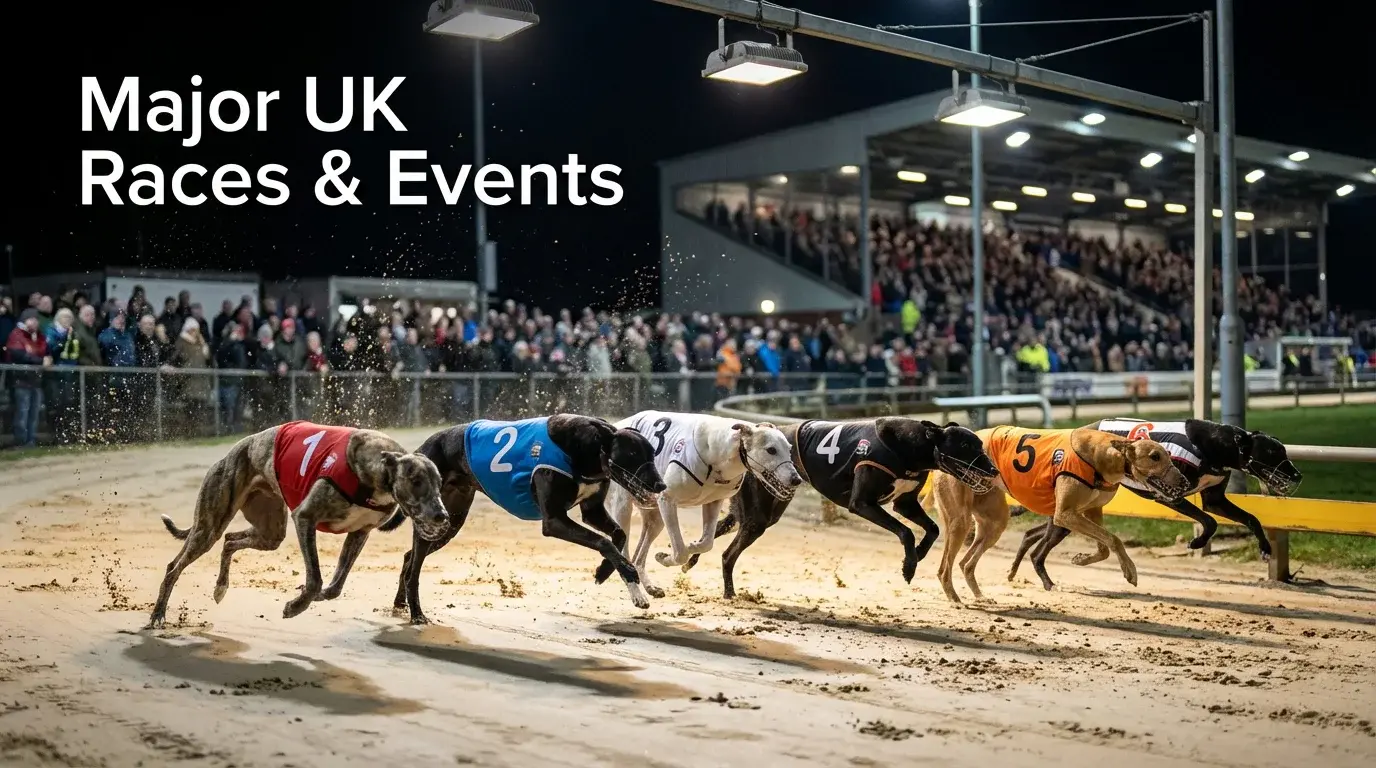
Unlike horse racing, which has a flat season and a jumps season with a natural break between them, greyhound racing runs every day of the year except Christmas Day. There is no off-season. Every week, across eighteen GBGB-licensed tracks, hundreds of graded and open races take place under floodlights, afternoon sun, and everything in between. The unbroken schedule is what makes greyhound betting a volume game — and it is also what makes the calendar so important to anyone betting seriously.
Within that year-round programme, there is a structure. The major championship events cluster in two windows: a spring block built around the English Greyhound Derby from May to June, and an autumn block anchored by the St Leger and a series of Classic events from September to November. The spaces between these peaks are filled with Category One and Category Two open races that serve as qualifying and preparatory events — trial grounds where trainers test their best dogs against elite competition before targeting the big prizes. Understanding this rhythm matters because it tells you when the best dogs are peaking, when the form data is most reliable, and when the ante-post markets offer the longest prices.
The early months of the year — January through March — are when trainers bring young dogs into the grading system and establish the form profiles that will determine which animals are Derby contenders. Spring trials at Towcester in April often provide the first concrete data on the season’s leading prospects. From May onwards, the calendar intensifies: the Derby heats dominate the sport’s attention for six weeks, and the form data generated during those rounds becomes the reference point for the rest of the year. After the Derby final in mid-June, the circuit enters a transitional summer phase before the autumn Classics begin. The Pall Mall Stakes, the Gold Cup at Monmore, and various regional opens fill the July and August slots, keeping the top dogs race-fit while their trainers decide which autumn targets to pursue. By September, the St Leger arrives, the Oaks follows, and the calendar peaks again before settling into winter graded racing that sustains the sport until the cycle restarts.
English Greyhound Derby
The English Greyhound Derby is the most prestigious event in UK greyhound racing and one of the biggest sporting prizes in British betting. It has been run annually since 1927, moving from White City to Wimbledon in 1985, then to Towcester in 2017, to Nottingham in 2019 and 2020 during Towcester’s temporary closure, and back to Towcester from 2021 onwards. The current format is a knockout competition over 500 metres at Towcester Greyhound Stadium, running from first-round heats in May through to a six-dog final in mid-June. The winner’s purse stands at 175,000 pounds, making it comfortably the richest prize in UK greyhound racing.
The competition typically begins with 180 to 200 entries spread across thirty-two first-round heats. Each round eliminates the majority of the field: usually the first two finishers in each heat progress, supplemented by a handful of fastest losers. By the quarter-finals, the field has been cut to twenty-four dogs. After the semi-finals, six remain. The multi-round structure tests not just speed but consistency, recovery between rounds, and the ability to handle different trap draws and competitive configurations across successive weeks. Derby winners tend to be the most complete dogs in training — fast, consistent, adaptable, and physically durable.
For bettors, the Derby ante-post market opens months before the first heat and offers the longest prices of any greyhound market. The risk is correspondingly high: injuries, poor trials, and unexpected form dips can eliminate a dog before the competition begins, and most ante-post markets do not offer non-runner, no-bet terms. Once the heats start, the round-by-round form data becomes the primary analytical tool. Sectional times from heats — particularly the first-bend split and the second-half pace — reveal which dogs are improving through the competition and which are plateauing. Dogs that record progressively faster times from round one through to the semis are the ones the sharp money follows into the final.
Towcester’s wide, galloping layout imposes a specific selection filter on the Derby. Dogs bred for tight tracks with explosive early speed sometimes struggle with Towcester’s dimensions, while middle-running dogs with sustained pace thrive. The data consistently shows that previous Towcester experience is a significant advantage — dogs making their first appearance at the track during Derby heats underperform relative to those with established course form.
Greyhound St Leger
The Greyhound St Leger is the premier staying event on the British calendar, run over 730 metres at Nottingham Greyhound Stadium. It occupies the autumn slot in the racing year, typically taking place in September or October, and it attracts a specialist field of stayers whose form profiles look entirely different from the sprinters and middle-distance dogs that contest the Derby.
Staying races demand a different analytical approach. Over 730 metres, the dogs run additional bends and longer straights, which amplifies the importance of stamina, physical condition, and the ability to sustain pace through the second half of the race. Early speed still matters — leading at the first bend is still an advantage — but it is not decisive in the way it is over 480 or 500 metres. Dogs that lead early but fade in the closing stages are common at staying distances, and identifying which dogs have genuine stamina versus those that simply break fast and hold on is the key analytical challenge.
The St Leger ante-post market is thinner than the Derby market, reflecting the smaller audience for staying races. This thinness creates opportunity: the prices are less refined, the market is less efficient, and bettors who follow staying form closely can find value that the generalist market overlooks. The pool of genuine top-class stayers in the UK is small, which means the same dogs tend to contest the St Leger and its supporting events year after year, building a form database that rewards long-term followers of the distance.
The form indicators that matter most for the St Leger are finishing speed over the final 200 metres and consistency across runs at 680 metres or above. A dog that runs fast sectional times in the first half of a staying race but decelerates sharply on the final straight is a sprinter in disguise — it will not survive the St Leger format. Conversely, a dog that posts moderate sectional times through the middle of a staying race but accelerates in the closing stages is demonstrating the kind of finishing stamina that the St Leger rewards. Identifying this distinction from the racecard data — which requires access to sectional splits, not just finishing times — is the analytical edge that staying-race specialists carry into the ante-post market.
Other Major Events
The Derby and St Leger are the headline acts, but the calendar is dense with Category One and Category Two events that shape the competitive season and produce form data of their own. Several of these have long histories and distinctive characters.
TV Trophy
The TV Trophy dates back to the era when greyhound racing had regular exposure on terrestrial television, most notably through the BBC’s Sportsnight programme. The event was one of the few greyhound races that reached a mainstream audience, and its name reflects that heritage. The format and distance have varied across venues and decades, but the trophy has retained its status as a significant mid-season event. For bettors, the TV Trophy’s value lies in its timing: it falls between the Derby and the autumn Classics, producing form data during a period when many of the top dogs are between peak targets. Results from the TV Trophy can signal which dogs are maintaining condition through the summer and which are tailing off after a demanding Derby campaign.
Scottish Greyhound Derby
The Scottish Greyhound Derby was historically staged at Shawfield Stadium in Rutherglen, near Glasgow, which was the last GBGB-licensed track in Scotland before its closure in 2020. With Shawfield gone, the event has been displaced, and its future venue and format have been subject to ongoing discussion within the sport. The loss of Shawfield removed Scotland entirely from the licensed greyhound circuit, and the Scottish Derby — once a proud fixture on the calendar with a competitive field that combined Scottish-trained dogs with raiders from England and Ireland — no longer has a natural home. For bettors, the historical form from Scottish Derbys at Shawfield is of limited current relevance, but the event’s potential revival at an alternative venue is something the calendar may accommodate in the future.
Golden Jacket
The Golden Jacket is a Category One staying event that spent its most prominent years at Crayford, where it was run over 714 metres and became one of the flagship races in the Ladbrokes portfolio. The race originated at Harringay, migrated through Hall Green and Monmore, and settled at Crayford in 1987, becoming synonymous with the venue’s identity as a home for staying races on a compact track. When Crayford closed in January 2025, the Golden Jacket’s future was left uncertain. The event may find a new venue — Central Park in Sittingbourne hosted the Grand National over a similar distance after inheriting it from Crayford — but as of early 2026, the Golden Jacket’s next chapter has not been formally announced. For bettors who followed the event at Crayford, the analytical angle was distinctive: stayers racing on a sharp, tight track produced results that differed markedly from staying races at galloping venues like Nottingham, and the specialists who thrived at Crayford’s dimensions were a breed apart.
Puppy Derby and Classic
The Puppy Derby and Puppy Classic are the premier juvenile events on the British calendar, open to dogs aged between fifteen and twenty-four months. These competitions offer an early look at the next generation of talent and often identify dogs that will go on to contest the senior Derby and Classic events in subsequent years. Towcester hosts the Puppy Derby, while other puppy events rotate across the circuit. Monmore Green stages the Ladbrokes Puppy Derby, and Romford runs its own Puppy Cup. The prize money at the top juvenile events is significant — Monmore’s Ladbrokes Puppy Derby offers a winner’s purse that ranks among the highest in the puppy calendar, and the prestige attached to winning a juvenile championship shapes a dog’s commercial and competitive profile for the rest of its career.
For bettors, puppy racing introduces a specific analytical challenge: the form data is shallower, the dogs are still developing physically, and improvement between races can be dramatic. A puppy that finishes fourth in its first heat and wins the next by five lengths is not showing erratic form — it is showing the kind of rapid progression that is normal at that age. Assessing juvenile potential rather than established ability is the skill that distinguishes profitable puppy-race betting from gambling on incomplete information. Breeding data becomes more relevant in puppy events than in senior racing, because when the form profile is thin, the genetic pedigree — the sire and dam records, the littermate performances — offers supplementary evidence of ability that the racecard alone cannot provide.
Ante-Post Betting on Greyhounds
Ante-post markets on major greyhound events operate on the same principle as ante-post markets in horse racing: you bet before the event begins, often weeks or months in advance, and your odds are fixed at the point of the wager. The appeal is price — ante-post odds on a Derby contender in March will almost always be significantly longer than the odds available on the same dog in the semi-final in June, assuming it has progressed that far. The risk is non-participation: if your selection is withdrawn due to injury, poor form, or a failed trial, your stake is lost under standard ante-post terms.
Most UK bookmakers do not offer non-runner, no-bet terms on greyhound ante-post markets, which distinguishes them from some horse racing ante-post markets where NRNB is more common. This means every ante-post greyhound bet carries the full withdrawal risk. The decision to bet ante-post is therefore a trade-off: the longer the odds, the greater the potential return, but also the greater the probability that something intervenes between the bet and the final.
The optimal window for ante-post Derby betting is after the entry list is published but before the first-round heats, when the market has crystallised around a set of named contenders but the competition has not yet produced any in-play form data. At this stage, the prices reflect pre-competition assessments based on seasonal form, trial times, and reputation. Once the heats begin and the round-by-round data starts flowing, the market adjusts rapidly and much of the ante-post value disappears. Early prices reward early conviction — but only if that conviction is grounded in analysis rather than reputation alone.
For smaller events — the Puppy Derby, regional open races, the TV Trophy — ante-post markets are thinner and sometimes only offered by one or two bookmakers. The prices can be attractive but the information available at the time of betting is even more limited, and the risk of withdrawal is higher because smaller events attract less stable entries. A cautious approach is to restrict ante-post betting to the Derby and St Leger, where the market is deepest and the competitive incentive for trainers to run their best dogs is strongest.
TV Coverage and Streaming
The landscape for watching greyhound racing has shifted decisively towards streaming and dedicated broadcast channels. Sky Sports occasionally covers major events, and RPGTV — Racing Post Greyhound TV — provides a dedicated channel covering live meetings from across the circuit. But for most bettors, the primary viewing route is through bookmaker-operated live streams. Every major UK bookmaker with a greyhound market offers live streaming of the races they cover, typically requiring a funded account or a placed bet on the meeting to unlock the feed.
The availability of live streaming has changed the betting dynamics for greyhound racing. Markets that were once illiquid because most bettors could not see the races now attract more in-play and late activity, which sharpens the prices. The exchange markets — particularly on Betfair — are deeper for streamed meetings than for non-streamed ones, because bettors are more willing to take positions when they can watch the outcome in real time. For analytical purposes, streaming also allows you to observe how dogs run, how they handle crowding, and how they respond to trouble in running — information that form figures alone cannot convey.
During the Derby and St Leger, TV coverage on Sky Sports produces a spike in betting volumes that compresses margins and sharpens odds. The casual viewer who tunes in for a Derby final is competing against the same market as the specialist punter who has followed every heat, and the additional liquidity from mainstream coverage occasionally creates late-market opportunities as uninformed money distorts the prices. For bettors who have done the work, the televised events are where form analysis meets its largest audience — and where the rewards for being right are highest.
Beyond the major events, the day-to-day streaming infrastructure is provided by SIS — Satellite Information Services — which broadcasts BAGS and evening meetings to betting shops and online platforms nationwide. SIS coverage means that even afternoon meetings at smaller tracks are visible to anyone with a bookmaker account, which has expanded the accessible racing programme from a handful of evening venues to the full circuit. The quality of the feeds varies, but for analytical purposes the coverage is sufficient to assess running styles, first-bend behaviour, and the kind of in-running detail that racecards cannot capture. Building a habit of watching the meetings you bet on — rather than simply placing the bet and checking the result — is one of the most effective ways to develop the track-specific intuition that separates informed bettors from casual punters.
The Calendar Is the Bankroll’s Clock
The racing calendar does not just tell you what is happening. It tells you when to push and when to pull back. The major events — the Derby in May and June, the St Leger in September, the autumn Classics from October to November — are the periods when the best form data is produced, the deepest markets are available, and the rewards for correct analysis are largest. These are the weeks to concentrate your research, sharpen your selection process, and commit your staking plan with conviction.
Between the peaks, the calendar runs on regular graded cards and BAGS meetings. These periods produce steady betting opportunities but at lower analytical intensity — the form is less distinctive, the market efficiency is higher, and the spectacular results are rarer. For the serious bettor, the inter-peak periods are maintenance windows: you keep your bankroll ticking over with selective level-stake bets on well-analysed races, but you do not force activity for the sake of action.
The calendar also serves as a natural circuit-breaker for discipline. A bettor who feels their analysis slipping, their staking drifting, or their confidence dropping after a cold run can use the calendar structure to step back, reset, and return for the next major event. The races will still be there. The circuit never stops. The only resource that can be depleted is the bankroll — and the calendar, used wisely, is one of the tools that protects it.
The most successful greyhound bettors treat the calendar the way a professional investor treats the financial year: they know the cycle, they prepare for the peaks, and they conserve resources during the quiet periods. When Derby week arrives, they have already studied the entries, watched the trials, and built their shortlists. When the St Leger heats begin, they already know the staying-form landscape because they have been following it since the summer. The calendar does not just organise the sport — it organises the work behind the betting. Respect it, plan around it, and let it set the tempo of your bankroll rather than chasing every meeting indiscriminately.